
What Is The Threat Bucket
Jan 15, 2026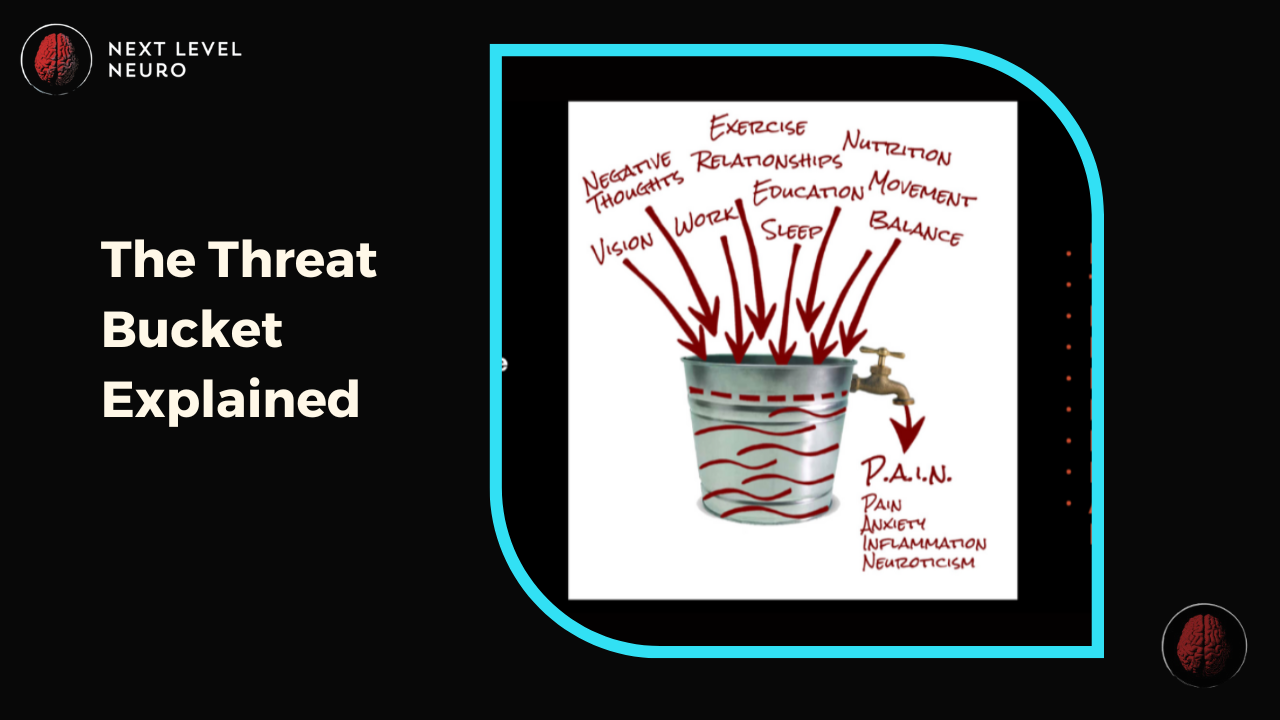
Why Stress Creates Pain, Fatigue, and Shutdown
The Question This Article Answers
Why do clients stay in pain, fatigued, or dysregulated when biomechanics look normal but stress load is high?
The Direct Answer
The Threat Bucket explains how the brain combines physical, emotional, metabolic, and sensory stress into a single safety calculation. When that cumulative stress load exceeds the nervous system’s capacity to regulate, the brain produces protective outputs such as pain, fatigue, anxiety, shutdown, and movement compensation. Applied neurology works by improving regulation and sensory inputs so threat drains and capacity is restored.
The Problem Most Models Miss
Many clients don’t present with a single clear injury.
They present with:
-
chronic pain that doesn’t fully resolve
-
fatigue that lingers despite rest
-
flare-ups that seem random
-
plateaus that appear even when programs are followed perfectly
From a biomechanical perspective, this can be confusing.
Strength looks adequate.
Mobility tests clean.
Imaging doesn’t explain the symptoms.
And yet the system is clearly struggling.
That’s because the problem isn’t isolated to one tissue.
It’s cumulative.
What the Threat Bucket Actually Represents
The Threat Bucket is a brain-based model that explains how the nervous system manages total stress load.
The brain does not track stress in neat categories.
It doesn’t separate:
-
emotional stress
-
physical injury
-
poor sleep
-
inflammation
-
sensory overload
Instead, it combines them into one internal safety score.
Each stressor adds water to the bucket.
When the bucket stays below capacity, the nervous system adapts.
When it fills too high, the brain shifts into protection.
What Happens When the Bucket Overflows
When the Threat Bucket overfills, the nervous system pulls a protective emergency brake.
This can show up as:
-
persistent pain
-
fatigue and low energy
-
anxiety or irritability
-
brain fog
-
shutdown or avoidance
-
reduced strength and coordination
-
increased muscle tone and guarding
None of these outputs require structural damage.
They are protective strategies designed to reduce load and risk.
Pain is often the loudest one.
Why Stress Makes Pain Worse
Stress increases threat prediction.
When threat is high:
-
tolerance to load decreases
-
movement options narrow
-
sensory input becomes less clear
-
pain thresholds drop
This is why pain often flares during:
-
high work stress
-
poor sleep
-
emotional upheaval
-
illness or inflammation
The tissue didn’t suddenly fail.
The nervous system lost capacity.
The Spout: Why Some People Recover Faster Than Others
The Threat Bucket isn’t just about how fast stress fills.
It’s also about how well it drains.
The spout represents regulation capacity.
A healthy spout allows stress to drain through:
-
sleep
-
breathing
-
movement variability
-
safety cues
-
social connection
When the spout is restricted, even small stressors cause overflow.
This explains why two people can experience the same load and have very different outcomes.
Where Biomechanics Breaks Down
Biomechanics explains how force moves through the body.
It does not explain:
-
why pain appears without damage
-
why symptoms fluctuate day to day
-
why rehab gains disappear under stress
-
why “perfect programs” stop working
When threat load is high, biomechanical inputs are filtered through a protective nervous system.
The output changes.
This is not a failure of biomechanics.
It’s a missing layer.
How Applied Neurology Empties the Bucket
Applied neurology works upstream of symptoms.
Instead of asking only What’s tight or weak?, it asks:
Is the nervous system regulated?
Are sensory inputs clear?
Does the brain feel oriented and safe?
Key leverage points include:
-
vision (orientation and prediction)
-
vestibular input (balance and head position)
-
proprioception (body mapping)
-
breathing and interoception (internal safety)
-
context and choice (perceived control)
When these inputs improve, the brain recalculates threat.
Water drains.
Outputs change.
The Framework: Assess → Input → Reassess
The Threat Bucket is not a theory you guess with.
It’s tested in real time.
-
Assess: pick a baseline (pain, range of motion, strength, gait, affect)
-
Input: apply one neurological strategy
-
Reassess: immediately retest the baseline
If the output improves, threat is lower.
If it worsens, threat increased.
This makes regulation measurable, not abstract.
A Common Clinical Pattern
A client presents with:
-
chronic low back pain
-
fatigue
-
inconsistent progress
Biomechanics alone hasn’t solved it.
A brief regulation-focused input is applied:
-
breathing
-
visual grounding
-
balance integration
Pain decreases.
Movement improves.
Energy returns slightly.
Nothing structural changed.
Capacity did.
Why This Changes the Narrative for Clients
When people understand the Threat Bucket, something important happens.
They stop blaming themselves.
They stop fearing every symptom.
They regain agency.
Pain becomes information, not identity.
That shift alone often lowers threat.
Where to Start
If this model resonates, the next step is learning how to assess and influence regulation without guessing.
That’s why we built The Neuro Advantage.
It teaches:
-
the Threat Bucket model
-
the Input → Output framework
-
practical ways to test and reassess regulation
It’s the fastest way to start working with stress and pain as nervous system outputs.
The Takeaway
Pain, fatigue, and shutdown are not signs of weakness.
They are signs the bucket is full.
When you help the nervous system drain stress and restore safety, the body often follows.
Biomechanics still matters.
But regulation decides whether it works.
FAQ: The Threat Bucket (Applied Neurology)
FAQ 1: What is the Threat Bucket in applied neurology?
Answer:
The Threat Bucket is a nervous system model that explains how stress, pain, trauma, and physiological load accumulate over time.
When the bucket exceeds the nervous system’s capacity, symptoms such as pain, fatigue, poor recovery, and movement limitations emerge—even without tissue damage.
FAQ 2: Why do symptoms appear when nothing seems structurally wrong?
Answer:
Symptoms can appear when the nervous system exceeds its tolerance for perceived threat, even if biomechanics and imaging look normal.
The brain responds to overload by producing protective outputs like pain, stiffness, or shutdown to reduce further stress.
FAQ 3: What types of stress fill the Threat Bucket?
Answer:
The Threat Bucket fills from multiple sources, including physical injury, chronic stress, poor sleep, emotional load, inflammation, breathing dysfunction, vision or balance challenges, and unresolved trauma. The nervous system does not distinguish between physical and emotional threat.
FAQ 4: How is the Threat Bucket different from biomechanics?
Answer:
Biomechanics explains how the body moves, while the Threat Bucket explains why movement may become restricted or painful despite adequate strength and mobility.
It accounts for nervous system regulation, perception of safety, and cumulative stress that biomechanics alone cannot explain.
FAQ 5: How does the nervous system decide when pain appears?
Answer:
The nervous system continuously evaluates safety based on sensory input, past experiences, and internal state.
When perceived threat outweighs safety, the brain produces pain or movement restriction as a protective output, regardless of tissue condition.
FAQ 6: Can the Threat Bucket be emptied or reduced?
Answer:
Yes. The Threat Bucket can be reduced by improving nervous system regulation through better sleep, breathing, nutrition, sensory clarity, emotional regulation, and applied neurology interventions that restore a sense of safety and predictability.
FAQ 7: Why do clients relapse even after successful rehab or training?
Answer:
Relapse often occurs when structural improvements are made without addressing nervous system load.
If the Threat Bucket remains full, symptoms can return once stress increases or supports are removed, even if biomechanics initially improved.
FAQ 8: How does applied neurology work with the Threat Bucket?
Answer:
Applied neurology uses targeted assessments and sensory inputs—such as vision, vestibular, proprioceptive, and breathing drills—to reduce perceived threat, improve regulation, and increase the nervous system’s capacity before symptoms appear.
FAQ 9: Is the Threat Bucket the same as stress management?
Answer:
No. The Threat Bucket is a nervous system framework, not a mindset concept. It explains how physiological, neurological, and emotional inputs accumulate and influence pain, movement, and recovery at a biological level.
FAQ 10: Who should understand the Threat Bucket model?
Answer:
Coaches, therapists, clinicians, and anyone working with pain, performance, or recovery should understand the Threat Bucket. It provides a missing layer that explains inconsistent results, plateaus, and unexplained symptoms in otherwise well-designed programs.
Want more information on our Mentorship and Programs?
We hate SPAM. We will never sell your information, for any reason.
