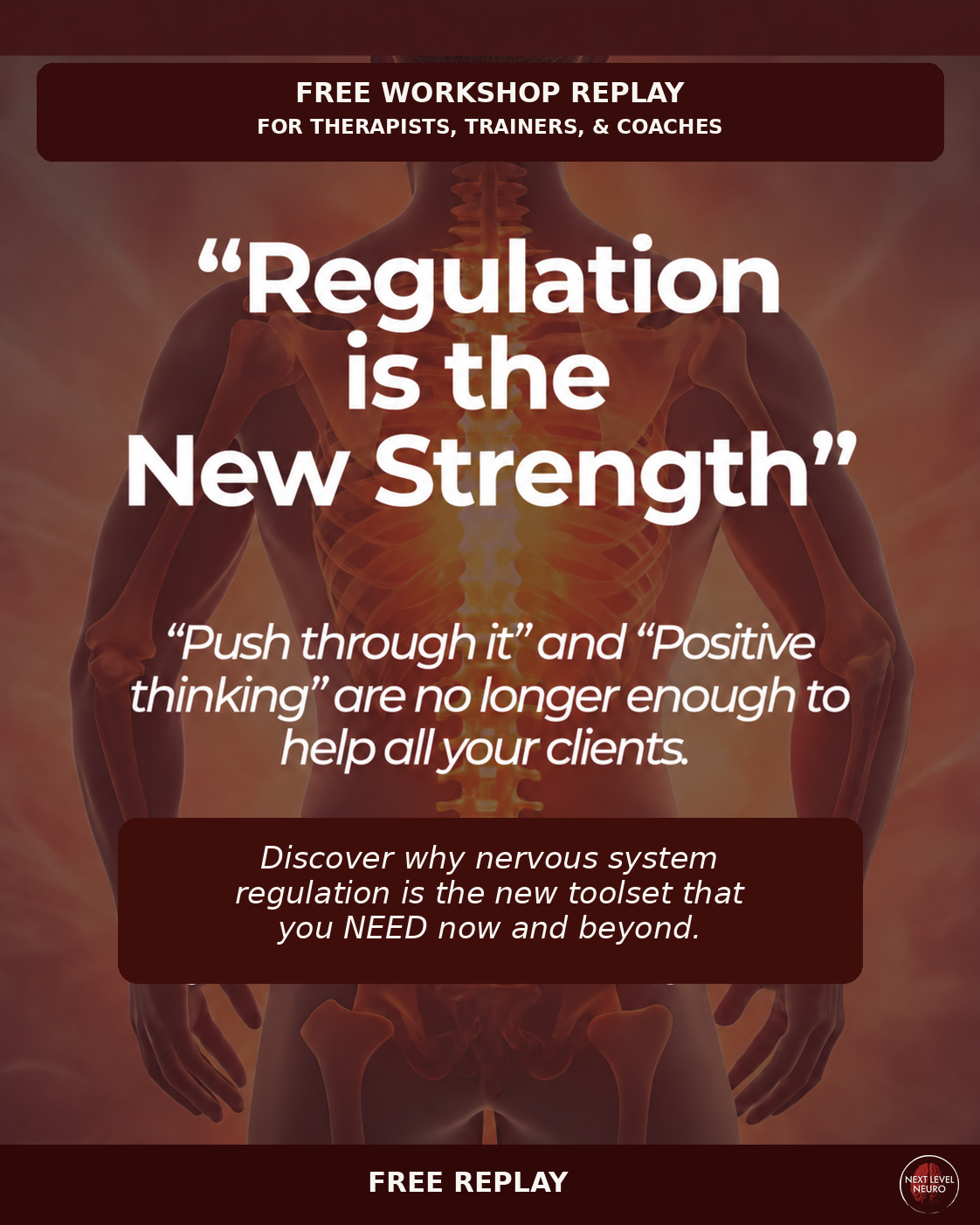
Regulation Is the Missing Strength Skill Nobody Trains
Feb 26, 2026
Why your best strength program fails when the nervous system can’t shift states
Question this article answers: Why do clients plateau, flare up, or feel inconsistent even when their strength work is solid? This article explains why regulation is the missing strength skill underneath performance. You will learn what regulation really is, why a nervous system stuck in protection limits adaptation, what to measure to spot a regulation problem fast, and how to train regulation like strength using a simple assess → stimulus → reassess approach.
Most people train strength as if strength is the foundation.
It’s not.
Strength is an output.
Regulation is the system that decides whether output is available today, repeatable tomorrow, and adaptable over the next eight weeks.
That’s why two clients can run the same program and get very different results.
One adapts.
One survives.
The missing skill nobody trains
Regulation is not “calm.”
Regulation is state control.
Two questions define it:
• Can you mobilize under pressure and recover when the moment passes?
• Can you switch states efficiently without getting stuck in fight, flight, or freeze?
If the client can’t do those two things, it doesn’t matter how smart your programming is.
The body will eventually protect itself from the cost.
Sometimes through pain.
Sometimes through “random” flare-ups.
Sometimes through the kind of inconsistency that makes everyone blame motivation.
Why is strength not the foundation
The brain runs in a hierarchy.
Survival first.
Then efficiency.
Then performance.
So when a client is dysregulated, they don’t lose strength because they got weaker.
They lose access.
The nervous system narrows options when it senses threat.
Movement becomes more rigid, less variable, and more expensive.
That’s why a client can test well in a controlled environment and still fall apart when life is loud.
The issue isn’t always the muscle.
It’s the state.
How regulation problems actually show up in training
Most coaches look for a strength problem.
Regulation problems look like this instead:
• output changes with stress, sleep, or environment
• symptoms fluctuate more than structure explains
• the client can “push” but can’t recover
• the system stays revved after sets
• little inputs create big responses
The pattern is inconsistent.
The nervous system is not stable enough to adapt.
The key reframe: adaptation requires safety, not just stress
Training is stress.
But adaptation is not guaranteed.
Adaptation happens when the nervous system decides the stress was safe enough to learn from.
If the system interprets training as threat, you can still get output in the moment.
You don’t get clean learning afterward.
That is why some clients get stronger but also get tighter, more reactive, and more fragile.
They adapt inside protection.
That’s not performance.
That’s survival with PRs.
What to measure instead of guessing
Regulation becomes coachable the moment you stop treating it like a feeling.
Measure it.
A simple way is to track state shifts around training.
• how fast they settle after a hard set
• whether they can exhale fully between sets
• whether their breathing stays accessible in warm-ups
• whether output changes after a downshift input
• whether symptoms decrease when the state improves
You’re not diagnosing emotions.
You’re testing the nervous system responsiveness.
The Tier 1 method: train regulation like strength
Here’s the simplest implementation that keeps this out of the “soft skills” category.
Use the same logic you use for strength.
Assess → stimulus → reassess.
That’s it.
You are not adding a ritual.
You are running a test.
If the client’s output changes after a regulation input, you just proved that the state was a limiter.
And now you have a target.
The 4-layer target map
The NLN model breaks regulation into four layers: safety, emotion-to-motion, internal balance, and executive control.
• Amygdala: safety signals
• Midbrain: state-to-movement control
• Hypothalamus: internal stress balance
• Prefrontal cortex: executive control under demand
You don’t need to “fix” all four in one session.
You need to know that regulation is multi-layered, so you stop treating it like breathwork only.
The line that lands with athletes and high performers
You don’t need less intensity.
You need more access.
Access to movement options.
Access to recovery.
Access to output that doesn’t cost you tomorrow.
That’s regulation as a strength skill.
Ready to Train Regulation Like a Skill (Not a Guess)?
If this article has gotten you to think, you probably already know the problem.
Your clients do not always need more cues, more volume, or more intensity.
They need a nervous system that can shift states, access output, and recover after the work is done.
That is exactly why we built the NLN Fundamentals Program.
Inside Fundamentals, we show you how to:
-
assess what is actually limiting performance
-
use applied neurology tools in a practical way
-
choose the right input instead of guessing
-
reassess fast so you know if it worked
-
build stronger, more adaptable clients without making training feel soft
This is where the concepts in this article become a coaching system you can actually use in sessions.
If you want to stop chasing symptoms and start training what drives output, recovery, and consistency, start with Fundamentals
👉 Explore the NLN Fundamentals Program and receive 62% off with the Neuro Advantage program as a FREE GIFT.
FAQ: Regulation as the Missing Strength Skill
1) What is regulation in one sentence?
The ability to shift nervous system state on purpose, mobilize under pressure, and recover afterward.
2) Why call regulation a strength skill?
Because it determines whether strength is accessible, repeatable, and recoverable under stress.
3) How do I know it’s regulation and not a strength deficit?
Strength deficits are consistent. Regulation problems are context-dependent and fluctuate with sleep, stress, environment, and state. Test with assess → stimulus → reassess.
4) What is the fastest way to start training regulation with clients?
Pick a simple baseline, apply one regulation input, and reassess immediately. If output changes, the state was the limiter.
5) Why do clients plateau even with great programming?
Because the brain prioritizes survival first. If the nervous system stays in protection, adaptation quality drops even if the session “looks good.”
Want more information on our Mentorship
and Programs?
We hate SPAM. We will never sell your information, for any reason.