
Why Vestibular Dysfunction Changes Strength and Stability
Jan 29, 2026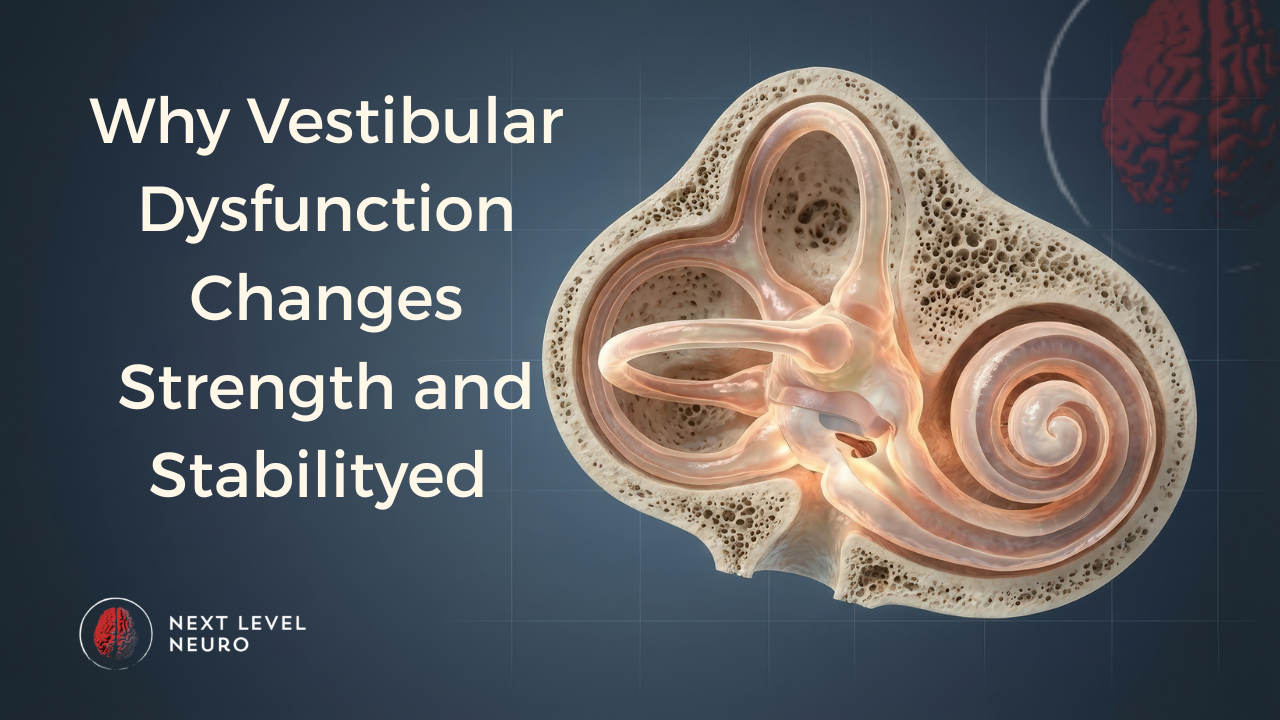
Why can someone feel weak, unstable, or asymmetrical under load even when strength, mobility, and imaging look “fine”?
Question this article answers:
Why can someone feel weak, unstable, or asymmetrical under load even when strength, mobility, and imaging look “fine”? This article explains how vestibular dysfunction can quietly change muscle tone, midline control, and force output by triggering protective bracing and movement rerouting. You will learn the signs that stability is a sensory and regulation problem, not a glute problem, plus quick self-tests and training fixes.
And why some “weakness” is actually your brain protecting you.
There is a moment in the gym that feels personal.
You walk up to a bar that you have lifted a hundred times.
The weight is not new. The movement is not new.
But today… your body feels like it is lying to you.
One side feels strong.
The other side feels delayed.
Your balance feels “off,” but you cannot explain how.
Your trunk braces like it is expecting impact.
Your neck tightens like it is holding secrets.
Your hips shift like they are trying to escape the task.
And the most annoying part is this....
Nothing is “injured.”
This is where a lot of people get stuck.
Because strength training is supposed to be simple: apply force, build tissue, get stronger.
But your nervous system does not care how many sets you did last week.
It cares if you feel stable enough to create force right now.
And one of the fastest ways to change stability in the body…
…is to disrupt the vestibular system.
The Vestibular System Is Your Brain’s “Gravity + Safety” GPS
Most people think of the vestibular system as “balance.”
That is like calling the nervous system “a couple nerves.”
Technically true. Painfully incomplete.
Your vestibular system tells your brain:
- Where your head is in space
- How fast you are moving
- Whether you are rotating, tilting, accelerating, or decelerating
- Whether the ground beneath you is “trustworthy”
- Whether it is safe to relax… or time to lock down
It is one of the most primitive systems you have.
It connects into areas that regulate posture, muscle tone, eye movement, autonomic state, and threat response.
So if vestibular information is messy, mismatched, or unreliable…
Your brain does not say:
“Let us be brave and deadlift anyway.”
Your brain says:
“Cool. We are going to survive. Everyone tighten up.”
Why “Vestibular Weirdness” Looks Like Strength Loss
This is the part that messes with lifters, coaches, and therapists.
Vestibular dysfunction rarely feels like a cartoon dizzy spell.
Sometimes it does.
But more often it looks like:
- Random strength drops that do not match training volume
- One-sided instability (especially in split stance patterns)
- Sudden fear in overhead work
- Shaky single-leg patterns
- A bar path that starts drifting for no reason
- A trunk that braces too early and never lets go
- “Weak glutes” that do not fix with more glute work
- Low back tightness that shows up as soon as load increases
- A shoulder that feels unstable even with good mobility
- A body that feels strong but not coordinated
And people assume it is a muscle problem.
When it is often a mapping problem.
A sensory problem.
A regulation problem.
To read the companion piece to this, click the link: The Stability Problem That Glute Work Will Not Fix
The Real Reason Vestibular Dysfunction Changes Strength
Strength is not only “how much muscle you have.”
Strength is your brain’s ability to create force without needing to protect you from it.
To lift heavy, your system needs:
- Clear visual information
- Reliable vestibular information
- Confident proprioception
- A stable sense of midline
- Enough safety to let force output rise without emergency braking
The vestibular system influences all of that.
1) Vestibular Input Controls Muscle Tone and Postural Output
Your vestibular system has direct lines into the brainstem and spinal cord.
That means it can change:
- baseline tone
- extensor activation
- postural reflexes
- protective co-contraction
- how hard your body “grips the ground”
So when vestibular input becomes unreliable, your system often chooses one of two survival strategies:
Strategy A: Stiffen Everything
You get tight, rigid, braced, and locked.
Strategy B: Decrease Force Output
You get shaky, unstable, cautious, and underpowered.
Neither is a character flaw.
Both are protection.
2) Your Eyes and Vestibular System Work as a Single Team
Your vestibular system is married to your visual system through something called the vestibulo-ocular reflex (VOR).
In normal function, when your head moves, your eyes stabilize so the world does not smear.
That is how you can walk, run, turn, and still see clearly.
When that system is off, your brain detects uncertainty.
Uncertainty is a threat signal.
So the brain does what it always does under threat:
it reroutes movement toward safety.
That rerouting often means:
- more rigidity
- less rotation
- less speed
- less overhead tolerance
- less single-leg confidence
- more “centered” patterns that avoid edge ranges
Which is why so many people feel strong only in very controlled, symmetrical lifts.
Then they get exposed the moment the environment changes.
3) Vestibular Dysfunction Changes Midline and Makes You “Leak Force”
Force production is a coordination problem.
When your brain knows where the center is, it can stack the system and transfer force cleanly.
When the brain cannot find midline, everything becomes a compensation.
So you will see:
- the pelvis shift
- the ribcage rotate
- the foot collapse
- the knee drift
- the shoulder dump forward
- the head subtly tilt and never return to neutral
Then someone tells you to “activate your core.”
You try.
It feels worse.
Because the problem was never effort.
The problem was orientation.
The Threat Bucket Connection: Vestibular Dysfunction Is a Loud “Danger” Signal
*Want to learn more about The Threat Bucket, click here.
If your system already has stress load…
- poor sleep
- high anxiety
- chronic pain
- unresolved injury history
- high training volume
- life chaos
- fear of reinjury
…vestibular dysfunction becomes the final drop in the bucket.
You do not “just get weaker.”
You get more protective.
And protection looks like:
- less range
- less speed
- less power
- less tolerance to instability
- more bracing
- more breath holding
- more tension in the neck and jaw
This is why vestibular issues often come with:
- headaches
- neck tightness
- motion sensitivity
- nausea
- light sensitivity
- brain fog
- derealization
- fatigue after training sessions that used to feel easy
Your system is spending energy trying to create certainty.
That is regulation.
Not motivation.
Signs Vestibular Function Might Be Driving Your “Instability”
Here are the clues coaches miss because they look “too subtle.”
Movement Clues
- Single-leg work feels dramatically worse than bilateral work
- Split squats feel unsafe even with “good form”
- Lunges feel like your body cannot find the floor
- Heavy carries make you feel anxious or disoriented
- Turning your head changes your strength immediately
- You feel stronger when you stare at one spot
- You lose power when the lights are bright or busy environments are present
Daily Life Clues
- You hate scrolling in the car
- You hate grocery store aisles (too much visual motion)
- You feel weird on escalators
- You get dizzy when you roll over in bed
- You feel “off” when looking up or bending down
- You clench your jaw without realizing it
- You feel unsteady after long screen time
Again: not a personality trait.
A sensory system that is asking for help.
The “It Is Not My Muscles” Self-Test
Here are simple checks you can run in 2 minutes.
Test 1: Head Turn Strength Check
- Do a max effort isometric row hold or split squat hold.
- Then repeat it while slowly turning your head left and right.
If strength drops or shakiness appears with head turns, vestibular input is likely involved.
Test 2: Eyes Closed Balance Check
- Stand on one leg.
- Do it with eyes open.
- Then close your eyes.
If you collapse instantly, it does not mean you are weak.
It means your brain is not confident in your internal maps yet.
Test 3: Gaze Stabilization Challenge
- Hold your thumb out in front of you.
- Keep eyes locked on the thumb.
- Turn your head side to side slowly for 15–20 seconds.
If you feel dizzy, nauseous, or unstable, that is information.
This is not about diagnosing anything.
This is about noticing what your nervous system is prioritizing.
Why Your Body Tightens the Neck When Vestibular Input Is Off
This part is hilarious and tragic.
Your neck becomes the “seatbelt” for your head.
If the vestibular system is unreliable, your brain tries to stabilize the head by increasing neck tone.
Because if your head feels stable, the world feels safer.
That is why vestibular issues often show up with:
- upper traps always on
- SCM tightness
- jaw tension
- headaches
- limited thoracic rotation
- shoulder discomfort in pressing patterns
And you can stretch it all day.
It will come back.
Because the brain did not tighten it to be annoying.
It tightened it to keep you alive.
Training Implications: Why Traditional Strength Fixes Fail
If the vestibular system is the limiter, then adding load often creates one of two outcomes:
Outcome 1: More Compensation
You get stronger inside the compensation.
Your numbers go up, but you feel worse.
Your pain increases.
Your symmetry decreases.
Your recovery tanks.
Outcome 2: Plateau and Frustration
Your strength does not increase because the brain will not allow higher output in an unstable system.
This is when people start blaming effort.
Or age.
Or genetics.
Or “tight hips.”
But the system is simply choosing safety over performance.
And that choice can be changed.
To Learn even more about Applied Neurology
Pain Is Not Coming From Your Tissues Alone
How the Brain Reroutes Movement Under Threat
Why the Biomechanical Model Fails Chronic Pain And How Applied Neurology Changes Everything
How to Restore Strength by Training the Vestibular System (Without Making It Weird)
You do not need to stand on a BOSU ball in the corner like a confused flamingo.
You just need to feed the brain better information and prove stability again.
Step 1: Start With Regulation, Not Intensity
If someone gets symptomatic, do not push harder.
Train in ranges and speeds that keep the nervous system calm enough to adapt.
A good rule:
If it spikes symptoms, it is too much.
If it feels easy but clear, it is probably perfect.
Step 2: Use Gaze Stabilization Before Heavy Work
A simple primer:
VOR x1 (beginner)
- Eyes locked on a target
- Small head turns side to side
- 10–20 seconds
- Rest
- Repeat 2–3 rounds
Then reassess a movement.
Many people will feel their stability return immediately.
Not because you “fixed them.”
Because you gave the brain clean input.
Step 3: Rebuild Midline With Low-Threat Patterns
Good options:
- suitcase carries
- front rack carries
- split stance RDL holds
- half-kneeling press holds
- slow tempo step-ups
- wall-supported single-leg balance with controlled breathing
The goal is not to destroy them.
The goal is to teach the brain:
“We are stable here. You can release the brakes.”
Step 4: Layer Head Movement Into Strength, Gradually
Once basic stability returns:
- add gentle head turns during carries
- add controlled gaze shifts during split stance work
- add rotational patterns in safe ranges
- add speed only after stability is consistent
This is how you integrate vestibular input into real movement.
Not as a circus drill.
As a nervous system upgrade.
The Part Everyone Misses: Vestibular Dysfunction Is Often a “Confidence Leak”
Here is the emotional layer.
When your vestibular system is off, you do not just lose balance.
You lose certainty.
And the brain hates uncertainty more than it hates load.
That is why people say things like:
- “I do not trust my leg.”
- “I feel like I am going to tweak something.”
- “I feel unstable for no reason.”
- “I feel fine until I do not.”
That is not weakness.
That is prediction error.
Your brain is trying to predict safety.
It cannot.
So it tightens and limits output.
Fixing vestibular function often restores something deeper than movement.
It restores trust.
What This Has to Do With “How the Brain Reroutes Movement Under Threat”
When vestibular input signals danger, the brain reroutes movement in predictable ways:
- more rigidity
- less rotation
- less overhead freedom
- more “stuck” patterns
- more protective bracing
- more reliance on vision to control everything
This is why some people look strong but move like they are negotiating with gravity.
The system is not failing.
It is adapting.
And once you understand the adaptation, you can reverse engineer the solution.
The Real Takeaway.....
If your stability changes day to day…
If strength disappears when you turn your head…
If overhead work makes you feel unsafe…
If you feel “weak” in one leg but strong everywhere else…
Do not assume your muscles forgot how to work.
Assume your brain is missing clean information.
And remember this:
Strength is a nervous system decision.
Your vestibular system helps make that decision.
If it is noisy, protection wins.
If it is clear, performance returns.
To read the companion piece to this, click the link: The Stability Problem That Glute Work Will Not Fix
FAQ: Vestibular Dysfunction, Strength, and Stability
1) Does vestibular dysfunction always mean dizziness or vertigo?
No. Many people do not feel “spinning.” They feel unstable, off, guarded, or asymmetrical under load. Vestibular issues can show up as coordination loss, bracing, or sudden confidence drops without classic dizziness.
2) Can vestibular issues cause one-sided weakness or instability?
Yes. If the brain is uncertain about orientation or midline, it often changes tone and motor output asymmetrically. It can look like one leg “fails” or one side delays under intensity.
3) Is this just a glute weakness or core weakness problem?
Sometimes strength is part of the picture, but many “weakness” presentations are actually protection. If the nervous system does not trust the environment, it will limit force output and increase bracing even when muscles are capable.
4) Why does overhead work feel unsafe when vestibular input is off?
Overhead positions increase the demand for head, neck, and midline orientation. If the brain is not confident in where the head is in space, it often tightens, reroutes, or reduces output to stay safe.
5) Why do bright lights, busy gyms, grocery stores, or scrolling make symptoms worse?
Vision and vestibular function work together. High visual motion or sensory chaos increases processing demand, and if vestibular input is already noisy, the nervous system may shift into protection faster.
6) What is the safest first step if this resonates?
Start with low-dose gaze stabilization and calm, controlled strength patterns. If a drill spikes symptoms, decrease speed, range, or duration. Train clarity, not intensity.
7) When should someone see a medical professional?
If there is sudden severe dizziness, fainting, neurologic symptoms (new weakness, numbness, facial droop, speech or vision changes), severe headache, or symptoms that are rapidly worsening, they should seek medical evaluation. For persistent dizziness/vertigo, referral to a vestibular-trained clinician can be appropriate.
8) Is this article diagnosing vestibular disorders?
No. This is pattern recognition for training and rehab contexts—helping you notice when “strength problems” behave like orientation/regulation problems.
Want more information on our Mentorship
and Programs?
We hate SPAM. We will never sell your information, for any reason.
