5 Applied Neurology Principles Every Practitioner Should Steal
Oct 14, 2026
You do not need hundreds of neuro drills to start thinking more neurologically. You may just need to change the way you assess, dose, and make decisions with the tools you already use.
The question this article answers is:
What principles from Applied Neurology should you start incorporating into your practice and training right now?
The answer is probably simpler than you think. We know you hear the word “neurology” and automatically exclude yourself from the conversation if you do not have a PHD in neuroscience.
That is NOT the case.
You do not need to throw away your strength training.
And you do not need to abandon biomechanics.
We will also tell you that we will NOT have you stop using mobility, breathing, rehab, manual therapy, or the movement systems you already trust.
They ALL matter.
And you certainly do not need to memorize 300 neurological drills before you can start.
What you can do is begin borrowing some of the thinking behind Applied Neurology.
Because sometimes the biggest change is not adding another neuro drill.
It is changing the questions you ask before and after the exercise.
Here is what we think you should take first.
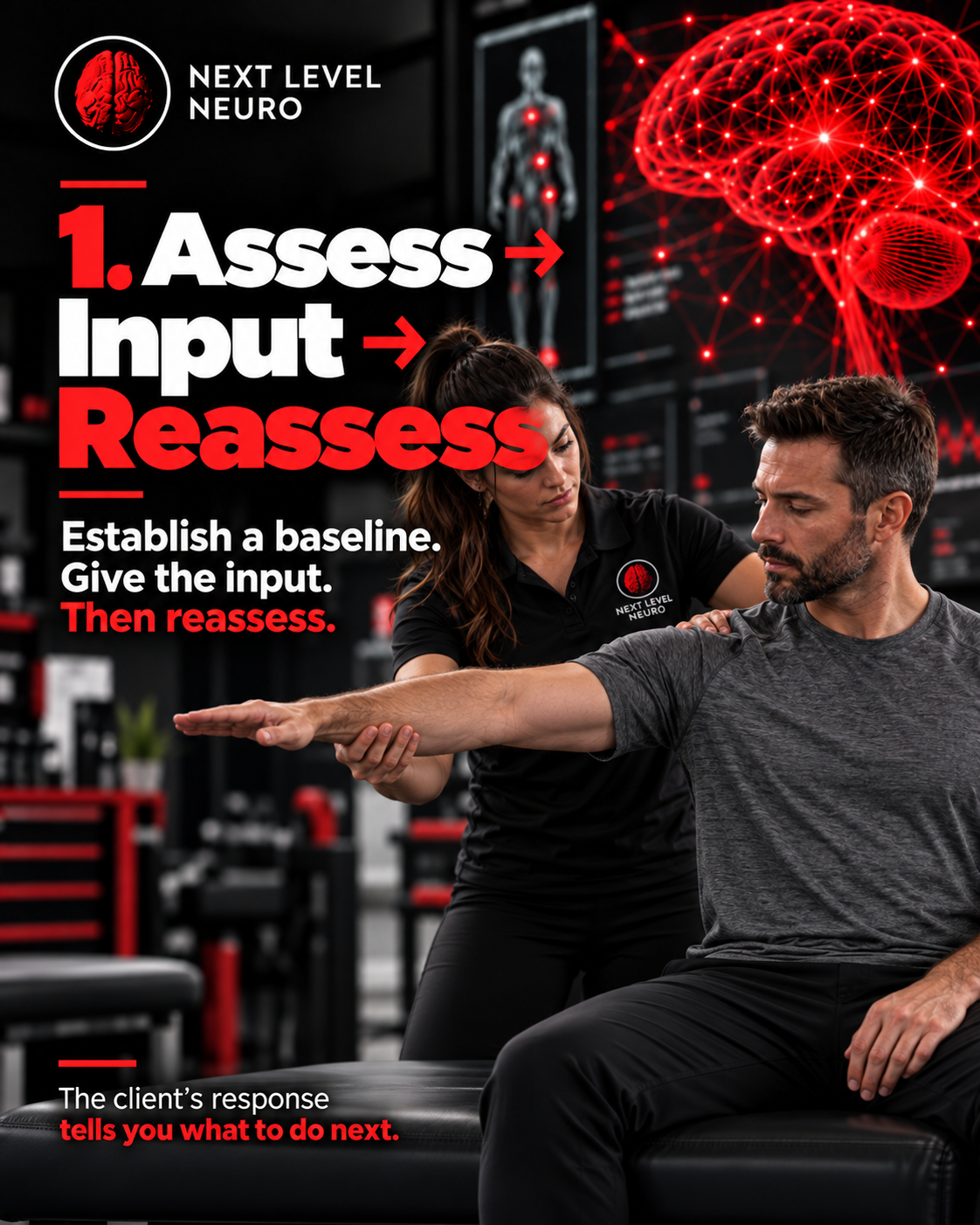
1. Assess → Input → Reassess
This is probably the first principle we would steal, because it is so easy to implement and changes the very outlook of each session.
Especially intersession.
Most of us have been taught to choose an intervention because it makes sense mechanically.
Applied Neurology wants you to ask…
What actually happened after you added the intervention?
- That intervention could be pushups, bench presses, squats, manual therapy, breathing exercises, mobility work, or the whole kit and caboodle of biomechanics and therapy.
- Establish a baseline.
- Give the input.
- Reassess.
- Did range of motion improve?
- Did balance change?
- Did strength increase?
- Did pain decrease?
- Did nothing happen?
Every one of those responses gives you information.
The drill does not tell you whether it worked.
The client's response does.

2. Regulate Before You Activate
This is one of our biggest principles at Next Level Neuro, and it formed the basis of our most downloaded free master calls.
Download here: Regulation is The New Strength
Before asking the nervous system for more speed, strength, complexity, sensory input, or cognitive demand, ask….
Is the system ready for more?
Sometimes the client does not need a harder exercise.
They need enough regulation to access the capacity they already have.
But this is where people often misunderstand regulation.
Regulation does not mean making someone calm.
A regulated nervous system should be able to increase activation when the situation requires it, perform, and then recover when the demand is over.
The goal is not permanent relaxation.
The goal is adaptability.
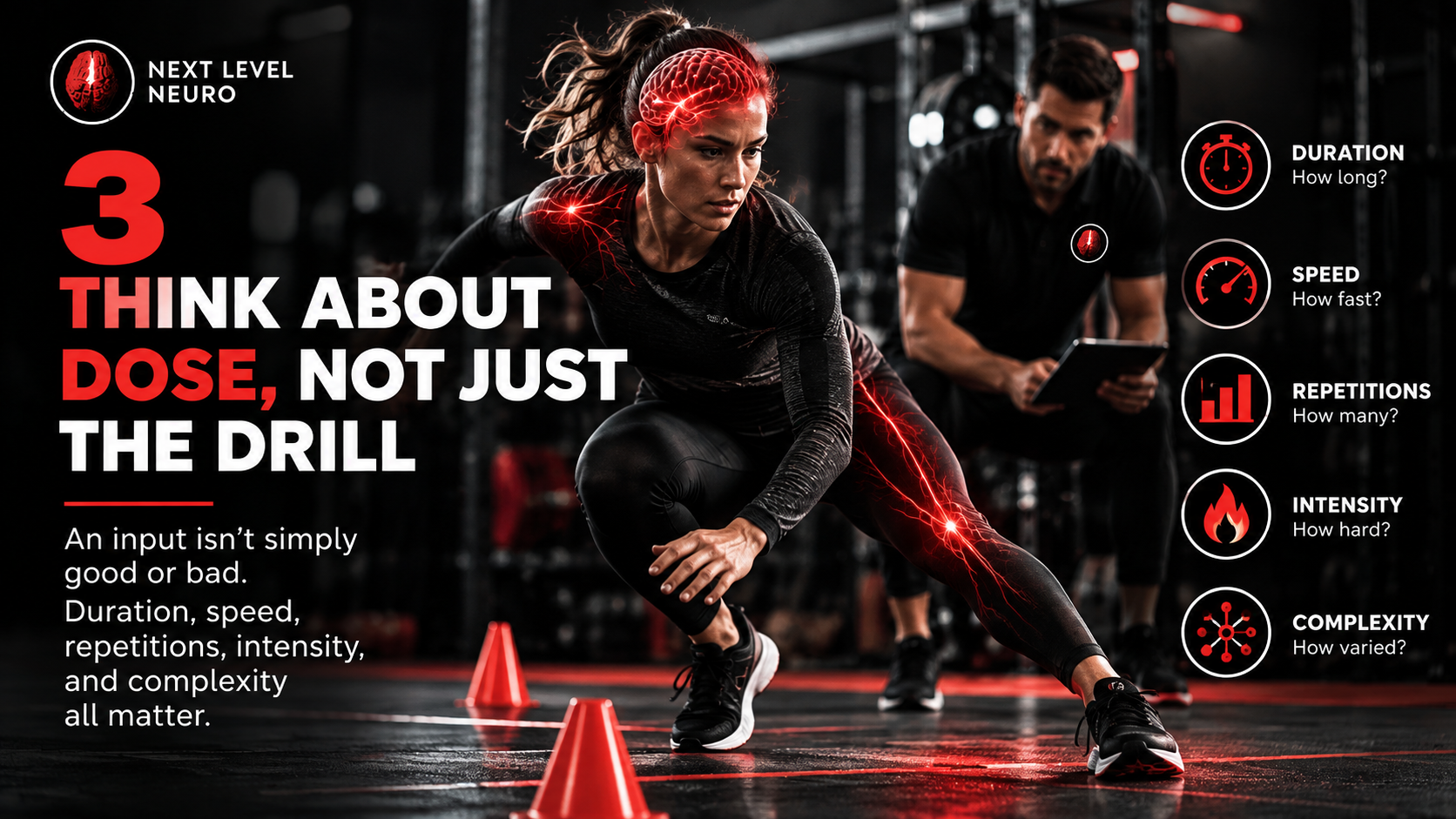
3. Think About Dose, Not Just the Drill
Practitioners love asking…
"Is this a good drill?"
A better question might be…
"What dose of this drill can this nervous system currently tolerate?"
Because an input is not simply good or bad.
Duration matters.
Speed matters.
Repetitions matter.
Intensity matters.
Complexity matters.
The environment matters.
A client might respond negatively to ten repetitions of a vestibular drill but respond positively to two.
That does not necessarily mean the drill was wrong.
It may mean the dose was wrong.
This is one of the easiest neurological principles to bring into almost any type of training tomorrow.
Stop thinking only about exercise selection.
Start thinking about dosage and response.
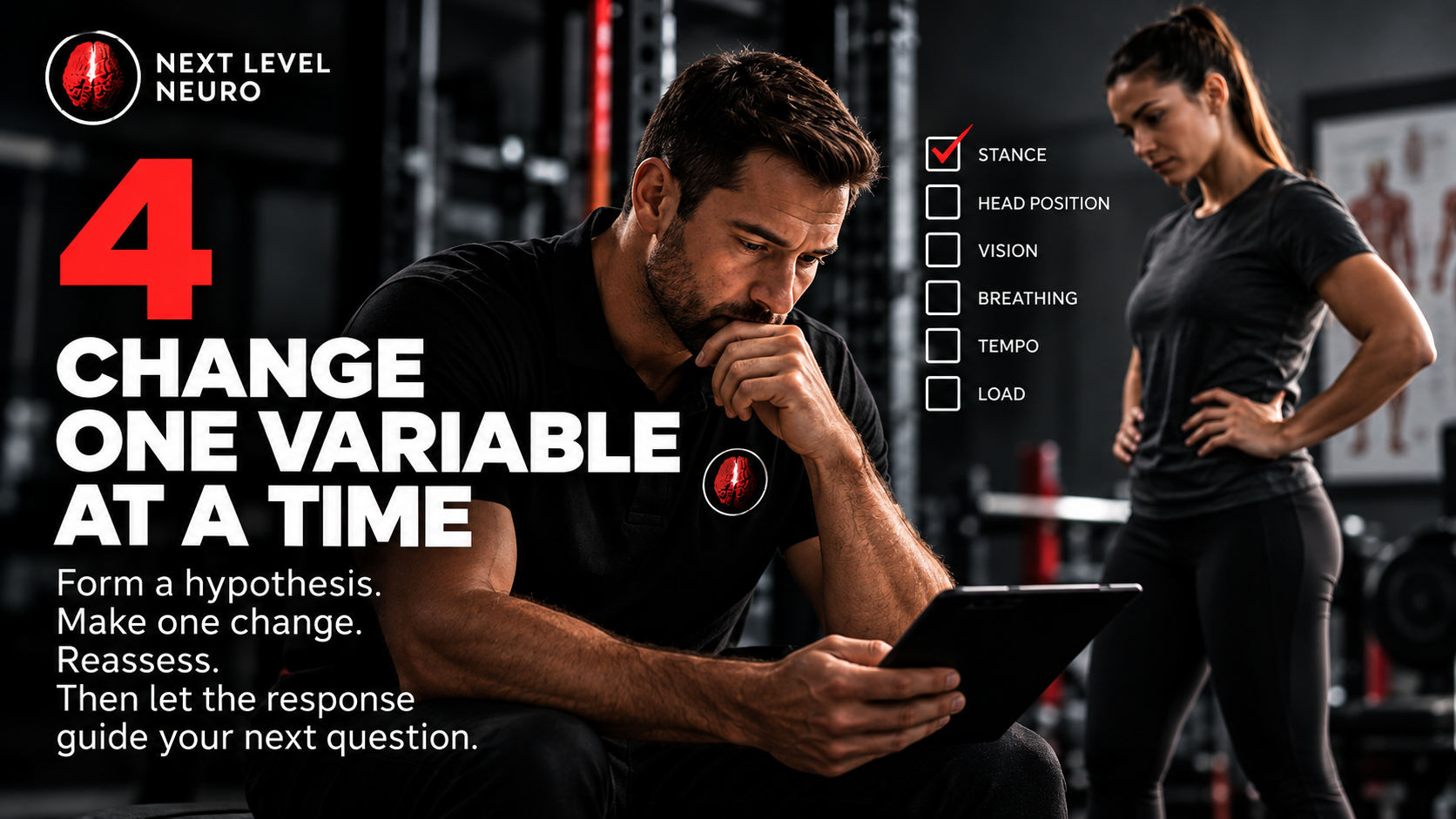
4. Change One Variable at a Time
We see this all the time…
- A practitioner changes the client’s stance.
- Then their head position.
- Then their breathing.
- Then their eye position.
- Then their tempo.
- Then their load.
- The client suddenly improves.
Great.
But now we have another problem:
What caused the improvement?
We do not really know.
Applied Neurology encourages us to slow that process down:
- Change one variable.
- Reassess the response.
- Decide what to change next.
- Use that response as information.
- Then refine the next step instead of guessing.
And it makes your next decision better.
Good clinical reasoning should look something like…
Form a hypothesis → test it → change one variable → reassess → refine the hypothesis.
You are not trying to prove that your first idea was right.
You are trying to learn something from the nervous system.
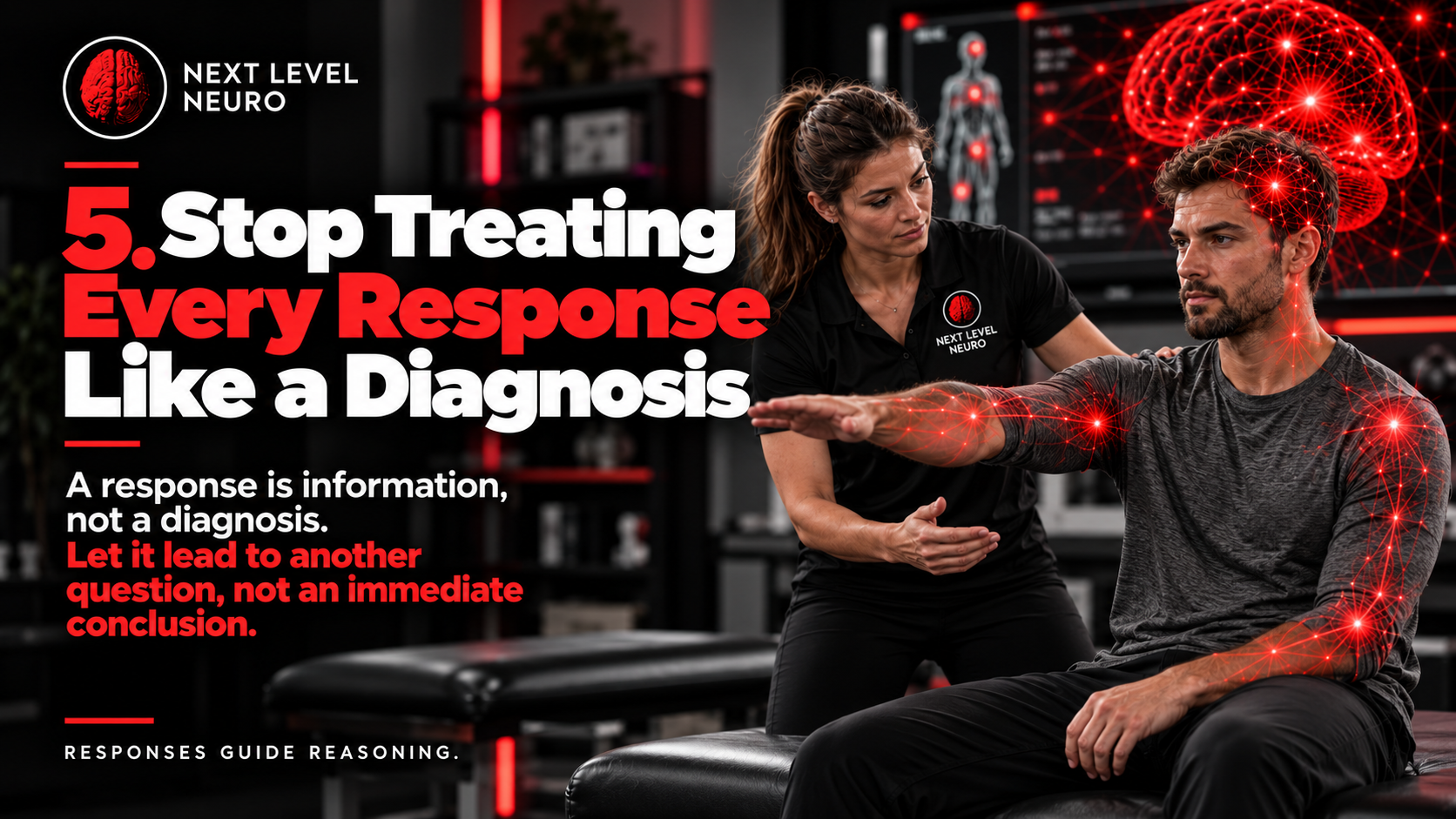
5. Stop Treating Every Response Like a Diagnosis
This may be the biggest principle on the list.
Let's say you add a vestibular challenge and your client's balance gets worse.
It is tempting to think…
"There it is. They have a vestibular problem."
But that is a much bigger conclusion than the assessment actually gave you.
What you really learned is…
Under those conditions, at that dose, the nervous system did not tolerate that input well.
This answer should lead to another question.
Can you reproduce it?
What happens if you reduce the dose?
Does a different vestibular input create the same response?
Does changing another variable improve it?
One response is a clue.
It is not automatically the diagnosis.
And good Applied Neurology should make you more curious, not more certain.
The Real Shift Is Not More Drills
This may be the most important part.
Applied Neurology does not have to mean replacing everything you already know.
It can mean bringing another layer of thinking into what you already do…
- Keep strength training.
- Keep working on mobility.
- Keep using breathing.
- Keep using manual therapy.
- Keep coaching movement.
- Just start asking better questions about how the nervous system is responding to each one.
But now you begin asking…
What is the nervous system telling me about this input?
That is a very different way of working with a client and implementing near drills and biomechanical exercises.
Instead of…
Find the problem → prescribe the correction.
The process becomes:
Assess → form a hypothesis → introduce an input → reassess → learn → adjust.
That is the part worth stealing.
Because eventually, Applied Neurology becomes much less about knowing hundreds of drills and much more about understanding the person standing in front of you.
Want a Framework for Putting This Into Practice?
If you are interested in Applied Neurology but do not want another giant library of exercises to memorize, that is exactly why we created The Neuro Advantage.
It gives practitioners a practical framework for understanding where to start, what to assess, how to choose an input, and what the reassessment tells you to do next.
Learn the framework inside The Neuro Advantage and start applying neurology to the work you are already doing.
FAQ
1. Do I need to become a neurologist to use Applied Neurology principles?
No.
The goal is not to diagnose neurological disease. It is to use nervous-system principles, assessment, reassessment, and appropriate dosing to improve your clinical reasoning.
2. Do I need hundreds of neuro drills?
No.
A smaller number of inputs combined with good assessment and reassessment can often teach you more than memorizing hundreds of drills without understanding when to use them.
3. Does Applied Neurology replace biomechanics?
No.
Biomechanics still matter. Applied Neurology simply asks another question: What nervous-system inputs may be influencing the movement or output you are seeing?
4. What should I assess and reassess?
Use an output that matters for the client and that you can reproduce reasonably well.
That might be range of motion, strength, balance, pain, breathing comfort, movement quality, or another relevant assessment.
5. What if the reassessment gets worse?
That is information.
The input may have been too intense, too long, too complex, or simply inappropriate for that client at that moment.
Reduce the dose, change one variable, and reassess again.
6. What if nothing changes?
Flat is still a response.
It may mean the input was not relevant enough, the dose was too small, the assessment was not sensitive enough, or your hypothesis needs to change.
7. Why is regulation the first step?
Because if the nervous system is heavily prioritizing protection, adding more complexity may simply create more noise.
Regulation gives the system a better opportunity to process and adapt to the inputs you provide.
8. Does a positive reassessment mean I found the cause?
Not necessarily.
It tells you the input may be useful.
Now look for repeatability, adjust one variable at a time, and keep testing the hypothesis.
9. What is the biggest mistake beginners make?
Jumping from a response to a diagnosis.
A response should usually lead to another question.
10. What is the simplest way to start using Applied Neurology tomorrow?
Pick one reliable baseline.
Apply one input.
Reassess.
Then let the response help determine what you do next.
Want more information on our Mentorship
and Programs?
We hate SPAM. We will never sell your information, for any reason.