5 Things the Nervous System Can Tell You About Your Client's Pain That Biomechanics Can't
Nov 04, 2026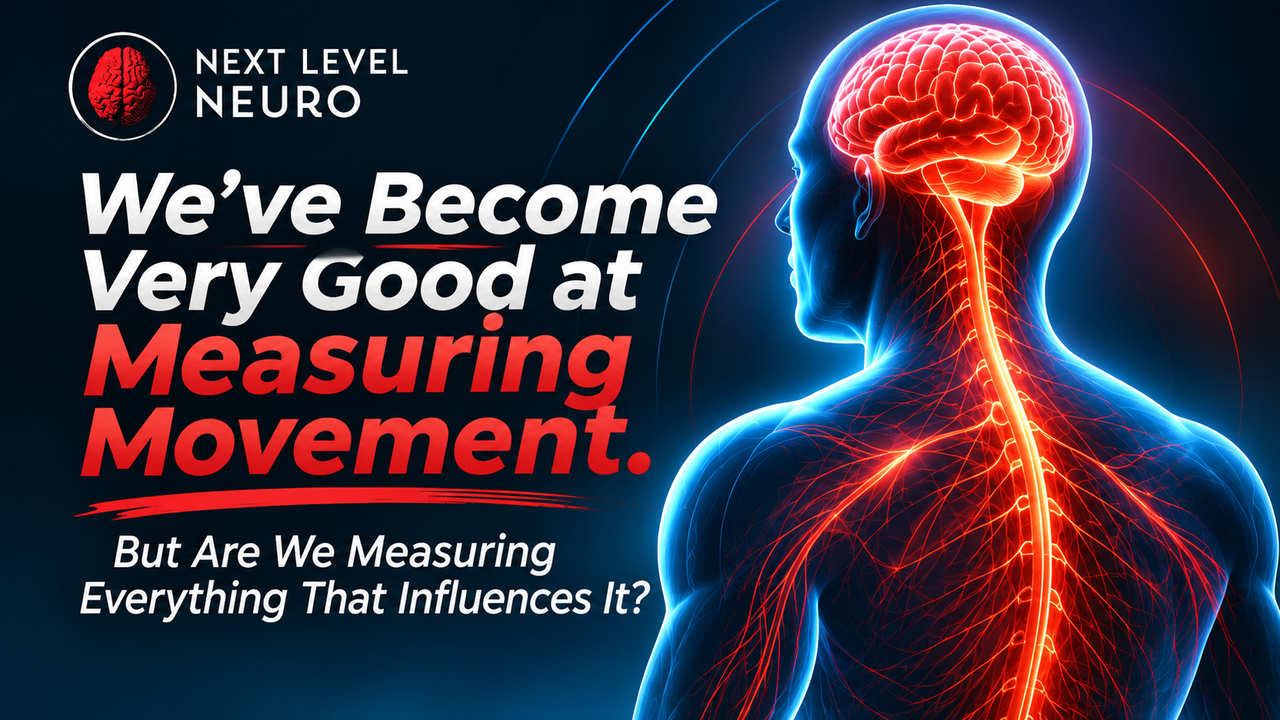
Your client's pain may make perfect sense from a neurological perspective, even when their movement assessments and treatment plan suggest otherwise.
We've Become Very Good at Measuring Movement. But Are We Measuring Everything That Influences It?
Think about how much our understanding of the human body has changed over the last 30 years.
When many of today's rehabilitation principles and educational models were developed, the industry built its approaches around the research, technology, and clinical understanding available at the time.
That education gave practitioners an extraordinary foundation for helping people move and function better.
It also shaped how the industry learned to assess and treat movement problems:
- Joint mechanics: Understanding how joints move and how restrictions influence function.
- Muscular imbalances: Identifying weaknesses, compensations, and differences in muscle performance.
- Range of motion: Measuring mobility and identifying limitations.
- Force production: Evaluating strength, stability, and physical capacity.
- Movement patterns: Observing how the body organizes movement and responds to mechanical demands.
These principles remain essential to rehabilitation today.
But science doesn't stop evolving simply because we've become comfortable with what we've learned.
Over the past several decades, advances in neuroscience have expanded our understanding of how the brain and nervous system influence pain, movement, sensory processing, and protective behavior.
Today, practitioners have access to a deeper understanding of how the nervous system integrates information from the visual, vestibular, and proprioceptive systems, along with signals originating inside the body.
Yet many assessments continue to focus primarily on the mechanical side of the equation.
Consider a few questions that traditional movement assessments may not fully answer:
- How might sensory information be influencing a client's range of motion?
- Could protective nervous system responses be contributing to movement limitations?
- Why might two clients with similar structural findings experience completely different levels of pain?
- How do stress, sleep, and physiological regulation influence a client's response to treatment?
- Why might an exercise improve someone's movement one day but produce a completely different response the next?
These questions aren't intended to dismiss biomechanics. They're opportunities to expand the clinical reasoning practitioners already use.
The education that brought our industry this far doesn't have to be the education that limits where we go next.
As our understanding of the nervous system advances, so should the way we assess pain, interpret movement, and make treatment decisions.
Identifying a mechanical limitation is only part of understanding why someone hurts. The nervous system is constantly processing sensory information, responding to internal physiological changes, and influencing how the body moves and protects itself.
And some of that information may never become apparent through a purely biomechanical assessment.
For therapists and movement professionals, this creates an opportunity to ask better questions, recognize factors that might otherwise go unnoticed, and make more informed treatment decisions.
Understanding these principles is one thing. Learning how to assess them, determine which findings matter, and apply that information with real clients is where things become interesting.
Here are five neurological principles that can change how you understand your client's pain and what you look for during your next assessment.
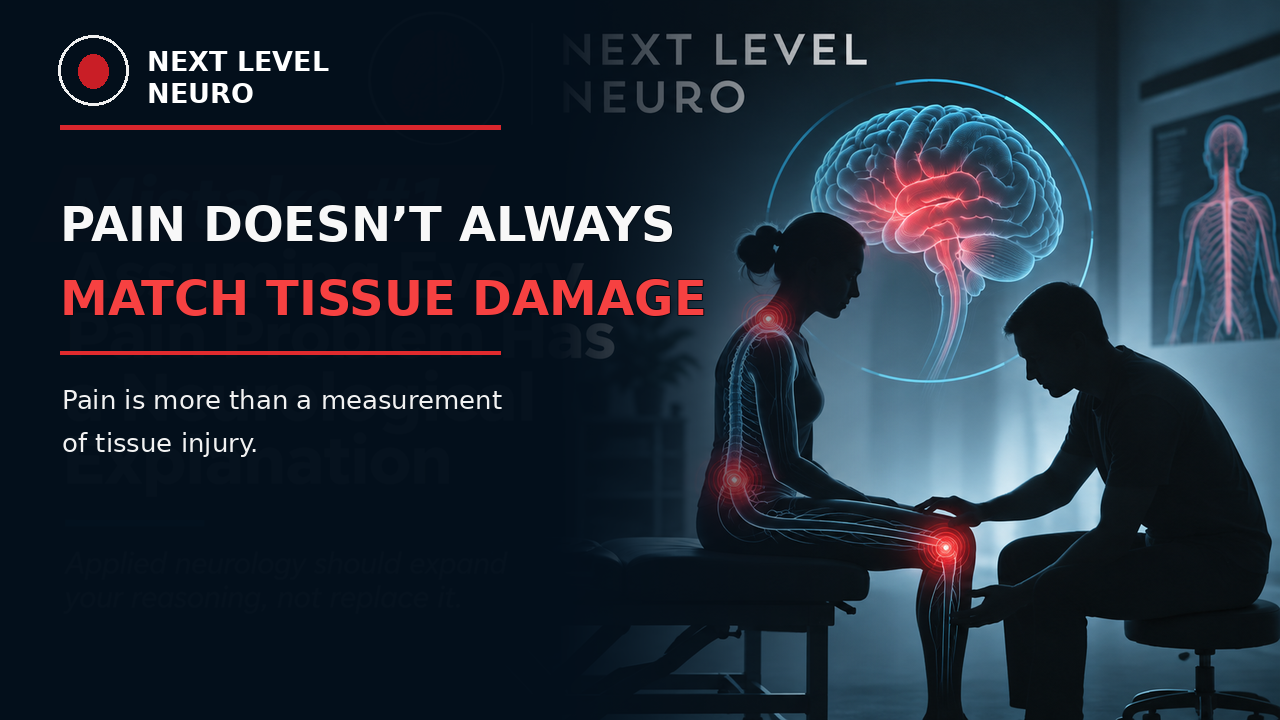
1. The Nervous System Can Explain Why Pain Doesn't Always Match Tissue Damage
One of the more frustrating things about treating pain is that the severity of someone's symptoms doesn't always match what you find during an assessment.
You've probably seen clients with significant structural changes on imaging who barely experience discomfort.
And you've probably treated clients with relatively unremarkable imaging who struggle to perform basic movements without pain.
How does that happen?
Because pain isn't a direct measurement of tissue damage.
The nervous system processes information from the body alongside other influences, including previous experiences, expectations, context, and the individual's current physiological state.
This means two people with similar tissue findings can experience pain very differently.
It also means that someone can continue experiencing pain after an injury has healed sufficiently, particularly when pain processing has become more sensitive.
The clinical question changes from "What's damaged?" to "What might be contributing to this person's pain experience?"
That doesn't mean tissue health is irrelevant. It means tissue findings are one part of a much larger picture.
And for practitioners, understanding that distinction can open up additional assessment and treatment possibilities.
This is one of the reasons pain education has evolved so much over the last several decades.
Recognizing that pain isn't always proportional to tissue damage changes how you think about a client's symptoms. But it also creates another challenge.
If tissue findings don't tell the whole story, what else should you be assessing?
That's a question worth keeping in mind as we explore the next four principles.
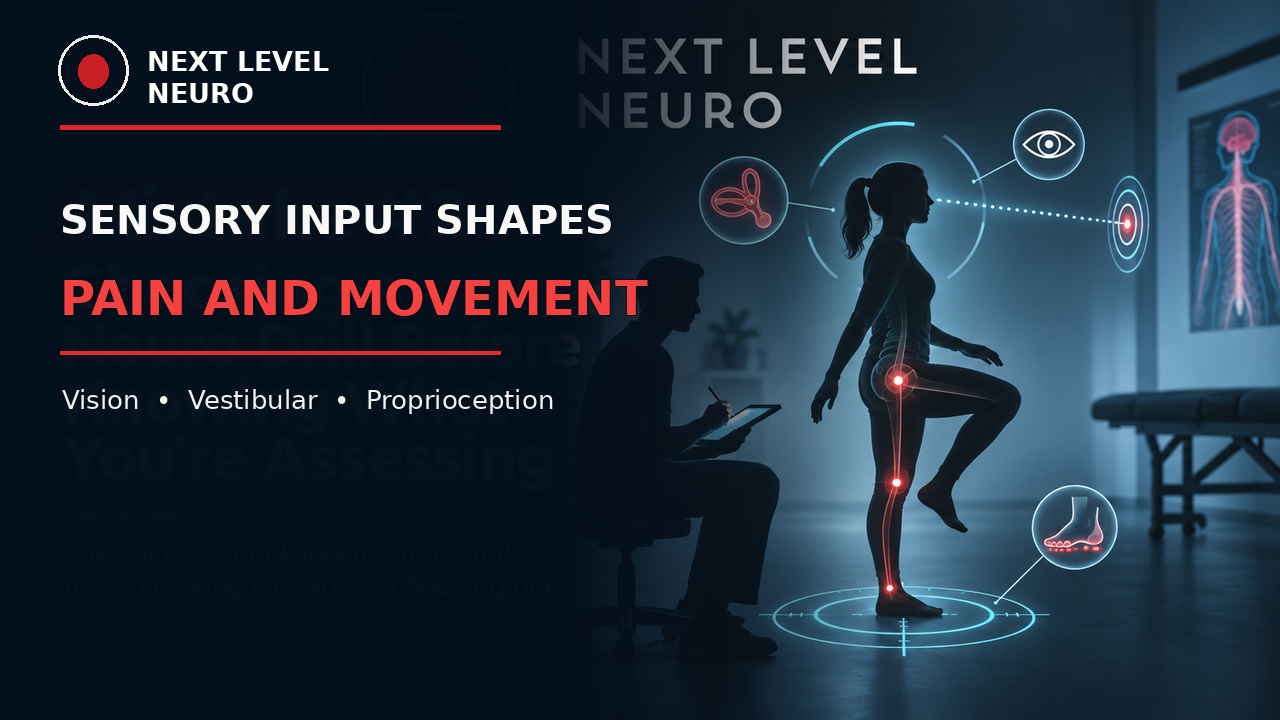
2. The Nervous System Can Reveal How Sensory Information Influences Pain and Movement
When you watch a client perform a movement, what are you paying attention to?
Maybe you're looking at joint angles, muscle activation, alignment, or compensation patterns.
All important information.
But here's something else we teach our Next Level Neuro students.
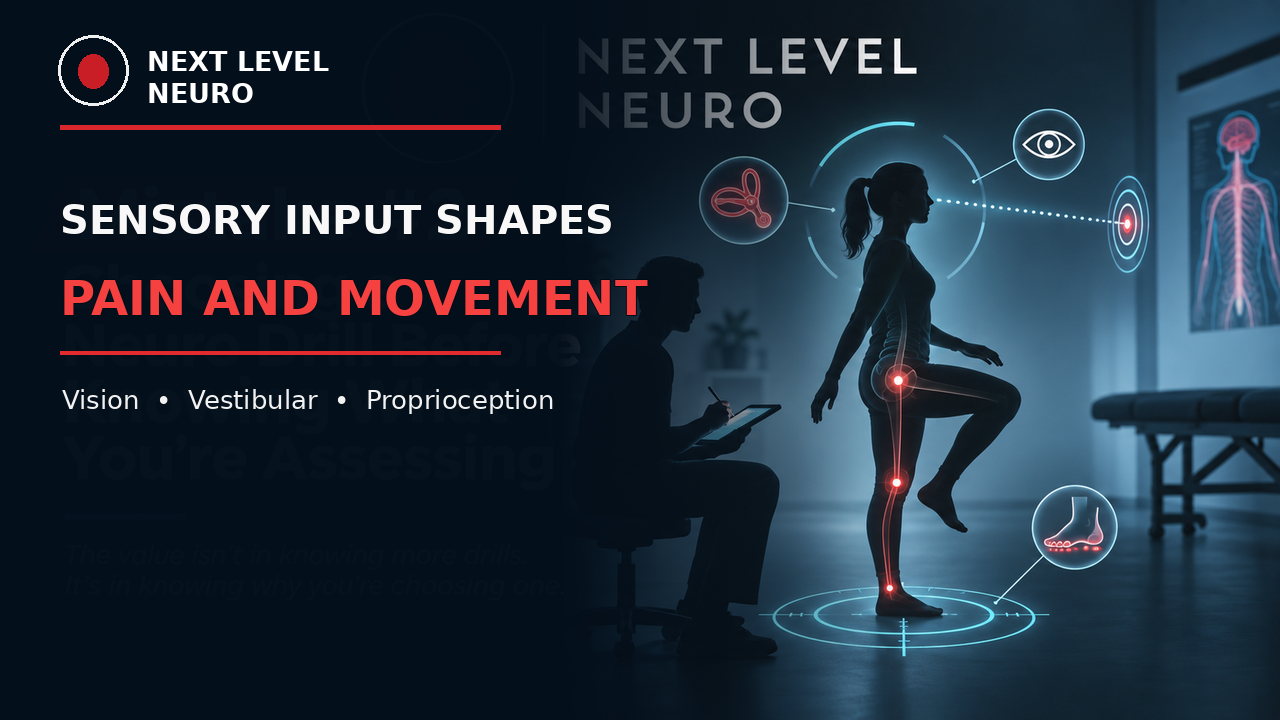
Your client's brain is constantly receiving and integrating information from multiple sensory systems to determine where the body is, how it's moving, and how to respond.
Three important contributors are the visual, vestibular, and proprioceptive systems.
Together, they help the nervous system maintain orientation, coordinate movement, and adapt to changing demands.
Now consider a client who demonstrates adequate shoulder mobility during an isolated assessment but becomes uncomfortable when performing a more complex movement.
You might immediately assume there's a mechanical limitation you haven't identified.
And there might be.
But the movement also places different demands on sensory processing, coordination, attention, and the client's perception of safety.
A neurological perspective encourages us to consider whether those demands are influencing the movement strategy.
This doesn't mean every movement problem is caused by a sensory deficit.
It means there are additional questions worth asking.
What sensory information does this movement require, and how is the client responding to those demands?
Sometimes a simple change in sensory conditions or movement demands can alter performance.
That response gives us information worth exploring through reassessment.
The challenge for practitioners isn't necessarily understanding that sensory processing influences movement.
It's knowing where to start.
Which sensory systems should you explore? What might a meaningful response look like? How do you determine whether an intervention is worth integrating into the client's treatment plan?
These are the questions that move applied neurology from an interesting concept into a practical clinical approach.
Want to explore how these concepts translate into clinical assessments? Take a look at our advanced pain education.
3. The Nervous System Can Reveal How Internal Body Signals Influence Pain
Most therapists are comfortable assessing information coming from the outside world.
Movement, balance, coordination, joint position, and responses to physical loading are all familiar areas of assessment.
But the nervous system is also constantly monitoring what's happening inside the body.
This process involves interoception, our ability to sense and interpret internal physiological signals.
These signals can include changes associated with breathing, heart rate, hunger, fatigue, and other internal bodily processes.
And they can influence how someone experiences pain.
Think about a client who tells you their neck pain becomes considerably worse after a stressful day at work.
They haven't necessarily lifted anything heavy or performed an unusual movement.
Their mechanical demands may be similar to those of a day when their symptoms were relatively mild.
Yet their pain has changed.
Why?
Because their internal physiological state may also have changed.
Increased arousal, poor sleep, fatigue, emotional stress, and changes in breathing can interact with the processes that influence pain sensitivity.
This is one reason understanding interoception, autonomic regulation, and the vagus nerve can add valuable context to clinical reasoning.
It doesn't mean stress caused the pain or that breathing exercises will automatically resolve it.
It means the internal environment deserves consideration when we're trying to understand why symptoms fluctuate.
Sometimes what's happening inside your client matters just as much as the movement you're asking them to perform.
At Next Level Neuro, this is one of the areas we explore in our advanced pain education.
Understanding the relationship between internal physiological signals and pain can change the way practitioners interpret persistent symptoms.
But the real value comes from learning how to incorporate that knowledge into an assessment rather than simply recognizing that the relationship exists.
And that becomes especially important when a client's protective responses begin influencing how they move.
4. The Nervous System Can Reveal Why a Movement Feels Threatening Even When the Client Can Physically Perform It
Imagine you're working with a client who has experienced low back pain for several months.
Their strength has improved, their range of motion is better, and they can perform most prescribed exercises without difficulty.
But every time you ask them to bend forward, they hesitate.
They brace their abdomen, tighten their shoulders, and move as though something terrible is about to happen.
From a mechanical perspective, they may have the capacity to perform the movement.
So why are they avoiding it?
Because having the physical capacity to perform a movement doesn't necessarily mean the nervous system expects that movement to be safe or comfortable.
Painful experiences can influence learning, expectations, and protective behaviors.
If someone repeatedly associates bending forward with pain, they may begin anticipating discomfort before the movement even occurs.
That anticipation can influence their movement strategy.
They might brace, move more slowly, reduce their range of motion, or avoid the movement entirely.
And sometimes those protective strategies persist even after physical capacity has improved.
This is where understanding pain-related fear, prediction, and protective behavior becomes useful.
Rather than simply telling the client they have enough strength to perform the movement, we can explore what happens when the movement is introduced gradually, with appropriate support and tolerable levels of exposure.
The question becomes, "What is this client expecting to happen when they attempt the movement?"
That question may reveal something a strength or mobility assessment alone wouldn't.
It also challenges us to consider whether we're treating the movement limitation or helping the client change their response to the movement.
Both may be necessary.
And understanding the difference can influence how we select, progress, and reassess an intervention.
5. The Nervous System Can Reveal Why the Same Treatment Produces Different Results on Different Days
Here's something nearly every therapist has experienced.
You work with a client on Monday and introduce a particular mobility drill.
Their pain decreases, their range of motion improves, and they leave the session feeling better.
Naturally, you decide to use the same exercise during their next appointment.
But Thursday arrives, and the response is completely different.
Their movement becomes more guarded, their discomfort increases, and the drill that worked so well three days earlier no longer produces the same result.
What happened?
Was the exercise wrong?
Not necessarily.
The client's nervous system is constantly adapting to changing conditions.
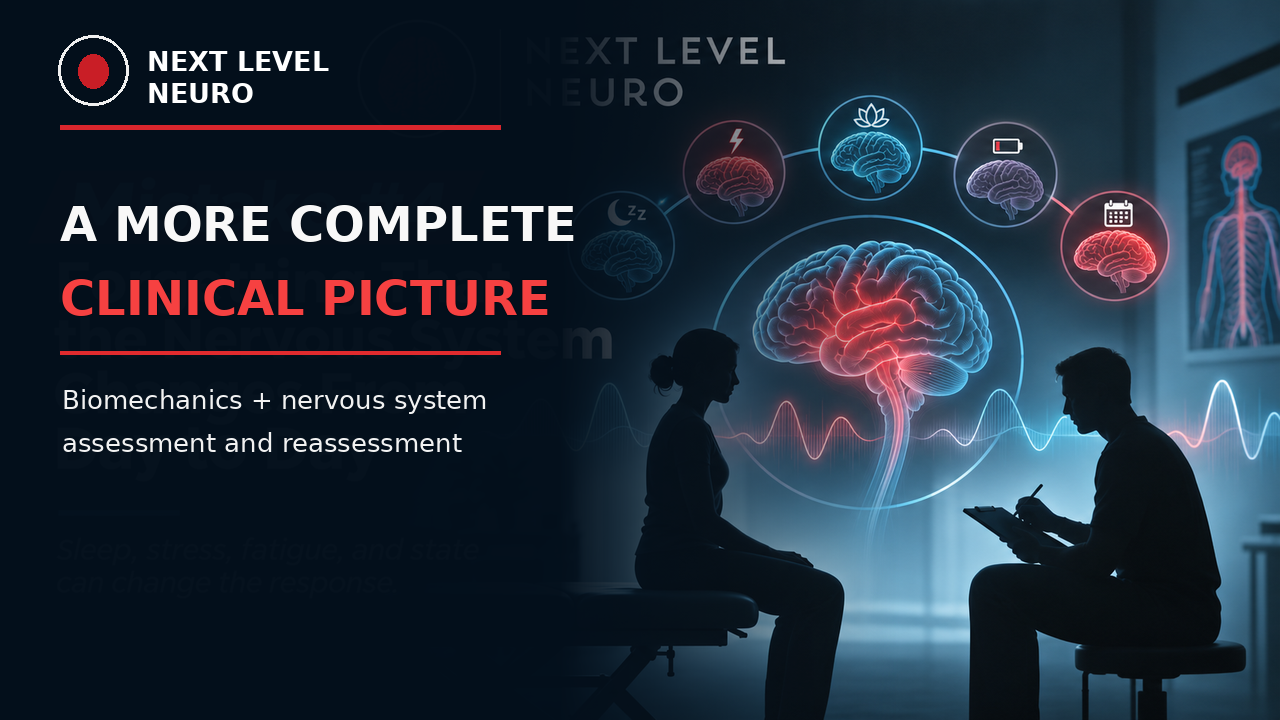
Sleep, fatigue, recent activity, stress, expectations, and the current sensitivity of the pain system can all influence how someone responds to an intervention.
An exercise that was well tolerated on Monday may be more challenging on Thursday.
This is why we place so much emphasis on nervous system regulation and reassessment at Next Level Neuro.
Regulation isn't simply about helping clients relax.
It involves the capacity to respond to changing demands and recover appropriately.
And because your client's state can change, their response to treatment can change too.
The mistake is assuming that because an exercise worked once, it will always produce the same result.
Your treatment plan gives you a starting point.
Your client's response tells you what to consider next.
And that brings us to something important about all five principles.
Each one introduces information that could change how you interpret a client's symptoms.
But knowing these neurological factors exist doesn't automatically tell you how to assess them, which findings matter, or what to do with the information.
That's where clinical reasoning becomes essential.
Applied Neurology Doesn't Replace Biomechanics
None of this means anatomy, biomechanics, or traditional rehabilitation are outdated.
They're essential.
But a biomechanical assessment and a neurological assessment can help us explore different aspects of the same clinical problem.
One helps us understand movement mechanics, loading, tissue capacity, and physical limitations.
The other can expand our understanding of sensory processing, pain sensitivity, physiological regulation, and protective movement strategies.
And when we consider both perspectives, we may develop a more complete understanding of the individual standing in front of us.
This is why we teach a simple approach at Next Level Neuro:
Assess → Apply → Reassess → Integrate.
- Assess: Explore the client's current presentation and identify a reasonable starting point.
- Apply: Introduce a targeted intervention based on your clinical hypothesis.
- Reassess: Determine whether the client's response is better, worse, or unchanged.
- Integrate: Incorporate useful findings and interventions into the broader treatment plan.
If the intervention makes things better, that gives you information.
If it makes things worse, that gives you information too.
And if nothing changes, perhaps you need to explore a different variable.
An immediate improvement doesn't prove you've identified the underlying cause of someone's pain. But it can help guide what you investigate next.
Your treatment plan can make perfect sense and still be incomplete.
The goal isn't to collect more exercises or memorize another set of protocols.
It's to become better at asking questions, interpreting responses, and making decisions based on the person standing in front of you.
That's what makes continued education so valuable.
And it's why we've been expanding our advanced pain education at Next Level Neuro.

Ready to Go Beyond Understanding Pain and Start Assessing It Differently?
If you've made it this far, you've probably recognized something important.
Understanding the neurological side of pain can change the questions you ask during an assessment.
But knowing which questions to ask is only the beginning.
The next step is developing the knowledge and clinical reasoning to explore the answers.
That's why we're making something special available to the Next Level Neuro community.
For a limited time, we're offering our Pain Relief Education Bundle, bringing together five educational workshops exploring the neurological mechanisms behind pain.
You'll also receive:
- 2 advanced neurological assessment roadmaps covering shoulder/limb pain and low back/spinal pain.
- 4 real-world client case studies illustrating how applied neurology concepts can be explored in practice.
- Access to 2 advanced NEURO+ workshops previously reserved for Next Level Neuro Mentorship graduates.
These workshops bring together many of the concepts discussed throughout this article, including pain processing, interoception, sensory information, and nervous system regulation.
The goal isn't to replace what you've learned about biomechanics.
It's to expand your clinical perspective and give you more ways to understand clients whose symptoms don't respond the way you expect.
Total listed value: $497
Limited-time price: $99
Offer ends November 14 at 11:59 p.m. Pacific.
Explore the Pain Relief Education Bundle
The education that brought our industry this far doesn't have to be the education that limits where we go next.
Frequently Asked Questions
Can someone experience pain even when imaging doesn't reveal significant tissue damage?
Yes. Pain is influenced by many factors beyond visible structural changes, including nervous system sensitivity, previous experiences, expectations, and physiological state.
Normal or relatively unremarkable imaging doesn't mean someone's pain isn't real.
Does Applied Neurology replace physical therapy or traditional rehabilitation?
No. Applied Neurology complements existing rehabilitation approaches by incorporating additional considerations related to sensory processing, nervous system function, movement coordination, and physiological regulation.
How can therapists begin exploring the neurological side of persistent pain?
Start by considering the client's broader presentation. Explore how their symptoms change with movement, sensory demands, fatigue, stress, and other relevant conditions.
Use targeted assessments and careful reassessment to determine how the individual responds, while continuing to evaluate biomechanical factors and screen for conditions requiring further medical investigation.
The goal isn't to assume every pain problem has a neurological explanation.
It's to recognize that pain is a nervous system experience, and understanding that experience can expand the way we assess and treat it.
Want more information on our Mentorship
and Programs?
We hate SPAM. We will never sell your information, for any reason.