5 Ways the Nervous System Connects Your Client's Neck and Feet
Oct 28, 2026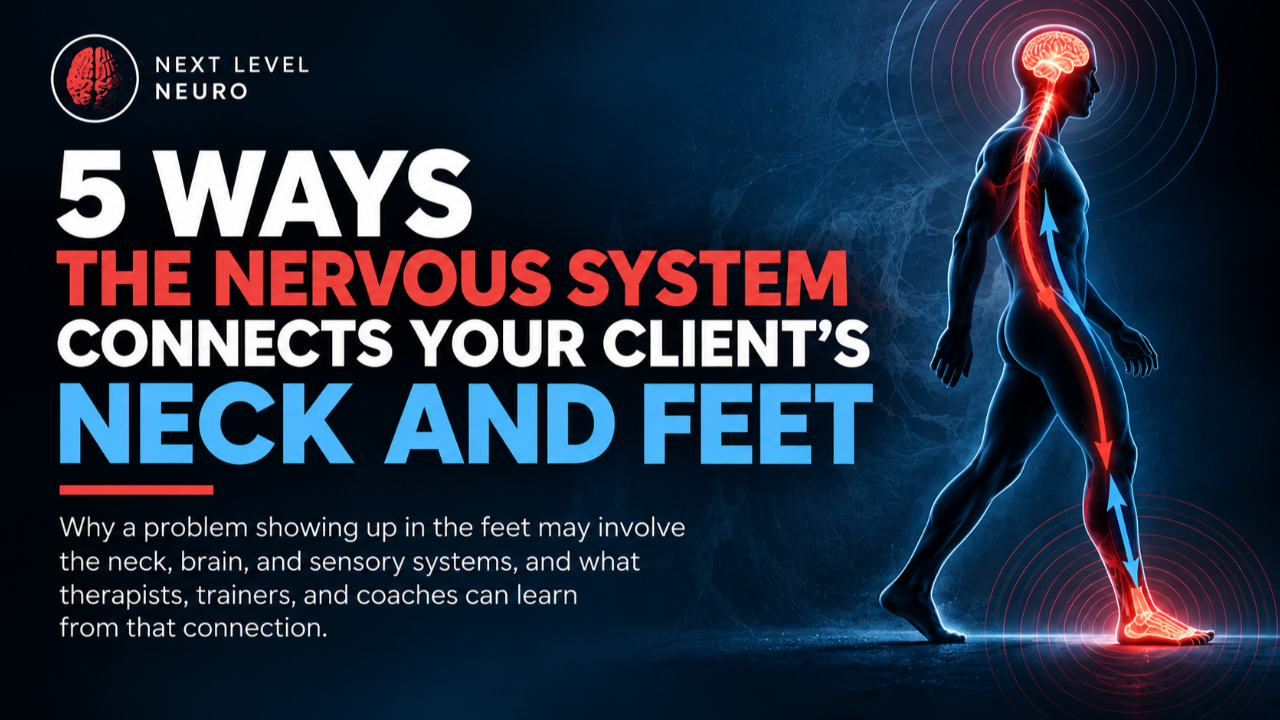
Why a problem showing up in the feet may involve the neck, brain, and sensory systems, and what therapists, trainers, and coaches can learn from that connection.
The Question This Article Answers
How does the nervous system connect the neck and feet, and why does that relationship matter when assessing movement, balance, and stability?
You've all worked with a client who struggles with balance.
Maybe their ankle seems unstable.
It could be that their gait never looks quite right.
Or maybe they perform perfectly well until you ask them to turn their head.
You've assessed their ankle mobility, strengthened their feet, and worked on proprioception.
Traditional biomechanical education often teaches us to look for the problem where the movement breaks down.
If the ankle is unstable, we examine ankle mobility, strength, joint mechanics, and the muscles responsible for controlling it.
And there's nothing wrong with that approach.
But applied neurology asks us to consider another possibility.
What if the problem isn't simply the body's ability to produce the movement, but the nervous system's ability to organize it?
Some things improve, but the problem keeps showing up.
Then you change something that doesn't seem directly related to the feet.
You ask them to turn their head.
Suddenly, their balance changes.
Why?
Because the nervous system doesn't control the neck and feet as two completely independent systems.
Every time your client stands, walks, turns, or changes direction, the brain combines sensory information from multiple regions to help organize movement.
And there are five (5) important neurological connections every practitioner should understand.
The Answer
The neck and feet participate in shared neurological networks involving proprioception, the vestibular system, brainstem pathways, and the cerebellum.
These systems help the brain understand where the head is positioned, what is happening beneath the feet, and how to coordinate movement between them.
Five important parts of that relationship involve…
- Sensory information from the feet.
- Proprioceptive information from the neck.
- Vestibular and brainstem coordination.
- Cerebellar integration of movement.
- The nervous system's ability to adapt its movement strategy.
When something changes within these systems, movement can change too.
And that's why a problem appearing at the foot doesn't always originate at the foot.
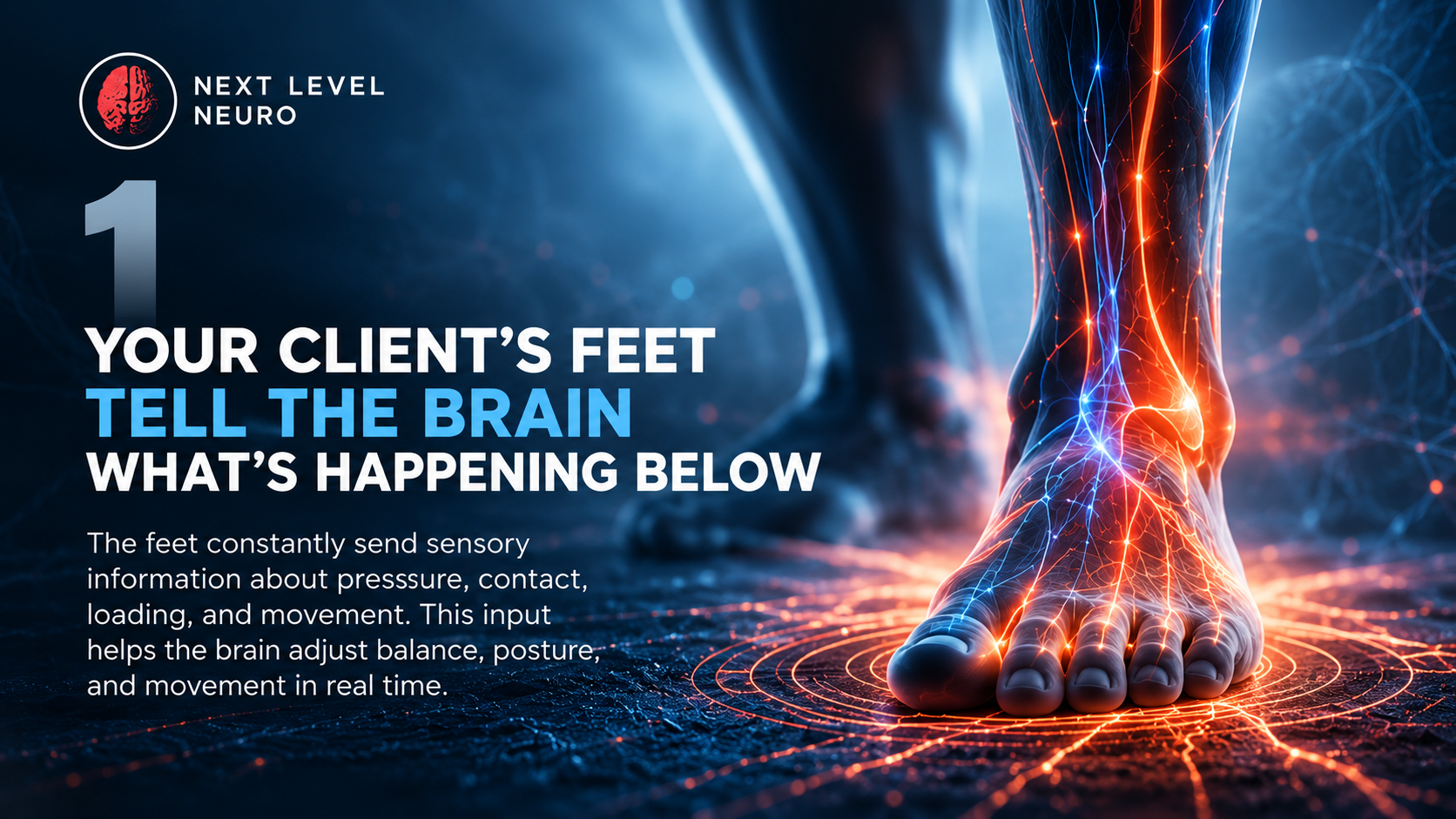
1. Your Client's Feet Tell the Brain What's Happening Below
Your feet do much more than support your body weight.
They constantly send sensory information to the nervous system about pressure, contact, loading, and movement.
Think about walking across a smooth floor compared with walking across uneven ground. Your muscles may be strong enough for both tasks, but the neurological demands are different.
The nervous system must continuously interpret information coming from the feet and adjust movement accordingly.
If that information becomes less reliable, maintaining balance may become more challenging.
What can go wrong?
A practitioner sees poor ankle stability and assumes the client needs more strength.
But muscular strength may not be the only limitation.
The nervous system may be struggling to use the sensory information needed to coordinate the movement.
More strengthening alone may not address that problem.
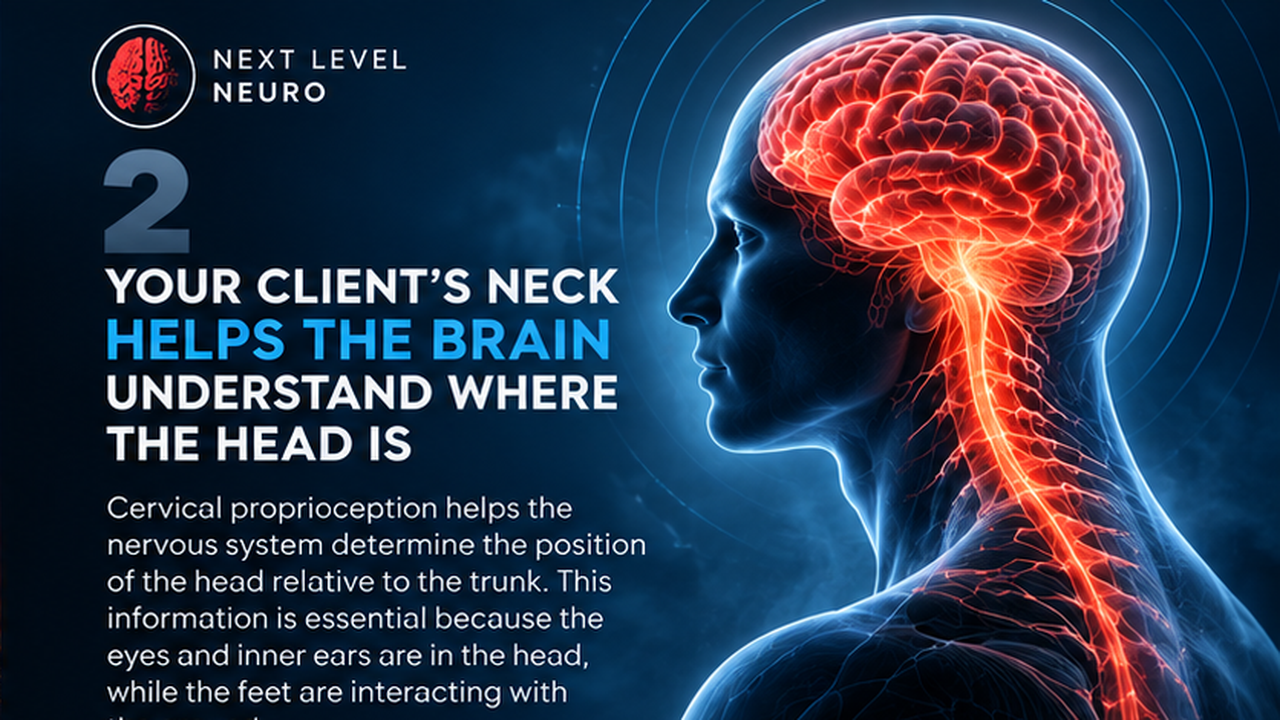
2. Your Client's Neck Helps the Brain Understand Where Their Head Is
The cervical spine contains an important source of proprioceptive information.
Deep cervical muscles help the nervous system determine the position of the head relative to the trunk.
Why does that matter?
Because your eyes and vestibular system are located in your head, but your feet are interacting with the ground.
The brain needs to understand how those different reference points relate to one another.
Imagine standing on one leg while slowly turning your head.
Your foot is still contacting the same surface.
Your ankle hasn't suddenly become weaker.
Yet the sensory demands of the task have changed.
What can go wrong?
A client might maintain balance when looking straight ahead but struggle when turning their head.
The practitioner keeps adding ankle exercises without investigating the client's response to cervical movement.
The problem may involve how sensory information is being integrated rather than ankle strength alone.
We go through a lot of these considerations in our FREE WORKSHOP COURSE - Regulation is the New Strength.
Click here to get it for free.
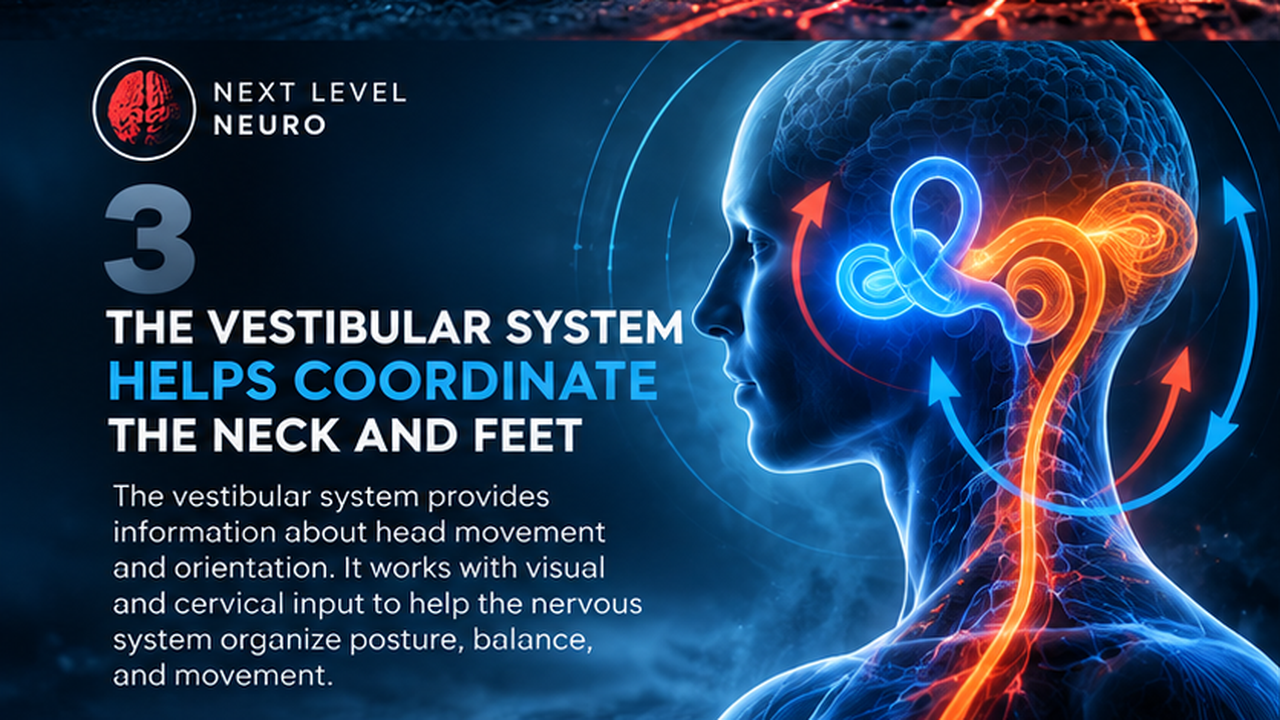
3. The Vestibular System Helps Coordinate the Neck and Feet
Your vestibular system provides information about head movement and orientation.
That information interacts with visual and cervical sensory input to help the nervous system organize posture and balance.
Brainstem pathways contribute to the adjustments needed to keep the head and body stable.
These adjustments can involve muscles throughout the body, including the legs.
Now think about a client who walks comfortably in a straight line but becomes unstable when turning their head or changing direction.
The issue may not be their ability to produce force.
It may be their ability to coordinate movement while managing changing sensory demands.
What can go wrong?
A practitioner makes balance exercises progressively harder by adding head turns, unstable surfaces, and visual challenges.
But more complexity doesn't automatically mean better training.
If the client cannot manage the additional demands, the exercise may reinforce excessive guarding or produce less useful movement.
Sometimes the next step isn't making the drill harder.
It's making the neurological demands more appropriate.
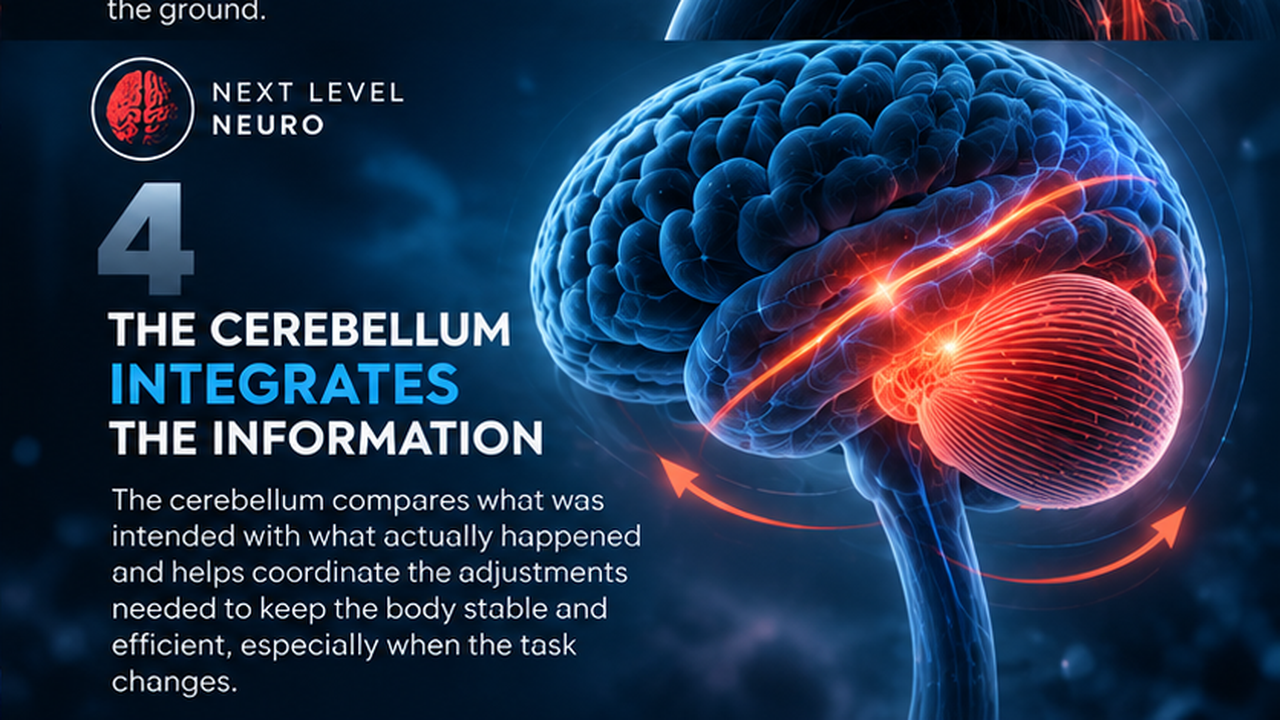
4. The Cerebellum Helps Coordinate the Information
Your cerebellum plays an important role in coordinating movement and updating responses when the outcome differs from what the nervous system expected.
Imagine stepping onto an uneven surface.
Your foot encounters something different from what was anticipated.
The nervous system must adjust the ankle, knee, hip, trunk, and head to maintain balance.
The cerebellum contributes to the coordination of those adjustments using incoming sensory information and predictions about movement.
This is an important understanding for practitioners.
Having enough strength to perform a movement doesn't guarantee the nervous system can coordinate that strength effectively under every condition.
A client may perform well during a traditional strength test but struggle when movement requires rapid adaptation.
What can go wrong?
You keep increasing strength because the client continues to look unstable.
Yet the instability appears primarily when the task requires greater coordination.
The better question may be whether the client can organize the available strength when sensory demands change.
5. The Nervous System Can Change Its Movement Strategy
This may be the most important connection for therapists and trainers to understand.
The nervous system doesn't simply receive information and produce identical movement every time.
It adapts its responses based on the task, available sensory information, previous experiences, pain, fatigue, and other conditions.
Consider someone recovering from an ankle injury.
Even after strength improves, they may continue moving cautiously.
They might reduce push-off, limit trunk rotation, or stiffen their head and neck while walking.
These adjustments can be part of a protective movement strategy.
And protective strategies aren't always limited to the area where the original problem occurred.
What can go wrong?
A practitioner sees the compensation and immediately tries to correct the mechanics.
But the client may be using that movement strategy because it currently feels more manageable or protective.
Forcing a different movement without understanding the underlying demands may not produce lasting improvement.
This is why we continually return to one principle at Next Level Neuro:
Assess the client, change one variable, and reassess the response.
Where the Neuro Advantage Transformation Ladder Changes the Conversation
Understanding these five neurological connections is one thing.
Knowing what to do with that information when a client walks into your clinic or training facility is another.
This is where the Neuro Advantage Transformation Ladder becomes valuable.
Instead of looking only at the movement that's going wrong, the ladder encourages you to investigate the conditions supporting that movement.
Rung 1: Regulation
Is the client's nervous system in a state that supports the task?
Pain, stress, fatigue, or excessive guarding may influence how the client responds to movement challenges.
A client who is already struggling to tolerate a simple task may not benefit from adding more sensory complexity.
What can go wrong: Increasing the challenge before the client can comfortably manage the starting conditions.
Rung 2: Fuel and Input
Is the nervous system receiving useful sensory information, and does the client have the resources to perform the task?
This is where the neck–foot relationship becomes especially relevant.
Cervical proprioception, visual information, vestibular signals, and sensory feedback from the feet all contribute to movement control.
What can go wrong: Assuming poor balance must be caused by weak ankles without investigating other sensory contributions.
To check out the other 3 rings to the ladder, how to implement, when to change, when to decrease, etc., click on The Neuro-Advantage Framework.

4 Mistakes Practitioners Make When They Miss the Neurological Connection
Understanding the relationship between the neck and feet can help you avoid four common mistakes.
Mistake #1: Training Output Without Investigating Input
Poor balance doesn't automatically mean weak ankles.
Before adding more strength or stability exercises, consider whether sensory information or coordination demands may be contributing.
Mistake #2: Assuming Harder Drills Produce Better Results
Adding head movements, visual challenges, or unstable surfaces makes an exercise more demanding.
It doesn't guarantee a better neurological response.
The goal is useful adaptation, not simply greater difficulty.
Mistake #3: Assuming an Immediate Improvement Proves the Cause
Suppose your client's balance improves after a cervical movement drill.
That's interesting information.
But it doesn't prove the neck was the original cause.
Attention, practice, pain modulation, and other factors can influence performance.
The response gives you a clue worth investigating.
Mistake #4: Forgetting to Reassess
You can choose an exercise with an excellent neurological explanation and still get the wrong response for that client.
The drill doesn't tell you whether it worked. The client's response does.
How to Assess the Neck–Foot Connection With Your Next Client
You don't need to begin with a complicated neurological examination.
Start with a relevant, repeatable movement assessment.
Step 1: Establish a baseline.
Choose something meaningful, such as single-leg balance, walking, or another movement the client finds difficult.
Step 2: Change one variable.
When appropriate, introduce a small, comfortable change in head position or another relevant sensory demand.
Step 3: Reassess.
Does the original movement improve, worsen, or stay the same?
Step 4: Investigate the response.
Can you reproduce the change? What happens when you modify the task or return to the original conditions?
Step 5: Let the response guide your next decision.
You may need to simplify the task, investigate another input, address local capacity, or progress the challenge.
The point isn't to prove that the neck is responsible for the foot problem.
It's to understand which variables may be influencing the client's movement.
These observations complement, rather than replace, an appropriate clinical examination. Progressive walking difficulty, new weakness, or hand clumsiness accompanying neck symptoms warrants medical evaluation.
Stop Looking at Movement Problems in Isolation
The foot helps your nervous system understand the ground.
The neck helps it understand the position of the head.
Your visual and vestibular systems provide additional information, while the brain and spinal cord coordinate the responses needed to move.
When those systems interact differently, movement can change.
That doesn't mean every foot problem begins in the neck.
It means the movement you're observing may be influenced by more than the muscles and joints you can see.
And that is one of the most useful lessons applied neurology can teach practitioners.
A good plan can still be wrong for the moment.
The better approach is to establish a baseline, investigate relevant inputs, change one variable, and reassess.

Ready to Start Thinking Like an Applied Neurology Practitioner?
Discover the Neuro Advantage for $37
The Neuro Advantage introduces a practical framework for looking beyond symptoms and movement compensations.
Learn how to use the Transformation Ladder to organize your thinking, recognize the importance of nervous system regulation and sensory input, and begin applying assess-and-reassess principles with your clients.
Frequently Asked Questions
1. Can a Neck Problem Actually Affect Foot Function?
Yes. Cervical proprioceptive information contributes to postural control and movement coordination. Changes in that information can sometimes influence balance and lower-body performance, even when the foot itself hasn't changed.
2. Does Every Ankle or Balance Problem Start in the Neck?
No. Local injury, strength, mobility, sensory function, and many other factors can contribute. The cervical spine is one potential influence, not the automatic explanation for a movement problem.
3. Why Might a Client Balance Well Until They Turn Their Head?
Head movement changes the sensory demands of the task. The nervous system must integrate information from the neck, vestibular system, eyes, and supporting surface while maintaining balance. That additional demand may reveal a coordination difficulty.
4. Can Strength Training Alone Fix a Neurological Coordination Problem?
Strength training can contribute to improved movement and motor learning, but greater muscular capacity doesn't necessarily address every sensory or coordination challenge. The appropriate intervention depends on the individual's assessment and response.
5. How Does the Neuro Advantage Transformation Ladder Help Practitioners?
The ladder encourages practitioners to consider regulation, fuel, sensory input, integration, output, and increasing task complexity.
Rather than assuming the visible movement problem identifies its cause, practitioners use the framework to develop better assessment questions and guide appropriate training decisions.
Want more information on our Mentorship
and Programs?
We hate SPAM. We will never sell your information, for any reason.