7 Reasons You're Missing Out by Not Adding Applied Neurology to Your Training
Oct 21, 2026
From pain and performance to vision, balance, and proprioception, discover seven ways understanding the nervous system can improve how you assess, train, and treat your clients.
The Question This Article Answers
Why should trainers, therapists, and rehabilitation professionals incorporate applied neurology into their training and treatment programs?
The Answer
Applied neurology helps practitioners understand how the nervous system influences movement, strength, balance, coordination, pain, and performance. By considering the visual, vestibular, and proprioceptive systems, along with cranial nerve function, nervous system regulation, and individual responses to neurological inputs, practitioners can develop a more complete understanding of why clients struggle with certain movements or fail to respond to conventional training.
These seven reasons are what we think you should consider when adding applied neurology to your practice.
The goal isn't to replace traditional strength training, mobility work, or rehabilitation. It's to add another layer of assessment that can help practitioners make more informed decisions about the clients in front of them.
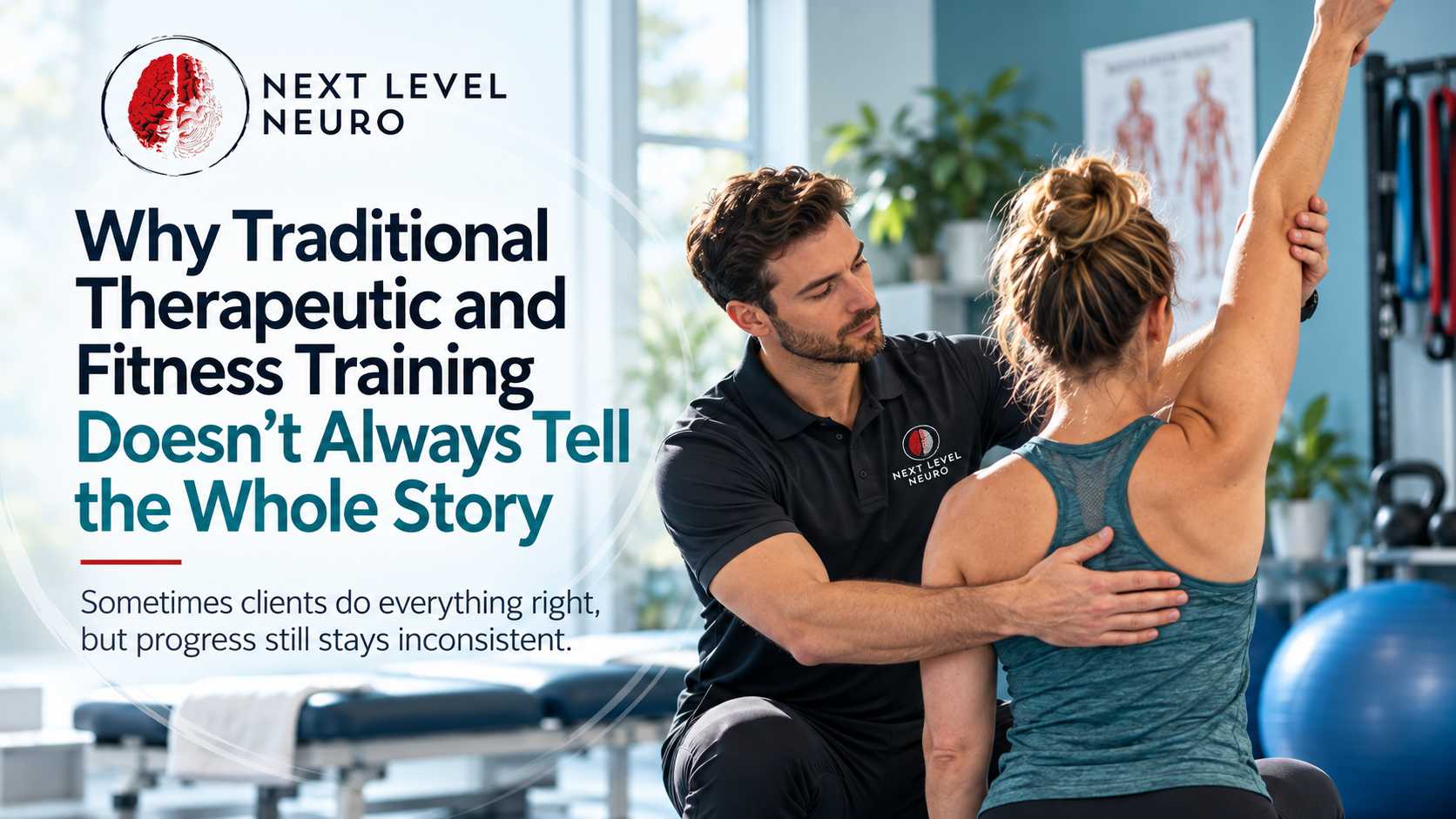
Why Traditional Therapeutic and Fitness Training Doesn't Always Tell the Whole Story
You've probably worked with a client who seemed to have everything they needed to improve.
Their strength was increasing.
All mobility assessments looked good.
They were consistent with their exercises and following the program.
But, as with many clients, certain things just weren't changing.
- Balance remained unpredictable - One session they were stable and confident. The next, they struggled with the same movements.
- Mobility improvements didn't last - Their shoulder range of motion improved during the session but returned to its previous limitations a few days later.
- Exercises produced inconsistent results - A drill that worked beautifully last week suddenly caused discomfort, tension, or hesitation.
- Progress started to plateau - Despite consistent effort and good programming, their strength, mobility, or performance wasn't improving as expected.
So what do you do when your client is doing everything right, but the results aren't following?
Naturally, you start looking at the program.
- Should you increase the resistance?
- Change the exercise?
- Add more repetitions?
- Introduce another mobility drill?
That is a reasonable biomechancial thought process.
But what if the problem isn't necessarily the exercise you've selected?
What if you're overlooking some of the neurological information the client needs to perform the movement effectively?
Strength, mobility, and technique are important. But they're only part of a much larger neurological process.
Before we look at strength, balance, or movement limitations, let's start with something many practitioners rarely consider during their assessments.
The neurological pathways that help make movement possible in the first place.
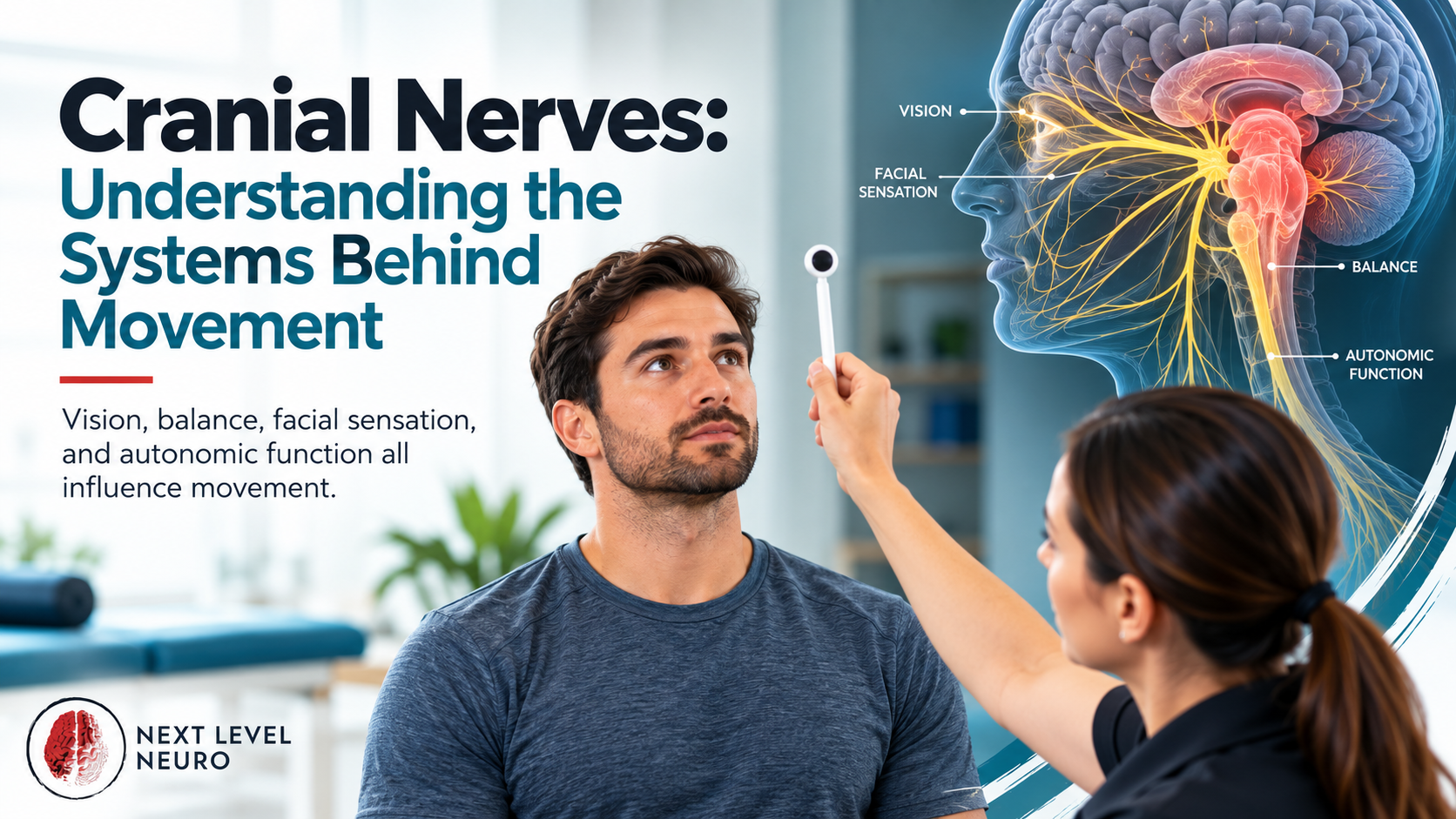
1. Cranial Nerves: Understanding the Systems Behind Movement
Most trainers and therapists spend considerable time studying muscles, joints, movement patterns, and exercise programming.
But how often do they consider the neurological pathways contributing to those movements?
The twelve pairs of cranial nerves carry important sensory, motor, and autonomic information.
They contribute to several functions we depend on every day, including:
- Vision and eye movement: Helping us process visual information and coordinate eye movements.
- Hearing and balance: Supporting our ability to detect sound, maintain equilibrium, and understand head movement.
- Facial sensation and movement: Allowing us to feel sensations in the face and control facial expressions.
- Swallowing and speaking: Helping coordinate muscles involved in swallowing, vocalization, and related functions.
- Autonomic regulation: Contributing to functions such as heart rate, digestion, and other internal processes.
For practitioners studying applied neurology, understanding these systems provides another perspective on how sensory information and motor control interact.
Consider something as simple as moving your head while keeping your eyes focused on an object.
That seemingly effortless task requires coordination between visual and vestibular pathways to help maintain stable vision.
And it's one example of why understanding the nervous system can add another layer to how we assess movement, balance, and performance.
Understanding these relationships can help explain why seemingly simple activities involve multiple neurological systems working together.
This doesn't mean trainers should diagnose cranial nerve dysfunction or assume that stimulating a cranial nerve will automatically improve performance.
It means developing the anatomical and functional understanding needed to recognize relevant patterns, stay within professional scope, and know when referral is appropriate.
What to investigate:
Which sensory and motor pathways contribute to the task you're assessing, and does the client show signs that warrant a more specialized evaluation?
Understanding these neurological pathways gives us a broader picture of how the nervous system contributes to movement.
But what happens when a client has the muscular strength to perform an exercise, yet pain or changes in performance continue to limit what they can do?
That's where our next consideration becomes important.
2. Pain Relief and Performance: Look Beyond the Muscles
When a client experiences pain or struggles to produce force, most practitioners investigate the muscles, joints, mobility, and surrounding tissues.
And they should.
But pain and movement are also influenced by the nervous system's processing of sensory information, previous experiences, expectations, and perceived demands.
Consider a client whose shoulder strength decreases when their arm moves into a particular position.
Does that automatically mean the muscle is weak?
Not necessarily.
Hang with us for a second.
Changes in joint position can affect mechanical demands, coordination, comfort, and the sensory information available to the nervous system.
This is where applied neurology encourages practitioners to become curious.
Rather than assuming the answer is always more strengthening, you begin investigating why performance changes across positions and conditions.
Perhaps altering a sensory demand changes the original assessment.
Perhaps it doesn't.
Either response helps you decide what to investigate next.
What to investigate:
Does the client's strength, discomfort, or coordination change when you modify one relevant variable while keeping the assessment as consistent as possible?
Pain and strength are two areas where neurological influences can be worth investigating.
But what about the client who isn't experiencing pain and has adequate strength, yet still struggles to maintain balance?
Now we need to consider where the nervous system gets its information about head movement and orientation.
3. The Vestibular System: Balance Is More Than Strong Ankles
A client struggles with single-leg balance.
Your immediate thought might be ankle strength, hip stability, or core control.
Those are important contributors.
But have you considered the vestibular system?
Located in the inner ear, the vestibular system detects head movement and orientation relative to gravity.
The brain integrates this information with visual and proprioceptive input to help maintain balance, stabilize vision, and coordinate movement.
That's why head position and movement can influence how stable someone feels during a particular exercise.
For example, a client might perform a balance assessment reasonably well while looking straight ahead but struggle when turning their head.
That doesn't automatically identify a vestibular disorder.
It does, however, provide information about how additional demands affect their performance.
Instead of prescribing more balance exercises without investigating why the client struggles, you now have another variable worth exploring.
What to investigate:
Does changing head position or introducing an appropriate head movement change the client's original balance assessment? Stop if symptoms such as significant dizziness occur, and refer for appropriate evaluation when indicated.
The vestibular system doesn't work alone.
It continuously interacts with visual and proprioceptive information to help us maintain balance and coordinate movement.
Which raises another question: What happens when the visual information a client depends on changes?
4. The Visual System: What If the Problem Isn't Where You're Looking?
A client has difficulty maintaining balance, so you prescribe stability exercises.
Another struggles with movement coordination, so you adjust their technique.
But when was the last time you considered whether visual demands were influencing either assessment?
Vision does much more than help us recognize objects.
It provides information about our environment, movement, distance, spatial orientation, and the relationship between our bodies and the world around us.
That information contributes to how the nervous system organizes movement.
Consider the difference between balancing with your eyes open and balancing with your eyes closed.
The muscles haven't suddenly become weaker.
You've changed the sensory information available to help maintain stability.
Now consider how visual tracking, gaze stabilization, or the complexity of the visual environment might influence a challenging movement.
These are additional factors practitioners can investigate when appropriate.
Visual function doesn't explain every movement limitation, and visual exercises aren't automatically the solution.
But ignoring visual demands altogether means potentially overlooking information relevant to the client's performance.
What to investigate:
Does modifying visual demand or gaze position change the client's balance, coordination, or movement assessment?
Vision helps us understand where we are in relation to our environment.
But here's something worth thinking about further.
You can close your eyes and still know where your arms and legs are positioned.
How?
Because your nervous system has another important source of information.
Proprioception.
5. Proprioception: Your Client May Be Missing Critical Movement Information
A client can have strong muscles, good mobility, and an excellent training program yet still struggle with movement control.
Why?
Because strength doesn't operate independently of sensory information.
The nervous system relies on proprioception to help determine where body parts are positioned and how they're moving, even when you aren't looking at them.
This information contributes to coordination, joint positioning, postural control, and the adjustments needed during movement.
Think about a client who repeatedly loses stability during a single-leg exercise.
You might immediately prescribe more ankle, hip, or core strengthening.
But what if changing the sensory information available from the foot, ankle, or surrounding joints influences their ability to perform the task?
That's an important question because the nervous system needs more than muscular force to coordinate movement.
It also needs information about what's happening throughout the body.
By understanding proprioception, you gain another way to investigate movement difficulties instead of assuming every stability problem requires more strength.
What to investigate:
Can you modify one proprioceptive demand and then reassess the client's stability or coordination?
We've now explored several important sources of neurological information that influence movement, balance, coordination, and performance.
But there's another consideration that can influence how a client responds to all of them.
The state of their nervous system at the moment you introduce an exercise.
A client might have adequate strength, useful sensory information, and the physical capacity to perform a movement.
Yet fatigue, pain, stress, or excessive task demands may still interfere with their performance.
And that's why nervous system regulation deserves our attention.
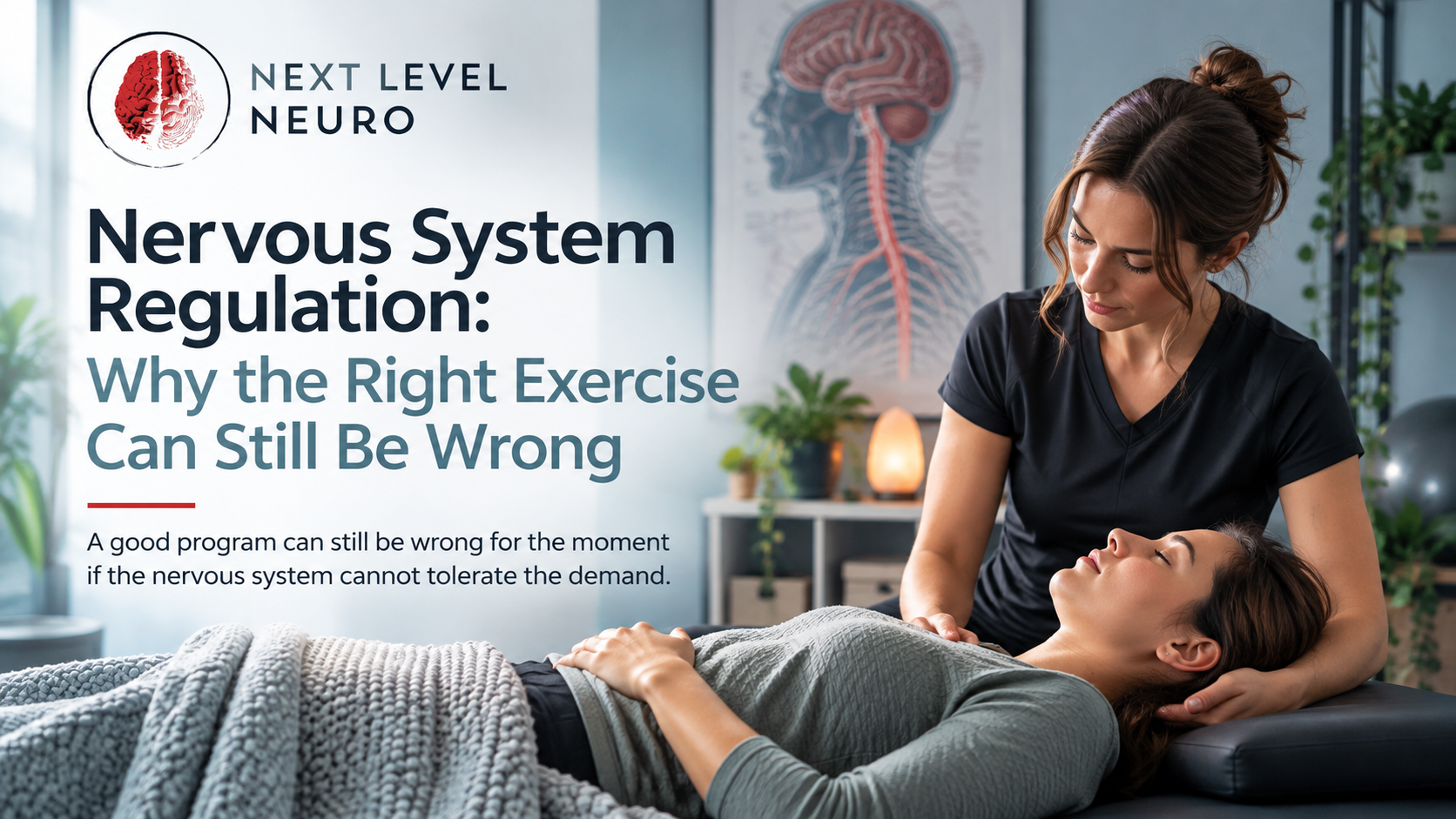
6. Nervous System Regulation: Why the Right Exercise Can Still Be Wrong
You can choose the right exercise, use the appropriate resistance, and build an excellent training or rehabilitation program.
But what happens when the client's nervous system isn't responding well to what you're asking it to do?
Several factors can influence how a client responds, even when the program itself is appropriate:
- Poor Sleep: Can affect coordination, reaction time, concentration, and the ability to recover from training.
- Fatigue: May reduce movement precision, stability, and the capacity to tolerate additional physical demands.
- Pain: Can influence muscle activation, movement strategies, and how the nervous system responds to certain positions or exercises.
- Stress: Can affect attention, muscle tension, breathing patterns, and the ability to process additional sensory demands.
- Sensory Overload: Too much visual, vestibular, or proprioceptive demand at once can make an otherwise manageable exercise more challenging.
The important takeaway is that a good program can still be wrong for the moment.
That's why understanding the client's current state, adjusting the demands, and reassessing their response can be just as important as choosing the exercise itself.
At Next Level Neuro, we teach a foundational principle:
Regulate Before You Activate.
Regulation doesn't mean every client needs to relax or become calm before exercising.
It means recognizing that the nervous system needs to respond appropriately to the demands being placed on it.
Depending on the client, that might mean…
- Reducing Complexity: Simplifying an exercise when the nervous system is struggling to coordinate multiple demands.
- Adjusting Intensity: Lowering the speed, resistance, or repetitions when the client isn't tolerating the current workload.
- Managing Sensory Input: Reducing visual, vestibular, or proprioceptive challenges when additional input is making performance worse.
- Increasing Activation: Introducing an appropriate level of movement or stimulation when the client needs more activation to perform effectively.
- Reassessing the Response: Testing whether the adjustment improved strength, mobility, balance, or another meaningful output.
The goal isn't to keep the nervous system calm. It's to help it become more adaptable.
And that's where one of our most important principles comes into play:
A good exercise can still be wrong for the moment.
What to investigate:
Before increasing the training challenge, consider how fatigue, discomfort, stress, and the complexity of the task may influence your client's response.
Want to Understand Nervous System Regulation Before Your Next Session?
Understanding nervous system regulation changes the way you think about exercise selection.
Instead of asking only, "What's the best exercise for this problem?" you begin asking, "What's appropriate for this client right now?"
Then we have to ask the follow up after you choose the appropriate near drill.
…”How do I know it was appropriate?”
This is the key to complete client care and modality choice. No matter what modality you choose to implement.
A well-designed intervention can produce a poor response when the demands exceed what the client can comfortably manage.
If you're new to applied neurology, regulation is one of the best places to begin.
In our FREE Nervous System Regulation Workshop, you'll explore how nervous system state can influence movement and performance, why some clients struggle with neurological inputs, and how to begin recognizing when regulation should come before additional activation.
Watch the Free Nervous System Regulation Workshop →
That leads us to answering the question, “How do you know the choice worked?”
Enter the Neuro Assess and Reassess
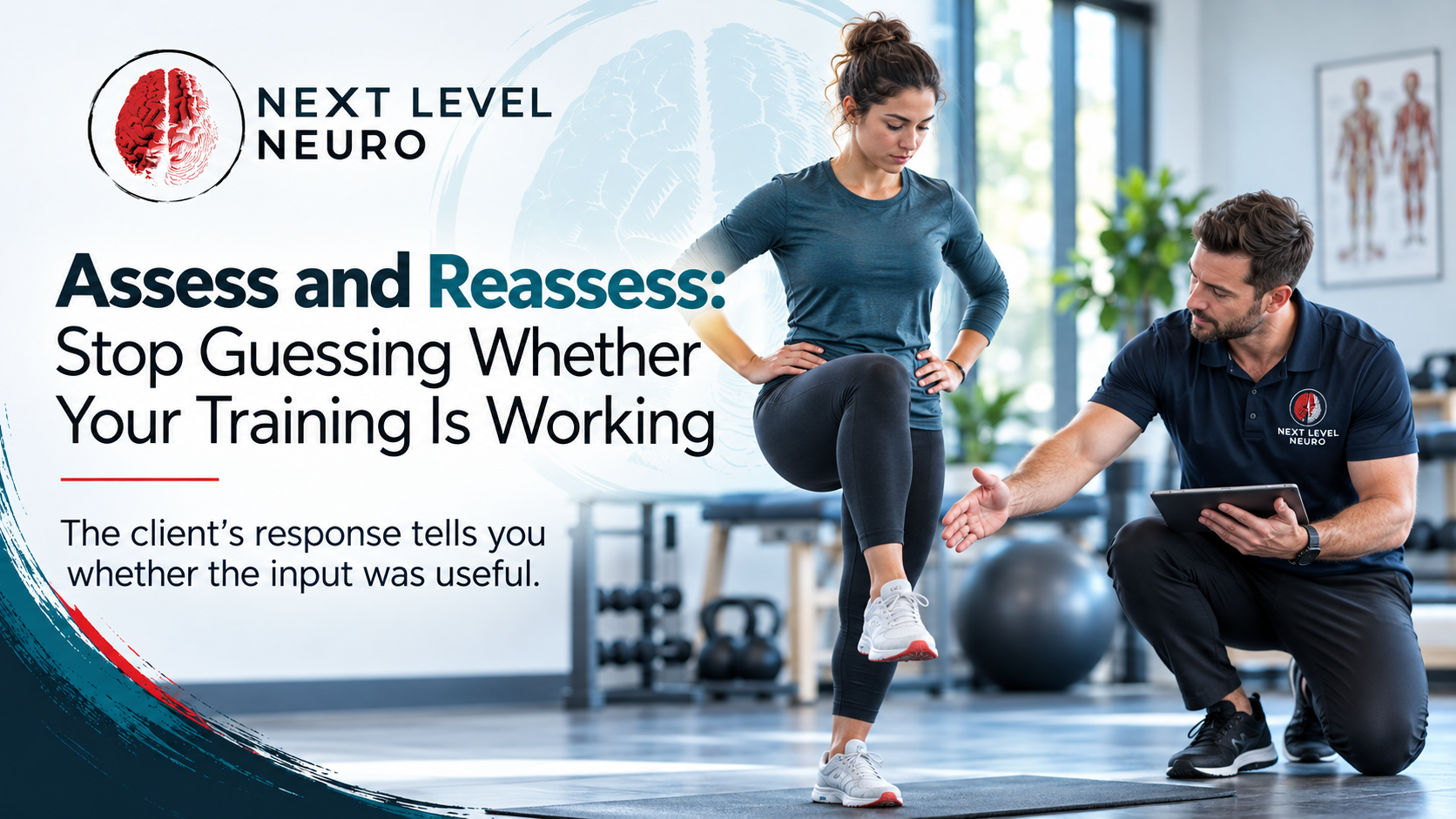
7. Assess and Reassess: Stop Guessing Whether Your Training Is Working
We've explored cranial nerves, pain and performance, the vestibular system, vision, proprioception, and nervous system regulation.
That's a lot of information to consider when working with a client.
But here's where many practitioners make a mistake.
They learn about these neurological systems, collect a handful of drills, and start adding them to their clients' programs.
The problem? Understanding a neurological system doesn't automatically tell you which intervention your client needs.
And performing a neurological drill doesn't necessarily mean it worked.
That's why the most important skill may not be knowing more neurological exercises.
It may be knowing how to assess the client's response.
This is one of the most important principles we teach throughout Next Level Neuro.
Baseline → Input → Reassess
Step 1: Establish a baseline.
Choose a meaningful assessment related to the client's primary limitation.
It might be range of motion, strength, balance, coordination, or another functional movement.
Document the initial response as consistently as possible.
Step 2: Introduce one appropriate neurological input.
Choose an input related to the question you're investigating.
Keep the intervention simple and change one meaningful variable whenever possible.
Step 3: Reassess the original movement.
Return to the same baseline assessment.
Ask yourself:
- Did the movement improve?
- Did it become more difficult?
- Did the client feel more stable or coordinated?
- Did discomfort increase or decrease?
- Can you reproduce the response when you test it again?
An immediate change doesn't prove you've identified the underlying cause or guarantee lasting improvement.
But it can provide useful information to guide your next decision.
This is where applied neurology becomes more than memorizing neurological drills.
Instead of choosing an exercise because you've heard it works, you're learning how to evaluate whether an intervention is appropriate for the client in front of you.
The drill doesn't tell you whether it worked. The client's response does.
The Real Advantage Isn't Knowing More Neurological Drills
It's knowing what to investigate.
A client struggles with balance. You consider whether vestibular, visual, or proprioceptive demands may be influencing the task.
A client responds poorly to an exercise. You consider their current nervous system state and whether the demands are appropriate.
A client experiences an immediate improvement after a neurological input. You reassess to determine whether the change is meaningful, repeatable, and relevant to their goals.
That's the difference between adding random neurological drills to your training program and beginning to think like an applied neurology practitioner.
You're not replacing the strength, mobility, or rehabilitation methods you already use.
You're adding another level of understanding that can help you make better decisions.
The seven areas we've explored give practitioners new ways to investigate why clients struggle with movement, balance, strength, or performance.
But there's a difference between understanding what might influence a client's performance and knowing what to do with that information.
Which system should you investigate first?
What neurological input makes sense for this client?
How do you decide whether to progress, modify, or change your approach?
These are the questions a structured applied neurology framework should help you answer.
And that's exactly why we created The Neuro Advantage.
Ready to Start Applying Neurology With Your Clients?
Understanding these seven areas is one thing.
Knowing where to begin, which neurological input to investigate, and how to determine your next step is another.
That's exactly what The Neuro Advantage was designed to help you do.
For just $37, you'll learn our practical five-step framework for applying neurology to the training and rehabilitation methods you're already using.
The Neuro Advantage helps you:
- Understand where to start with clients.
- Recognize which neurological factors may deserve attention.
- Choose appropriate neurological inputs rather than guessing.
- Use assess and reassess to guide your decisions.
- Develop a more structured approach to complex movement and performance challenges.
You don't need hundreds of neurological drills to start.
You need a clear framework that helps you understand what to do, when to do it, and why.
Explore The Neuro Advantage | $37 →
FAQ
1. What is applied neurology in fitness and rehabilitation?
Applied neurology involves using knowledge of nervous system function to inform assessments and interventions related to movement, balance, coordination, and performance.
Practitioners may consider visual, vestibular, proprioceptive, and other neurological influences when developing training or rehabilitation strategies.
It is best understood as an additional perspective that can complement established exercise and rehabilitation practices rather than a replacement for them.
2. Do I need to be a neurologist to use applied neurology in my training practice?
No. Trainers, therapists, and movement professionals can study relevant neuroscience and apply appropriate principles within their professional scope.
However, neurological diagnosis, treatment of neurological disorders, and certain clinical tests require specific professional training and qualifications.
Recognizing when to refer a client is an important part of responsible practice.
3. Can applied neurology help improve strength and balance?
Potentially. The nervous system is involved in force production, coordination, balance, and movement control.
Understanding sensory and motor contributions to a task can help practitioners identify additional factors worth assessing.
Whether a particular neurological intervention improves an individual's performance must be evaluated rather than assumed.
4. What are the visual, vestibular, and proprioceptive systems?
The visual system provides information about the environment, movement, and spatial relationships.
The vestibular system provides information about head movement and orientation relative to gravity.
The proprioceptive system provides information about body position and movement through sensory receptors in muscles, tendons, and joints.
The nervous system integrates information from these systems to support coordinated movement and postural control.
5. Why might a client respond differently to the same exercise from one session to the next?
Sleep, fatigue, pain, stress, recovery, familiarity, attention, and environmental conditions can all influence exercise performance.
These factors may change movement quality, coordination, tolerance, and the client's response to training.
That's one reason establishing a baseline and reassessing the response can be useful when making programming decisions.
6. How do I know whether a neurological drill is working?
Start with a meaningful baseline assessment. Introduce an appropriate intervention and reassess the original task under similar conditions.
Look for relevant, repeatable changes in performance, comfort, coordination, or movement quality.
Immediate improvements can be useful observations, but they don't necessarily identify the mechanism responsible or predict long-term outcomes.
Repeated assessments and functional progress matter.
7. What's the difference between nervous system regulation and neurological activation?
Nervous system regulation refers broadly to how the nervous system adapts and responds to internal and external demands.
Activation generally refers to increasing activity or readiness in a particular system or task.
Depending on the client's state and goals, an intervention might need to reduce excessive demand, increase appropriate engagement, or modify sensory complexity.
The goal isn't simply to calm or stimulate the nervous system. It's to select demands that support the intended activity.
8. Where should I start if I want to add applied neurology to my practice?
Start by developing a better understanding of nervous system regulation, sensory contributions to movement, and the value of establishing a baseline before introducing an intervention.
Rather than collecting hundreds of neurological exercises, focus on learning a structured process for assessing the client, selecting appropriate inputs, and evaluating the response.
The Next Level Neuro Regulation Workshop introduces an important foundation, while The Neuro Advantage provides a practical five-step framework for beginning to integrate applied neurology into your existing practice.
Want more information on our Mentorship
and Programs?
We hate SPAM. We will never sell your information, for any reason.