
Why a Negative Reassessment Can Show You Where to Start
Sep 23, 2026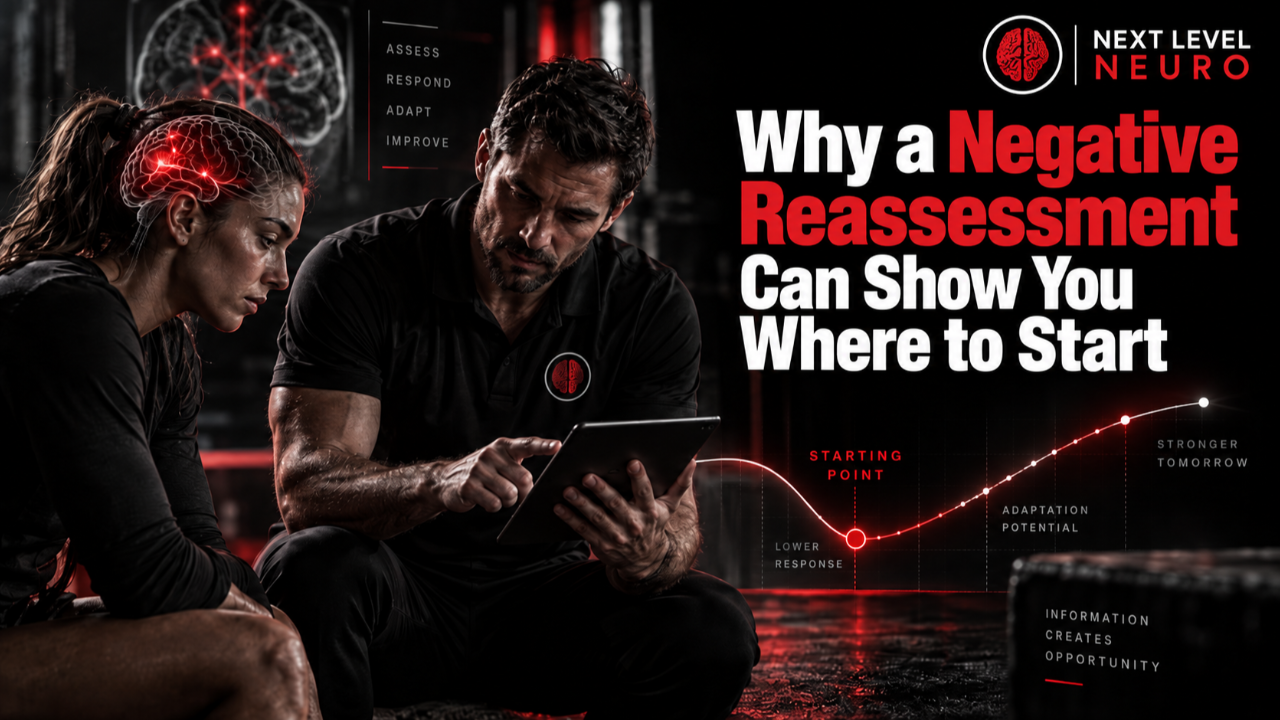
Sometimes the nervous system gives you more information when you carefully find its limit than when you keep trying to make every input feel better.
We had one of those clients who just didn't fit into any of the rules on our framework ladder.
If you've been doing this work long enough, you probably know exactly what I mean.
We assessed.
Decided on our first input.
An input we were very confident about based on our assessment.
We reassessed.
Nothing.
So we changed the input.
Reassessed again.
Nothing.
We tried another direction.
Then another.
Still nothing.
The reassessments weren't getting worse, which normally would have given us useful information.
They weren't getting better either.
They were just flat.
And that can be one of the most frustrating places to find yourself as a practitioner because you're not getting enough information from the nervous system to know where to go next.
Eventually, we had to change our thought process.
Our first line of thinking, which holds true a lot of the time, is,
"What can we give this nervous system to make the assessment better?"
In this case, we changed our perspective, and we think it’s worth talking about.
"Can we find an input that makes the assessment clearly worse?"
That probably sounds backward and completely against our views on regulation.
But is it?
Why would we intentionally give someone more neurological input when so much of what we teach at Next Level Neuro is about improving regulation?
Why would we intentionally look for a negative response?
Were we purposely dysregulating the client?
In a sense, we were deliberately increasing the challenge.
But dysregulation was not the goal.
Information was.
And that is a different way to look at the situation that looking for a positive assessment.
Here are some thoughts.
Regulation Does Not Mean Keeping Someone Calm
This is one of the biggest ideas we teach in our Regulation Is the New Strength workshop.
We define regulation as the ability of the nervous system to remain balanced and adaptive under changing circumstances.
That does not mean staying calm all the time.
A regulated nervous system needs to be able to:
- Mobilize when the situation requires more energy or output.
- Increase intensity when the demand increases.
- Adapt when the environment or task changes.
- Recover when the demand is over.
- Return toward baseline instead of remaining stuck in a heightened state.
- Move between higher and lower states of activation without losing control of the system.
That is why regulation is less about being calm and much more about being adaptable.
In the example we have used, we were seeing if the system can change states appropriately without getting stuck.
That perspective shift becomes very important here.
If regulation simply meant making someone calmer and calmer, then intentionally increasing neurological challenge would make very little sense.
But if regulation is about adaptability, then eventually we have to know:
How much can this nervous system adapt to before its output begins to deteriorate?
Now we have a very different question to work from.
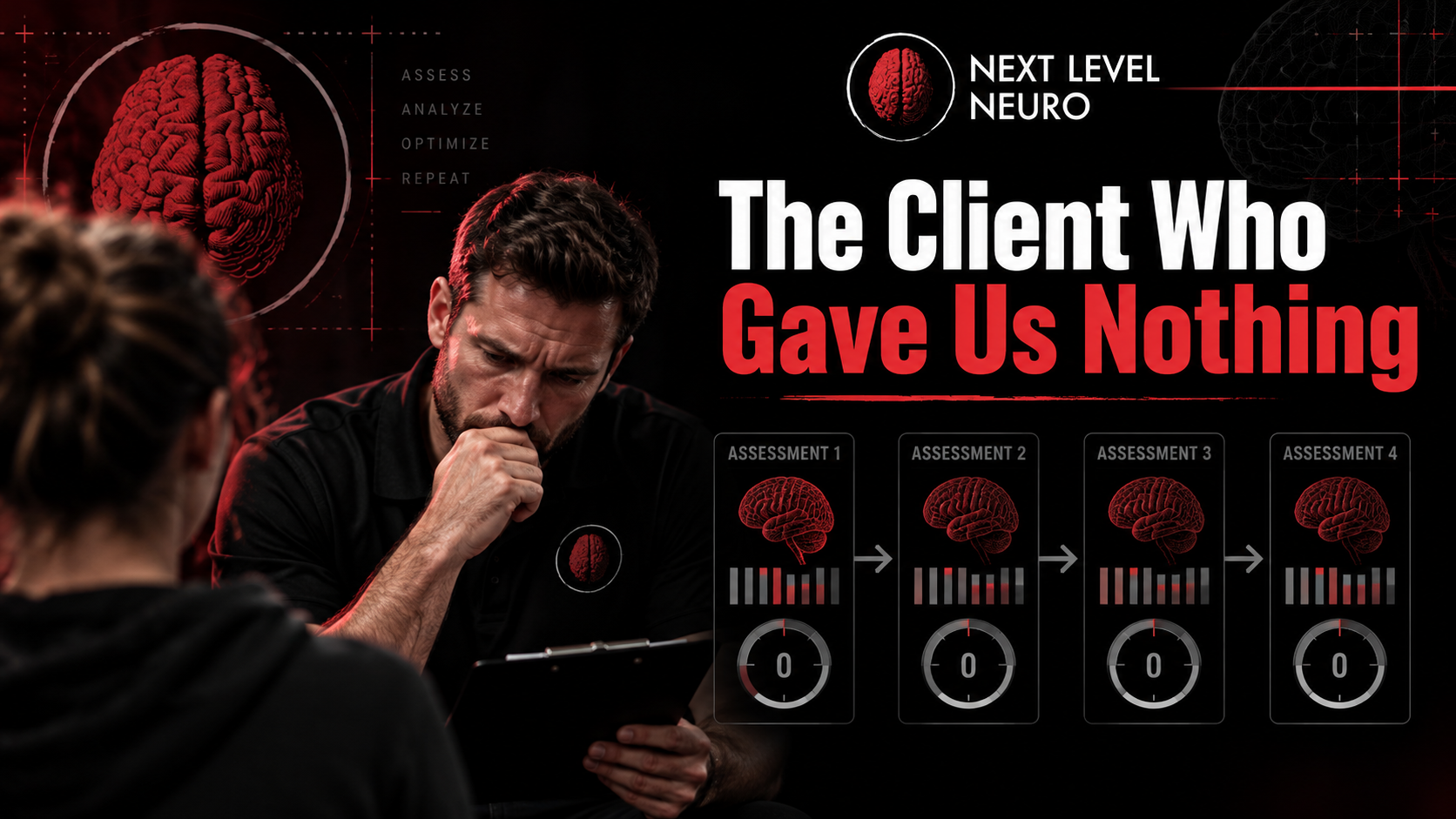
The Client Who Gave Us Nothing
Let's go back to that difficult client.
Our normal process at Next Level Neuro is simple:
Assess → apply an input → reassess.
One of the reasons we love this framework is that we don't have to guess whether an input is useful.
We can ask the nervous system.
If an output improves, we have evidence that the input may be useful.
If the output gets worse, that is useful information too. In the Regulation workshop, we specifically teach that a negative reassessment doesn't automatically mean the drill itself is "bad." It means we need to understand or modify the stimulus for that individual.
But what happens when you get neither?
That's where this particular client had us stuck.
Every attempt to create a positive shift gave us virtually the same answer.
Flat.
So we chose an area we suspected might be relevant and deliberately gave the nervous system more input than we normally would have started with.
And finally something happened.
The reassessment got worse.
That might sound like failure.
For us, it was the first useful information we had gotten.
We finally knew that the nervous system could respond to that input.
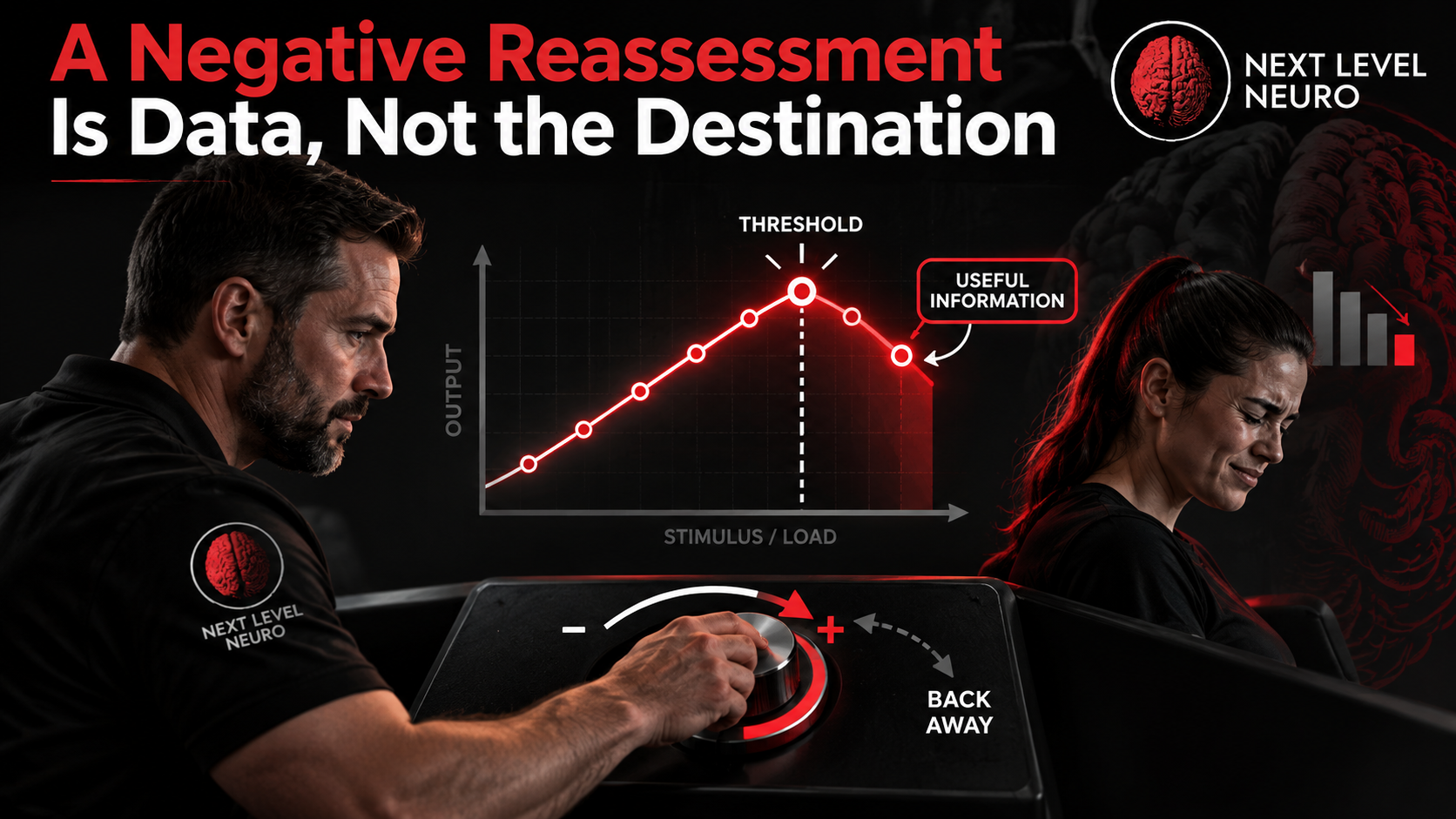
More importantly, we had found a point where its ability to process that input began to break down.
Now we had a line.
And once you find the line, you can begin working backward.
Sometimes You Need to Find the Edge Before You Can Find the Starting Point
This idea isn't unique to Applied Neurology.
Medicine and rehabilitation already use versions of it.
Consider concussion rehabilitation.
The Buffalo Concussion Treadmill Test progressively increases exercise demand until a defined symptom-exacerbation threshold is reached. That threshold provides information about the person's exercise tolerance. Exercise can then be prescribed below that threshold rather than simply telling someone to exercise more or avoid exercise altogether.
Think about what is happening there.
The clinician isn't trying to make the concussion worse.
They're increasing demand until the system reveals its current limit.
The provocation gives them information.
Vestibular rehabilitation provides another example.
Habituation exercises may systematically expose someone to a movement or visual stimulus that provokes symptoms. The goal isn't to overwhelm the individual. The stimulus is controlled, and clinical guidelines describe exposures that produce mild to moderate symptoms and are repeatedly trained so the response can diminish over time.
Balance testing uses another version of the same principle.
The Sensory Organization Test alters or removes available sensory information across different conditions. Vision may be removed or made unreliable. Somatosensory information from the support surface may be altered. As conditions become more difficult, changes in postural stability can reveal how sensory information is contributing to balance.
In every case, the underlying idea is similar:
Sometimes you have to challenge a system to see where it stops adapting successfully.
That is very different from recklessly overwhelming it.
A Negative Reassessment Is Data, Not the Destination
This is where we shouldn’t have to write, but we are going to write.
We are not suggesting that practitioners should start hammering their difficult clients with neurological input until something goes wrong.
That's not the lesson.
In fact, that would contradict much of what we teach.
Inside the free workshop Regulation Is the New Strength, we repeatedly teach practitioners that when a client responds negatively, the answer is often to make the input smaller.
That might mean:
- Reduce the duration.
- Decrease the number of repetitions.
- Lower the intensity.
- Decrease the complexity.
- Make the movement slower.
- Reduce the amount of sensory input.
- Make the experience more predictable.
- Give the nervous system more control over the task.
For example, if a breathing drill makes the reassessment worse, the answer is not necessarily to push the client through a longer or more demanding breathing pattern.
Instead, you might shorten the breath, reduce the number of repetitions, decrease the duration, or simplify the task until the nervous system can process the input successfully.
So why would we ever intentionally go in the opposite direction?
Because assessment and training are not always the same thing.
During training, I'm generally trying to find a dose the nervous system can successfully integrate.
With an assessment, there may be circumstances where I intentionally increase the challenge briefly because I'm trying to discover where successful integration stops.
Once I've found that point, I don't necessarily keep training there.
I may back off immediately.
That threshold has simply given me a new piece of information.
I Would Call This Threshold Mapping
I wouldn't present this as a new diagnostic test.
And I wouldn't tell a practitioner that a negative response to one input has magically diagnosed the dysfunctional brain region.
That's much too big a leap.
Instead, I would think about this as a Threshold Mapping Assessment, a clinical reasoning extension of assess → input → reassess.
It could look something like this:
- Establish a reliable baseline. Pick one or more outputs you can reproduce reasonably well. It might be range of motion, balance, strength, pain, movement quality, breathing comfort or another assessment appropriate for your client. Repeat the baseline if necessary so you know what normal variability looks like.
- Start with regulation. This is still the first rung of the ladder. In our Regulation workshop, we work through different layers involving threat and safety, movement integration, internal regulation and executive control. We begin with inputs the client can tolerate rather than immediately adding complexity. Regulation remains the foundation because if the nervous system cannot process the input, everything you layer on top becomes harder to interpret.
- Look for a positive response. Apply an appropriate input and immediately reassess. Better tells you something. Worse tells you something. If several logical inputs continue producing essentially no change, you may have a flat-response problem.
- Choose one variable to challenge. Don't change five things at once. You might increase duration, amplitude, speed, sensory contrast, movement complexity, cognitive demand or another appropriate variable. The important part is knowing what changed.
- Find the smallest clear negative change. You aren't looking for a massive symptom flare. You're looking for the first meaningful, reproducible deterioration in the output you're measuring. That may tell you you've crossed the nervous system's current capacity for that particular demand.
- Back away from the threshold. Once you've located it, decrease the input. Can you find a smaller dose where the reassessment becomes neutral? Can you go smaller again and finally produce a positive response? Now you are beginning to map dosage.
- Test your hypothesis. One response does not equal a diagnosis. Does the response repeat? Does changing the variable change the result? Does the client recover when the stimulus is removed? Can another input improve the assessment? The more reproducible the pattern becomes, the more useful it becomes for clinical reasoning.
That last point is an important one.
The negative response isn't telling you everything.
It's giving you another clue.
Don't Confuse a Threshold With a Diagnosis
Let's say you add a vestibular challenge and your client's balance gets worse.
What does that negative response actually tell you?
It tells you that under those particular conditions and at that particular dose, the client did not tolerate that input well.
It does not automatically mean:
- The vestibular system is broken.
- You found the cause of the client's pain.
- That system is the primary problem.
- The client needs more of that exact input.
- The client needs massive amounts of vestibular training.
- One negative reassessment gives you a diagnosis.
This is where good Applied Neurology requires restraint.
Instead, you:
- Form a hypothesis.
- Test the hypothesis.
- Change one variable at a time.
- Reassess the client's response.
- Look for repeatability.
- Adjust the dose or direction.
- Ask the next question.
That is very different from attaching a diagnosis to every negative response.
The response gives you information.
It does not give you the entire answer.
Flat Is Also a Response
There's another lesson here that practitioners sometimes overlook.
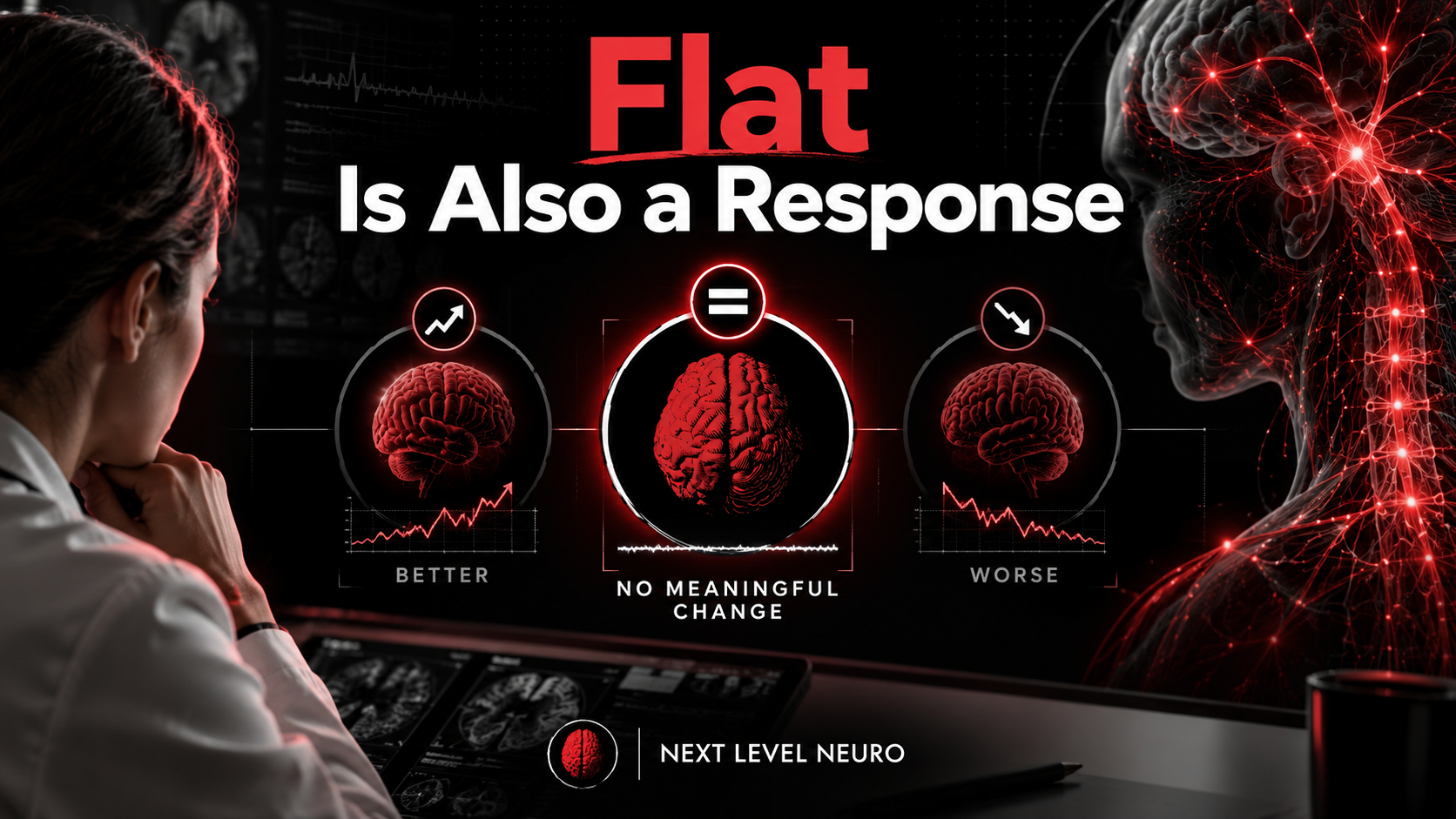
We tend to categorize our reassessments as:
Better or worse.
But there are really three useful categories.
Better.
Worse.
No meaningful change.
That third category does matter.
A flat response might mean the input isn't relevant enough.
It might mean the dose isn't large enough.
It could mean your assessment isn't sensitive enough to the change you're creating.
The client's current state could be masking the response.
You could simply be testing the wrong hypothesis.
Flat does not tell you which of those explanations is correct.
It tells you:
Keep asking better questions.
That's why assess and reassess is so much more powerful than collecting hundreds of drills.
The drill isn't the answer.
The response helps determine the next action.
This Actually Fits the Regulation Model Better Than It First Appears
The fascinating part is that this idea sounds like the opposite of regulation until you go back to what regulation actually means.
In the Regulation Is the New Strength workshop, we eventually progress people beyond gentle regulation drills.
Later in the progression, we intentionally change the environment.
We add duration.
We add music.
We work when someone is fatigued.
We introduce the regulation tools when the individual is already dealing with stress.
Why?
Because ultimately, the goal isn't to become regulated under ideal conditions.
The goal is adaptability in the real world.
That progression looks like this:
- Create access.
- Build capacity.
- Challenge that capacity.
- Find where the system begins to lose adaptability.
- Adjust the input or dose.
- Gradually expand what the nervous system can tolerate.
- Repeat the process under more realistic conditions.
That is much closer to what we mean when we say, “Regulation is the new strength.”
Regulation is the new strength.
Strength training has always understood this.
You don't discover someone's capacity by never putting demand on the system.
At some point, you increase load.
The skill is knowing when, how much and what the response means.
Neurological training requires the same respect for dosage.
Regulate Before You Activate Does Not Mean Never Activate
This is an important extension of one of our core principles.
Regulate before you activate.
The first job is still to determine whether the nervous system is ready to receive more input.
A brain prioritizing protection isn't going to suddenly become more adaptable because we throw additional complexity at it.
The Regulation workshop describes regulation as the foundation beneath higher levels of performance. Trying to skip that level usually makes everything above it harder to access.
But once you've tried to create regulation and every assessment remains completely flat, blindly adding more "calming" drills isn't necessarily better clinical reasoning either.
At some point you may have to ask…
What is this system actually responding to?
Sometimes answering that question requires carefully increasing demand.
Not because we want dysregulation.
Because we need contrast.
The Goal Isn't to Find What Breaks the Client
It's to understand where their current capacity ends.
That sentence may be the most important pieces in this entire article for us to understand.
If I know a client's nervous system can successfully handle a certain amount of visual, vestibular, proprioceptive, interoceptive, cognitive or movement demand, but begins to lose quality slightly beyond it, I now know something incredibly useful.
I have a window.
Below one end, the stimulus may not be meaningful enough to create change.
Above the other end, the stimulus may be too much for the nervous system to integrate successfully.
Somewhere between those two is where good programming begins.
And that is where Applied Neurology becomes much less about knowing more drills and much more about understanding the individual in front of you.
Stop Trying to Make Every Reassessment Positive
This may be uncomfortable for practitioners who have learned that every drill should immediately make the client look better.
Of course we want positive reassessments.
But if our only acceptable result is "better," we risk ignoring some of the best information the nervous system gives us.
A negative reassessment can tell you that the dose was too high.
A flat reassessment can tell you that your current hypothesis isn't producing enough signal.
A positive reassessment can tell you that you've found something worth exploring.
None of those answers exist in isolation.
They're part of a conversation between the input you're providing and the nervous system trying to make sense of it.
That's what assess → input → reassess is really about.
You're not trying to prove that your favorite drill works.
You're asking the nervous system a question.
And sometimes, when every answer has been silence, you have to change the question enough to finally hear it respond.
Want to understand where to start with Applied Neurology?
One of the biggest mistakes practitioners make is trying to memorize hundreds of neurological drills without having a framework for deciding what to assess, what input to choose and what the reassessment is actually telling them.
That's exactly why we created The Neuro Advantage.
We'll show you how we think about neurological input, assessment and reassessment so you can stop guessing and begin making better decisions about where to start with the person standing in front of you.
Learn more about The Neuro Advantage and start building the framework behind the drills.
FAQ
1. Are you intentionally dysregulating the client?
Not exactly.
The goal is not to make the client dysregulated. The goal is to carefully increase the challenge enough to create a measurable response when repeated inputs have produced nothing but flat reassessments.
The negative response is information, not the treatment goal.
2. Why would I ever want a negative reassessment?
Because sometimes a negative reassessment gives you information that a flat reassessment does not.
If several inputs create no meaningful change, carefully increasing one variable may help you identify where the nervous system begins to lose adaptability.
That gives you a threshold you can begin working around.
3. Does a negative reassessment mean I chose the wrong drill?
Not necessarily.
A negative response might mean:
- The dose was too high.
- The duration was too long.
- The input was too complex.
- Too many sensory demands were combined.
- The client was not ready for that level of challenge.
- The input may not be appropriate for that client right now.
The response tells you to investigate further, not automatically abandon the entire category of input.
4. What should I do once I find a negative threshold?
Usually, back away from it.
Reduce the duration, intensity, speed, complexity, repetitions or sensory demand and reassess again.
The goal is to determine whether you can move from:
Negative → neutral → positive
as you adjust the dose.
That begins to show you where the client's current training window may exist.
5. Does a negative response identify the dysfunctional neurological system?
No.
If vestibular input makes an assessment worse, for example, that does not automatically mean the client's vestibular system is "broken" or that you have discovered the cause of their symptoms.
It tells you that under those conditions and at that dose, the nervous system did not tolerate the input well.
That becomes another piece of information in your hypothesis.
6. What if every reassessment stays flat?
Flat is still information.
It may mean:
- The input is not meaningful enough.
- The dose is too small.
- Your assessment is not sensitive to the change.
- The client's current state is masking the response.
- You are testing the wrong hypothesis.
When repeated inputs stay flat, that may be the point where a carefully controlled increase in challenge helps you create enough contrast to learn something new.
7. How is this different from simply overwhelming the nervous system?
Intent, dosage and reassessment.
Overwhelming a client means applying more and more input without respecting what their nervous system is telling you.
Threshold mapping means changing one variable deliberately, watching for the smallest meaningful change, and adjusting immediately based on the reassessment.
More input is not automatically better.
8. Should I challenge the client before trying to regulate them?
Usually, no.
Our starting principle remains:
Regulate before you activate.
We first want to create enough safety and access for the nervous system to process information successfully.
The type of threshold testing discussed in this article becomes more relevant when you've already tried appropriate inputs and continue to get little or no useful information from your reassessments.
9. Isn't the goal of regulation to keep the client calm?
No.
Regulation is not the same as calmness.
A well-regulated nervous system should be able to:
- Increase activation when necessary.
- Handle changing demands.
- Recover when the demand passes.
- Move between different states without getting stuck.
The goal is adaptability, not permanent relaxation.
10. How do I know when I'm giving too much input?
Your reassessment helps tell you.
Look for meaningful deterioration in the outputs you are measuring, along with signs that the task itself is becoming increasingly difficult for the client to tolerate.
When the response becomes negative, you have learned something.
Now reduce the demand and continue testing.
11. What is the biggest mistake practitioners can make with this idea?
Assuming that provoking a response means they have found the diagnosis.
One negative reassessment should lead to another question, not a conclusion.
Good Applied Neurology looks more like:
Form a hypothesis → test it → change one variable → reassess → refine the hypothesis.
The nervous system's response helps guide your clinical reasoning.
12. What is the ultimate goal of this process?
To understand the client's current capacity well enough to expand it.
The progression is:
- Create access.
- Build capacity.
- Challenge that capacity.
- Identify where adaptability begins to break down.
- Adjust the dose.
- Gradually expand what the nervous system can tolerate.
- Repeat under increasingly realistic conditions.
That is what we mean when we say:
Regulation is the new strength.
Want more information on our Mentorship
and Programs?
We hate SPAM. We will never sell your information, for any reason.
