Workshop Reviews + Free Workshop Downloads
Jul 01, 2026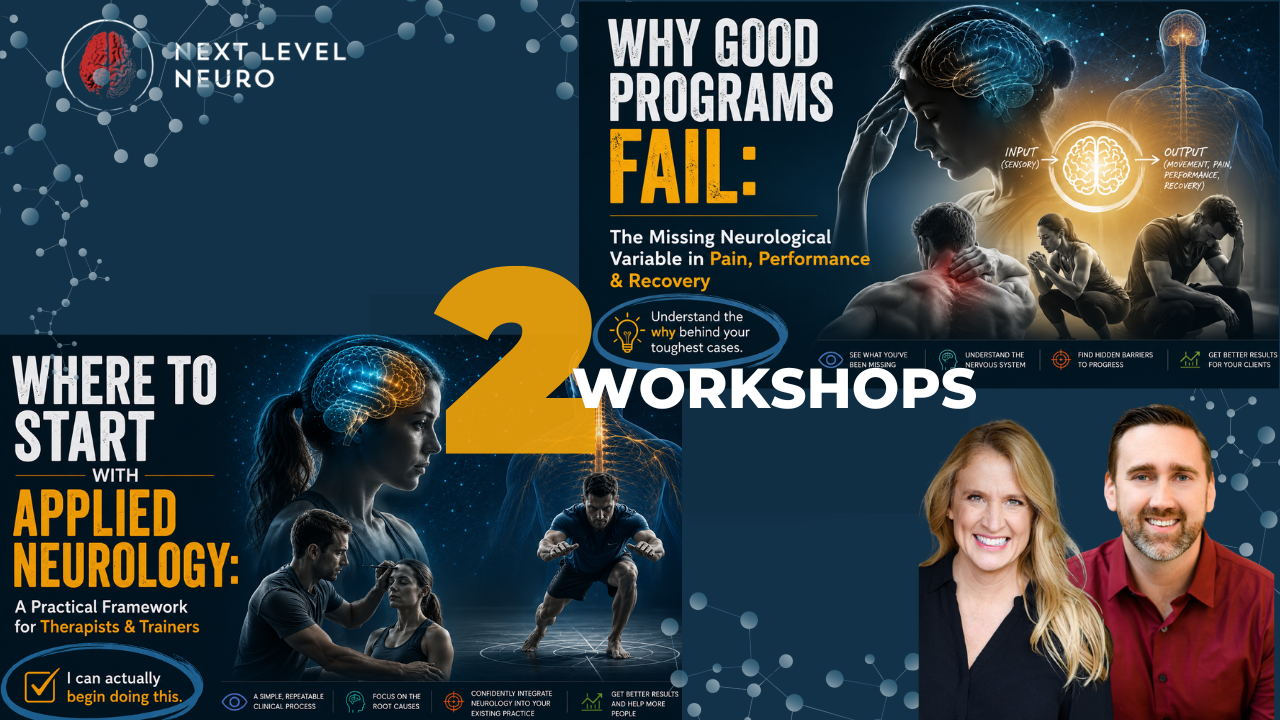
Why Good Programs Fail and Where Do We Start With Applied Neurology during our client session.
These two Applied Neurology workshops are a great starting point if you have ever wondered why some clients stay stuck even when the program looks right, and you want a clearer way to begin implementing applied neurology in your sessions.
They are exactly what many of our current coaches wish they had when they were first starting.
Month after month, these are the two questions that show up most often in our inbox from practitioners.
You may not have emailed us, but you might be experiencing some of these same things.
- You know the plan makes sense.
- The exercise selection is appropriate.
- The progression is spot on.
- The tissue work, strength work, mobility work, or corrective strategy all seem to fit.
But the client still does not respond the way you expected.
That is where the nervous system lens becomes so useful.
In these two free workshops, Matt walks us through why good programs sometimes fail, what the nervous system may be protecting against, and how to begin adding applied neurology into your current sessions without throwing away what you already know.
You will walk away with a clearer understanding of why some clients guard, compensate, flare, plateau, or lose access to movement and strength, even when the program looks solid on paper.
Most practitioners have had the experience.
A client comes in with a familiar issue.
You know the protocol.
You start the tissue work.
They begin their strength plan.
And teach them the mobility strategy.
But the client does not respond the way they “should.”
That is the conversation Matt opens up in these two free workshops.
This is not about saying biomechanics are wrong, or that strength and mobility no longer matter.
The point is that those tools work inside a bigger system: the nervous system.
The nervous system.
These two workshops help you understand why good programs sometimes fail and how to start adding applied neurology into your current work without throwing away what you already know.
Workshop 1: Why Good Programs Fail
In this workshop, Matt walks through one of the most frustrating problems in practice: when a good program does not create the expected result.
This is the client who keeps coming back with the same results.
Workshop One’s main message is simple: you have already been working with the nervous system.
Every movement, sensation, pain experience, strength output, mobility restriction, or protective response passes through the nervous system first.
The problem is that most practitioners were trained to chase outputs without knowing how to investigate the inputs driving them. This is the classic biomechanics model.
In this workshop, you will learn:
- Why two clients can have the same diagnosis, the same program, and completely different results
- Why chronic pain, dizziness, vertigo, hypermobility, concussion history, and persistent injuries often require a bigger lens
- Why anatomy, biomechanics, manual therapy, corrective exercise, and tissue-healing timelines are useful but incomplete
- Why pain, stiffness, guarding, reduced mobility, and movement compensations are often protective outputs
- Why the brain prioritizes safety before performance
- Why the nervous system may continue solving an old problem even after the tissue has healed
- Why better sensory inputs can change the outputs you see in pain, movement, balance, strength, posture, and performance
- How vision, vestibular function, proprioception, breathing, and interoception can all influence what looks like a biomechanical issue
- Why “non-responder” is often the wrong label
- How to start asking better questions when a client does not respond as expected
The biggest takeaway from Workshop 1...
- The client’s output is not random.
- Pain is not random.
- Guarding is not random.
- Stiffness is not random.
The nervous system is choosing those outputs for a reason, and your job is to understand what information the system may be missing.
That moves nicely into workshop 2, which helps us decide what to use and how to start using it.
For a full review breakdown of Workshop #1, click here for our in-depth article on Substack.
Workshop 2: How to Add Applied Neurology Into Your Sessions
The second workshop moves from “why this matters” into “how to start using it.”
Workshop two’s focus here is practical.
Matt is not asking practitioners to abandon their current tools or become neuroscientists.
Matt is showing you how to shift the way you observe, assess, and make decisions inside a real session.
Instead of the traditional biomechanical question, “What exercise do I give for this injury?” he teaches you to ask, “What output is the nervous system already producing?”
That gives the practitioner a much better clinical process.
In this workshop, you will learn:
- How to look beyond joints, muscles, posture, and structure
- How to observe pain, guarding, mobility loss, balance changes, fatigue, breathing issues, coordination problems, and confidence as nervous system outputs
- How to use the input, interpretation, output model in a real client session
- How to investigate the sensory inputs that may be driving the output
- Why unclear information from the body can increase guarding, pain sensitivity, tension, fatigue, and reduced force production
- How to ask better questions about vision, vestibular function, proprioception, interoception, and breathing
- How client history can reveal old injuries, concussions, surgeries, illness, dental work, stress, or life changes that may still matter
- How movement compensations can show you what the body is avoiding or overusing
- How to choose a baseline, apply a tool, and reassess immediately
- How to know whether to continue, modify, or move on based on the client’s response
- Why you should stop collecting random drills and start using better frameworks
- How applied neurology can fit inside what you already do instead of replacing it
Matt also gives a simple working model practitioners can start using right away…
- Observe the output
- Investigate the possible inputs
- Assess a meaningful baseline
- Test a tool
- Reassess the result
- Decide what comes next
The biggest takeaway from Workshop 2 is this…
Applied neurology is not about having a bigger drill library. It is about making better decisions. When you know what output you are seeing, what input may be driving it, and how to reassess the response, your sessions become clearer and your clients can feel change faster.
For a full review breakdown of Workshop #2, click here for our full breakdown.
Download Both Workshops for Free
These two workshops are a great starting point if you have ever wondered why some clients stay stuck even when the program looks right.
You will walk away with a clearer understanding of why good programs fail, what the nervous system may be protecting against, and how to begin adding applied neurology into your current sessions.
Download both free workshops here:
Want the Next Step?
If you want to go deeper, when you download the workshops, you will also be opening our live Fundamentals of Applied Neurology workshop.
Here is what you will get:
- The live Fundamentals workshop
- Access to NLN AI
- Advanced training around the brainstem and cerebellum, a $97 value
- The Neuro Advantage: Quick Start for Practitioners
Fundamentals is designed to help you build assessments that fit into your existing work, understand client patterns without getting lost in neuroanatomy, and begin applying this lens immediately in practice.
Join the LIVE Fundamentals workshop here:
Want more information on our Mentorship
and Programs?
We hate SPAM. We will never sell your information, for any reason.