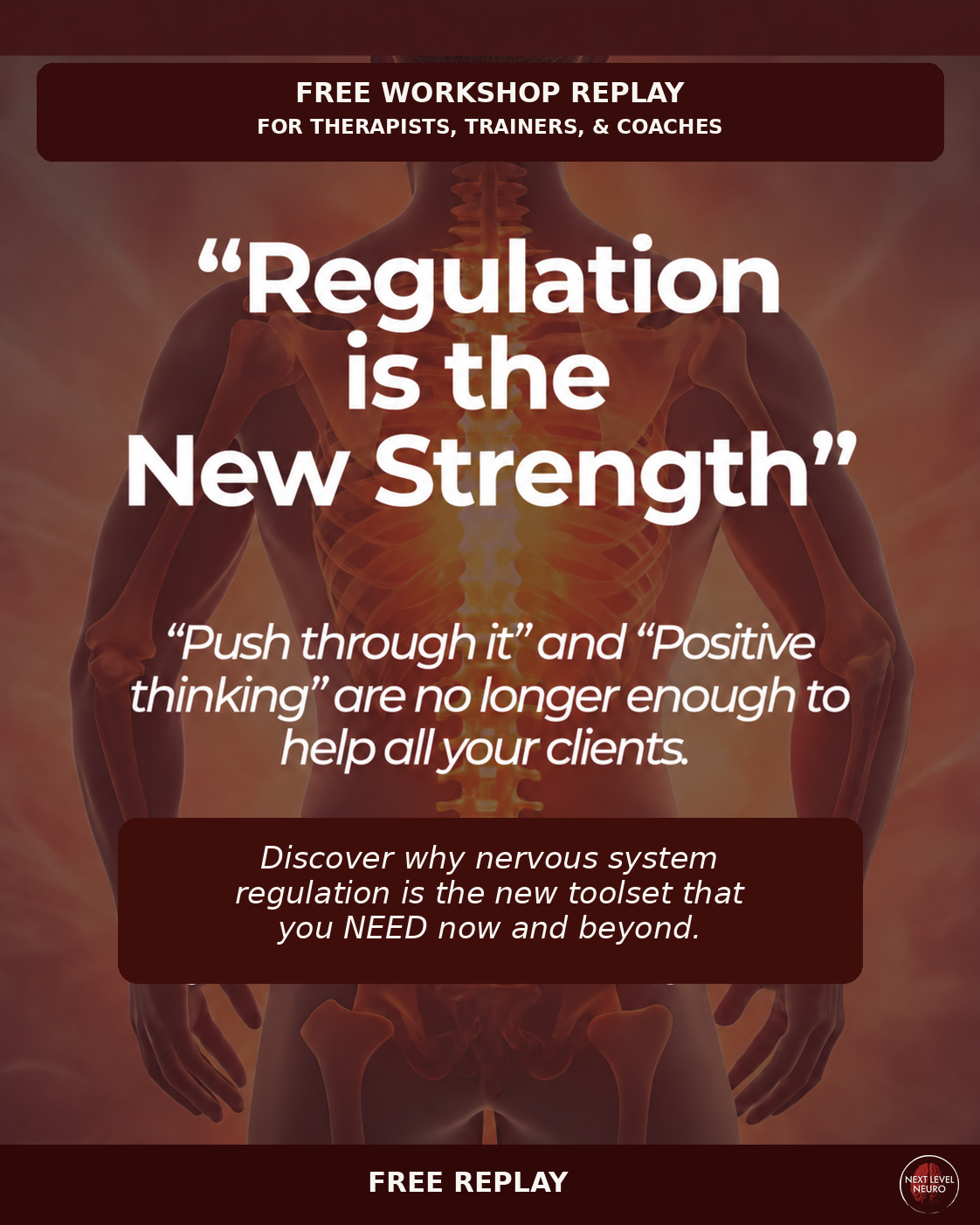
The Applied Neurology FAQ: 15 Questions Practitioners Keep Asking Us
Sep 05, 2026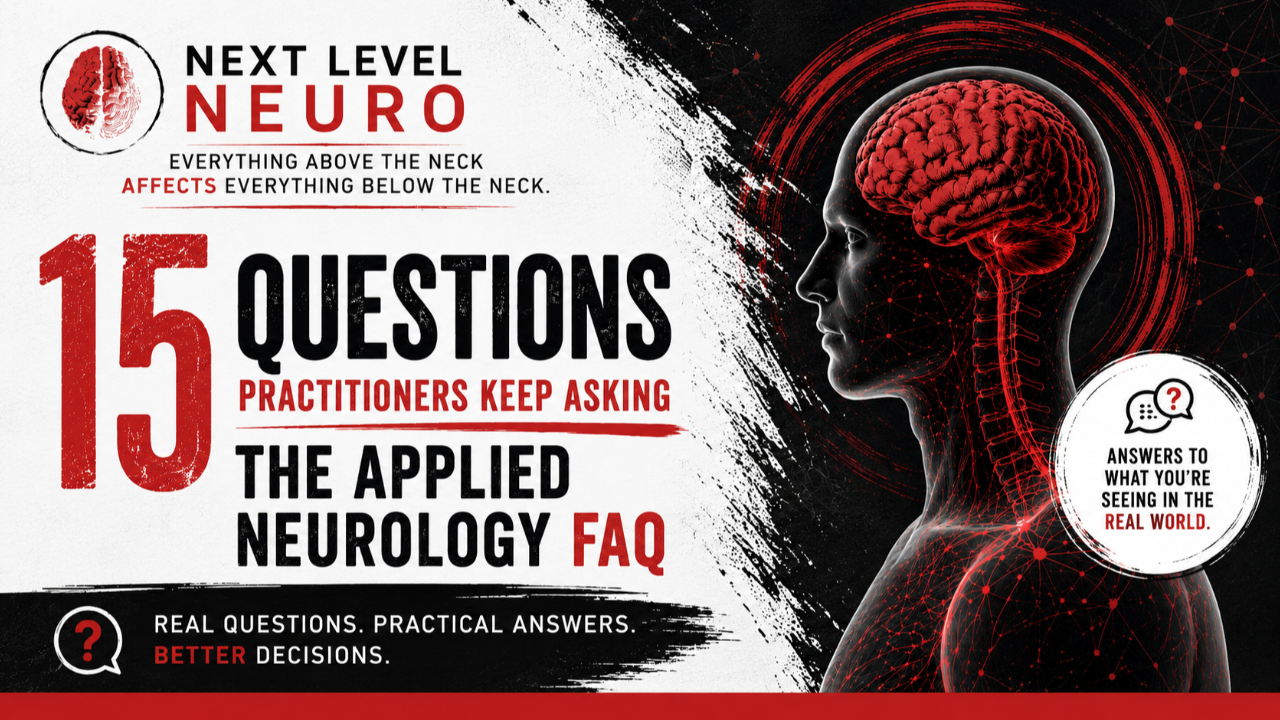
After years of teaching Applied Neurology, these are some of the questions we hear most often.
There is a point in every practitioner’s education where more information stops being the answer.
Everyone has reached the point of education saturation, and we need more application to what we have learned.
You have learned about biomechanics.
Everyone understands movement.
All practitioners have taken courses, collected exercises, learned corrective strategies, and built a toolbox that is probably much bigger than it was a few years ago.
Then you work with a client who does not respond the way they are supposed to:
-
The assessment looks good, but the person still hurts.
-
Mobility improves, then disappears by the next session.
-
The client is strong, but loses control when stress or complexity increases.
-
A drill works beautifully one day and does absolutely nothing the next.
This is where many practitioners reach out to us and start asking very thought-provoking questions.
That is where Applied Neurology can give you another lens to look through.
Over the years, we have collected hundreds of questions from practitioners trying to understand how the nervous system influences pain, movement, strength, stability, recovery, and performance.
Here are 15 of the questions we hear most often surrounding Applied Neurology specifically.
Some of these may be familiar, but they’re always worth revisiting, especially when you need to explain these concepts clearly to a client.
Others may offer a new insight or perspective you haven’t considered before.
1. What exactly is Applied Neurology?
Applied Neurology is a way of looking at how the nervous system influences the way a person moves, performs, adapts and responds to stress.
Instead of looking only at muscles, joints and biomechanics, you also consider the information the brain is receiving and how the nervous system is responding to that information.
This is why we always use the sentence, "Everything above the neck affects everything below the neck."
Vision, vestibular input, proprioception, breathing, movement and other sensory systems all contribute to the brain's perception of what is happening.
The goal is not to replace biomechanics.
It is to add another layer to your assessment and decision-making.
2. Does Applied Neurology replace biomechanics?
No.
That should end the discussion, but we get it weekly.
Every week.
And we say it all the time and why its hear, again.
This is one of the biggest misconceptions.
Biomechanics is still an integral part of a practitioner’s or trainer’s educational foundation.
-
Tissue capacity matters.
-
Strength matters.
-
Mobility matters.
-
Rehabilitation matters.
-
Biomechanics matters.
Applied Neurology doesn’t replace any of these.
It adds another lens for understanding what may be influencing the person in front of you.
Applied Neurology asks you to look at what biomechanics did not.
What is the nervous system allowing this person to do right now?
Biomechanics can explain how a movement happens.
The nervous system can help explain why the same movement strategy works beautifully for one person, fails for another, or changes from one day to the next.
The two approaches are much more useful together than they are in opposition.
3. What does “threat” actually mean?
Threat does not automatically mean trauma, anxiety, or psychological fragility.
Threat is broader than that.
And it is something we teach Day 1, Hour 1 in our mentorship.
It's that important.
The nervous system is constantly making predictions about safety based on sensory input, context and previous experience.
When the brain is uncertain about what is happening or what is about to happen, it increases protection.
That protection might look like tension, bracing, stiffness, reduced movement, changes in coordination or increased sensitivity.
Threat is a nervous system state, not a personality trait.
4. Why can someone be strong but still be dysregulated?
Because strength and regulation are not the same thing.
Someone can produce a tremendous amount of force through tension, bracing, and control while still operating in a high-alert state.
From the outside, they may look incredibly capable.
But look closer, and you might see breath holding, excessive bracing, jaw or neck tension, inconsistent performance, poor recovery, or difficulty adapting when the environment changes.
The question becomes less about whether they can produce output.
It becomes whether they can produce output without paying an unnecessarily high nervous system cost.
5. Why do clients sometimes feel tight everywhere?
Because stiffness can be a nervous system protection strategy.
When the brain is uncertain about orientation, stability, load, or control, reducing movement options can create a greater feeling of certainty.
The body essentially says, “If I make this more stable, I have more control.”
That can be useful in the short term.
But if the strategy stays in place long after the original reason for protection has disappeared, the client can end up feeling both tight and unstable at the same time.
More stretching is not always the answer.
When you learn applied neurology, you start thinking....
Why does the nervous system believe it needs the stiffness?
6. Can vision really affect pain, balance or movement?
Yes, but it is important to understand what that means.
Vision does not directly “cause” someone's back pain or shoulder pain in the same way an injury can damage tissue.
Vision is one of the major sources of information the brain uses to understand where the body is in space.=
And vision is much more than having 20/20 eyesight.
Tracking, focus changes, depth perception, peripheral awareness, and the way vision integrates with balance and proprioception all matter.
If that information becomes unreliable, the nervous system may increase protection.
That can show up as changes in balance, movement, muscle tone, confidence or pain.
7. Does vestibular dysfunction always mean dizziness or vertigo?
No.
This is another reason vestibular issues can be missed.
A person does not necessarily need to say, “The room is spinning.”
Vestibular issues can show up in other ways:
-
They feel unstable or “off.”
-
They become guarded during overhead work.
-
One side suddenly feels weaker.
-
Coordination breaks down as intensity increases.
-
Busy environments make symptoms worse.
-
Movement feels less predictable or less secure.
The vestibular system contributes to orientation and spatial awareness, so problems do not always present as classic dizziness.
Sometimes they present as a loss of confidence in movement.
8. Can pain be real if imaging is normal?
Absolutely.
A normal scan does not mean someone is imagining their pain.
Imaging tells you about structure.
It does not tell you exactly how the nervous system is interpreting sensory information, movement, previous injury, stress or perceived threat.
Pain is a real physiological experience.
And while tissue injury and inflammation absolutely matter, the nervous system also influences how pain is produced and maintained.
This is one reason pain can sometimes continue long after an injury has healed.
The tissue may have recovered while the nervous system is still operating from an old protective prediction.
9. Why does pain sometimes change immediately after a neuro drill?
Because not every limitation is purely structural.
If the nervous system is contributing to the limitation, changing the sensory information going into the system can sometimes change the output very quickly.
You might see:
-
An increase in range of motion
-
Better balance or stability
-
Improved strength expression
-
Smoother coordination
-
A reduction in pain
That immediate change does not prove that you found the one true cause of the problem.
It tells you something we explore in much greater depth our Applied Neurology mentorship.
The system responded to the input.
Now you have information you can use.
10. What if the neuro drill makes the client worse?
That is information too.
A negative reassessment does not automatically mean the drill is “bad.”
It may mean:
-
The input was too intense.
-
The dose was too high.
-
The drill was too complex.
-
The timing was wrong.
-
The client was not ready for that input in that moment.
-
Your original hypothesis may need to change.
This is why we do not believe in forcing a client through an intervention simply because a protocol says it should work.
The response should influence the next decision.
11. What exactly is Assess → Apply → Reassess?
This is one of the simplest and most important concepts in Applied Neurology.
The process is simple:
-
Establish a meaningful baseline.
-
Apply one targeted input.
-
Reassess the exact same baseline.
That’s it.
What might you reassess?
-
If range of motion was limited, reassess range of motion.
-
If balance was poor, reassess balance.
-
If strength was reduced, reassess strength.
-
If pain was present, reassess pain.
The goal is not to test everything constantly.
The goal is to find out whether what you just did created a meaningful change.
12. Does a positive reassessment prove you found the cause?
No.
And this distinction is extremely important.
If a visual input improves someone's shoulder range of motion, that tells you the visual input influenced the system.
It does not necessarily prove that poor vision was the root cause of their shoulder problem.
A positive reassessment is evidence of influence, not proof of causation.
That keeps us from turning Applied Neurology into another system of rigid explanations.
The practitioner is constantly testing, observing, and refining the hypothesis.
13. Why does the same drill work one day and fail the next?
Because the nervous system receiving the drill is not exactly the same every day.
Sleep changes.
Stress changes.
Training load changes.
Recovery changes.
Pain changes.
Nutrition changes.
The environment changes.
Even the amount of sensory information surrounding someone can change their response.
The exercise may be identical.
The person receiving it is not.
That is why fixed protocols can only take you so far.
Assessment tells you what is happening today.
14. Do I need hundreds of neuro drills to become good at Applied Neurology?
No.
In fact, this is one of the biggest traps we see.
Practitioners collect more and more exercises because they believe the missing answer must be somewhere inside the next technique.
Eventually they have a huge toolbox and still aren't sure which tool to use.
The real skill is learning how to answer four questions:
What am I seeing?
What is my hypothesis?
What input should I test?
What did the reassessment tell me?
The drill is only part of the equation.
The reasoning behind the drill is where the real value lives.
15. So what should I actually learn if I want to get better at Applied Neurology?
Learn how to:
-
Think through the person in front of you
-
Establish a meaningful baseline
-
Recognize when the nervous system may be influencing output
-
Choose an appropriate input
-
Dose that input correctly
-
Reassess the response
-
Interpret the result without forcing it to fit the story you already believe
That is the difference between collecting neuro drills and actually understanding Applied Neurology.
A good practitioner does not need an answer for every possible presentation before they begin.
They need a process for figuring out what the person in front of them needs.
The Question We Keep Coming Back To
After years of working with practitioners, we have found that the most important question to ask yourself when in front of a client is NOT...
...“What drill should I use?”
This is our biomechancial education influence.
What Next Level Neuro teaches you to ask is...
“What information am I getting from this person's nervous system, and what happens when I change it?”
That shift helps you understand why we say, "Everything above the neck affects everything below the neck."
It moves you away from memorizing protocols and toward developing clinical reasoning.
It allows you to stop asking whether a drill is “good” or “bad” and start asking whether it was appropriate for this person, at this time, in this state, at this dose.
That is ultimately what Applied Neurology is about.
Not having more exercises.
Having a better way to make decisions.
If that is the skill you are looking to develop, that is exactly what we focus on inside Next Level Neuro Mentorship.
Want To Learn More?
If these questions sound familiar, you may be at the point where collecting more information isn’t what you need.
You need a framework for knowing what to look for, what to test, how to apply the right input, and what the response is telling you.
That is what we teach inside the Next Level Neuro Mentorship.
M11 is our next mentorship cohort, and we’re now accepting applications.
If you’re a coach, trainer, therapist, or practitioner who wants to develop a deeper understanding of Applied Neurology and become more confident working with the person in front of you, we’d love to have a conversation.
Book a discovery call with Kathy and see if the mentorship is the right fit for you.
👉 Book your call: www.nextlevelneuro.com/discovery
Want to learn more about M11 first?
👉 Explore the Next Level Neuro Mentorship: www.nextlevelneuro.com/mentorship
Want more information on our Mentorship
and Programs?
We hate SPAM. We will never sell your information, for any reason.