Is Your Client’s Nervous System Ready for the Neuro Drill?
Aug 31, 2026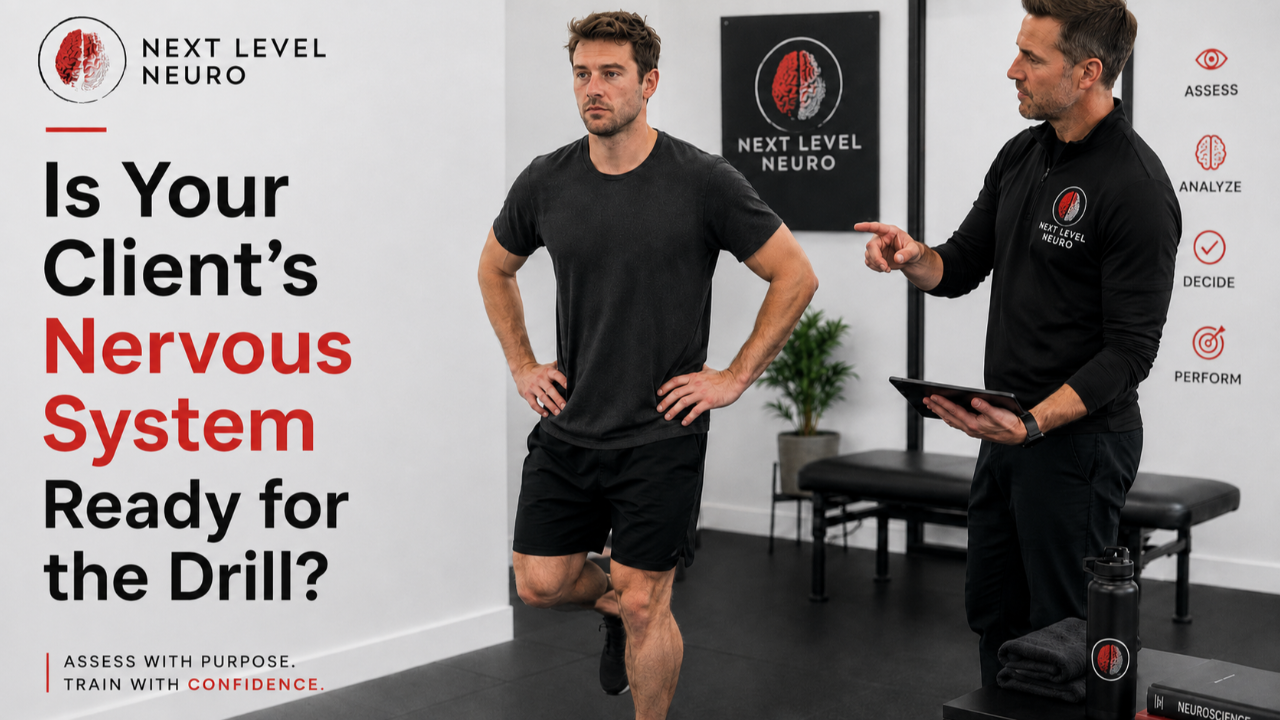
The drill may be appropriate. The nervous system may not be ready for it yet.How to adjust neurological input based on the client standing in front of you today
The question this article answers is:
How do you know whether your client’s nervous system is actually ready for the drill you are about to give them?
It is an important question because, in practice, the drill itself is only one part of the equation. A neurological input may be completely appropriate for a client, yet still be too much for them on a particular day, at a particular intensity, or in a particular state.
That is where practitioner reasoning comes into play. Clients do not walk into your office or training session as the exact same person every time. Their sleep changes. Stress changes. Travel, training load, nutrition, recovery, pain, and even the environment they have been in can all influence how they respond to sensory input. So many practitioners who have taken short neurology courses have a huge tool box of near drills, and become overwhelmed where to start.
We ask that our students you come into our mentorship ask themselves, “What is this nervous system showing me today, and how much input is it ready to tolerate?”
Before we get into the education of the article, let’s outline an example we will use throughout the entirety of the article.
A 6:00 AM Session After a Red-Eye
Here is a good example from my own work.
One of our students trains a highly traveled CEO, who comes to see him at 6:00 in the morning.
This particular time, it was right after landing from his red-eye flight.
Under normal circumstances, he already has a pretty good sense of how the client responds to certain visual, vestibular, balance, and movement-based inputs because he has assessed and reassessed them many times.
Now imagine he shows up for that same 6:00 AM session after getting off a red-eye flight.
Type A personality, ready to go no matter the circumstances.
This client has been on the road for three straight days.
His sleep has been disrupted, his normal schedule is off, he has spent hours sitting on airplanes and in airports, and his recovery probably looks very different from what it usually does.
The neuro assessment at the beginning of the session screams nervous system overload and threat.
Technically, the coach could give him the same drill(s) he used successfully the week before.
But should he assume his client's nervous system is going to respond the same way?
Probably not.
The previous sessions gave the coach useful information about how his client responded under those conditions.
It did not mean the coach could assume that the same neural inputs, at the same dose, would produce the same result today.
It’s easy to fall into the trap of assuming what worked before might work again.
The truth is, it's fast and effective to use the process we teach to our Next Level Neuro Students.
A practitioner who had success in applied neurology previously might think, “We already know this vestibular drill works for him.”
What we actually know is that the drill produced a useful reassessment the last time we used it.
Today is a new day, with a new baseline.
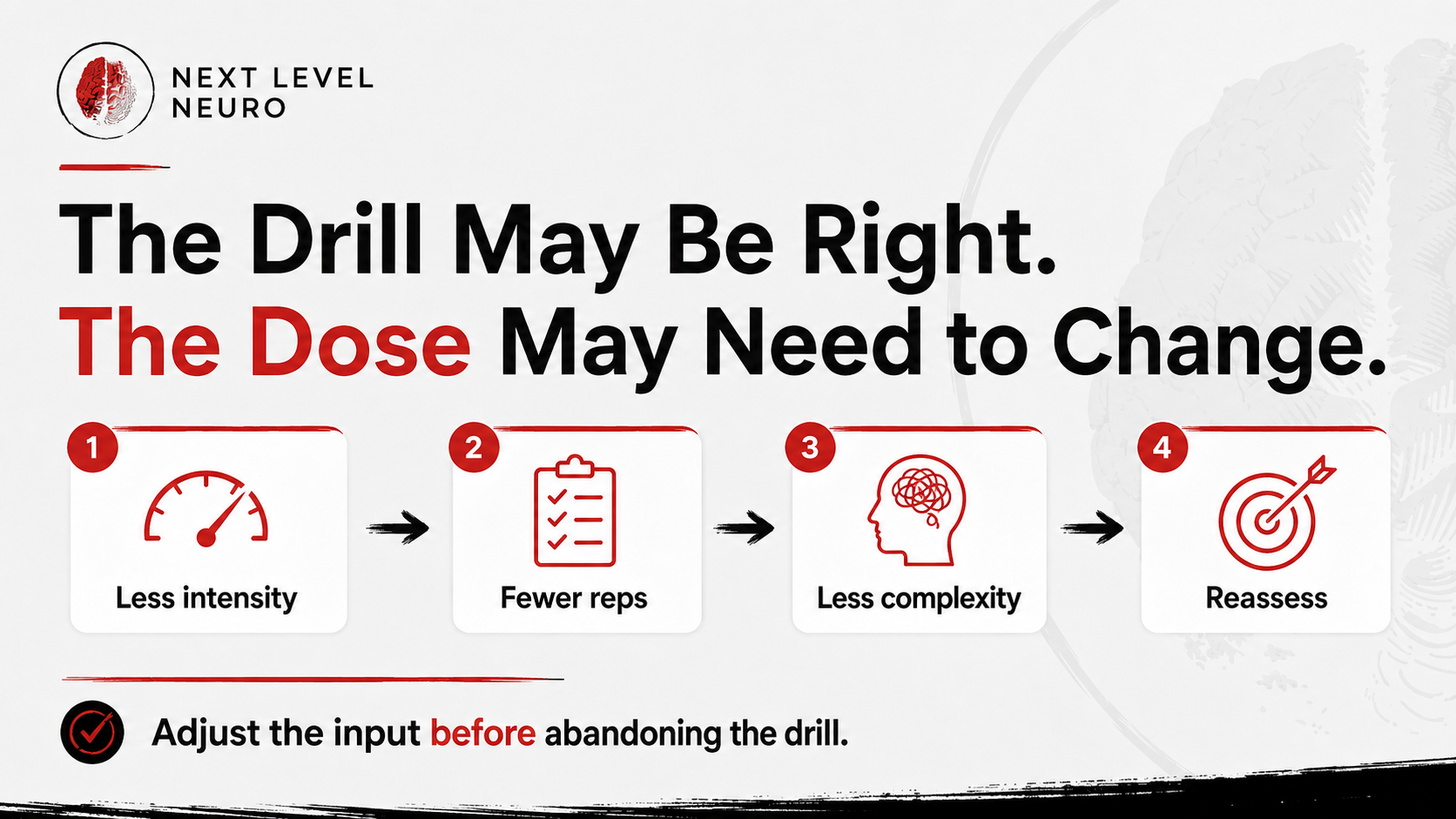
The Neuro Drill May Be Right - While the Dose Is Wrong
This is where applied neurology becomes more than simply matching drills to symptoms.
If our coach's client responds poorly to the same drill after three days of travel and a red-eye, He would not immediately conclude that the neuro drill has stopped working.
Instead, a coach/therpist should become curious about the variables surrounding it.
That might mean asking..
- Is the intensity too high for that morning?
- Is the drill too complex after a night of poor sleep?
- Do the number of repetitions need to come down?
- Does the sensory demand need to be simplified?
- Would a slower or less challenging version be more appropriate?
- Does the client need regulation before I ask the nervous system for more performance?
The key point is that the drill and the dose are not the same thing.
Health and performance professionals already understand this concept in other areas…
- A squat may be appropriate, but that does not mean every load is appropriate.
- Running may be useful, but that does not mean every volume or intensity is appropriate.
- Mobility work can be beneficial, but the dosage can still exceed what the client tolerates well.
- Strength work may belong in the program, while the number of sets, reps, or overall training demand still needs to change.
- A movement can be right for the client, while the way it is delivered is wrong for that day.
Neurological input deserves the same level of thought.
When we choose a drill, we are also choosing variables such as:
- Intensity
- Duration
- Number of repetitions
- Speed
- Range
- Complexity
- Position
- Environmental demand
- Amount of sensory input
Those variables can dramatically change how the nervous system responds.
Sometimes Less Gives You More Information
Practitioners with a strong strength-and-conditioning background often have to adjust to this idea because we are used to thinking in terms of progressive overload.
If a little was good, more can seem better.
That logic does not always translate neatly to neurological input.
Sometimes five repetitions produce a useful reassessment, while ten repetitions remove the benefit.
In another case, a slower version of the drill may work better than a faster one.
A balance challenge that looks almost too simple may create a better response than the more difficult progression.
The goal is not always to find the maximum amount of stimulus a client can handle.
Very often, we are trying to identify the smallest useful dose that gives us a positive response.
With the client coming in after the red-eye, the coach may decide to keep the same general drill but change the way it is delivered.
- Reduce the range.
- Lower the number of repetitions.
- Decrease the balance demand.
- Simplify the visual task.
- Change the body position.
- Slow the drill down.
- Reduce the overall sensory complexity.
- Start with breathing or regulation before adding more demanding sensory work.
Then we reassess.
That tells us much more than blindly repeating what worked last week.
The Assessment Tells You Who Is Standing in Front of You Today
This is one of the reasons the NLN assessment process is so central to how we teach applied neurology at Next Level Neuro.
Assessment is not something you do once and then set aside.
It gives you a real-time, current snapshot of the client.
Depending on your profession, scope of practice, and the person in front of you, that may include looking at movement, balance, coordination, pain, strength, visual function, vestibular responses, proprioception, breathing, regulation, or other relevant markers.
The goal is to establish a meaningful baseline before you make a change.
From there, you can form a hypothesis and apply a neural input that makes sense based on what you observed.
That input could involve the visual system, vestibular system, proprioception, breathing, balance, movement, or another sensory strategy within your scope.
The important part is that you are not throwing several drills at the client and hoping one of them sticks.
You are making a reasoned choice.
And then you are checking what happened.
The Reassessment Is Where the Learning Happens
Reassessment is not there to prove that a drill “worked.”
We need to look at the reassessments as a place where we get our feedback.
After applying an input, perhaps movement improves or balance feels more stable.
Coordination might change.
Pain may shift.
Strength output may feel easier, or the client may report that the task requires less effort.
In another session, nothing meaningful changes.
Maybe the baseline gets worse.
All three outcomes are useful.
A positive reassessment suggests the input may be worth continuing or integrating.
No meaningful change tells you that the current approach may not be giving you enough value.
A worse response provides equally important information because it indicates that something about the input, dosage, timing, or hypothesis may need to change.
That is why a negative reassessment is not a failure.
It is information.
The Goal Is Not to Prove the Drill Works
One of the easiest traps in applied neurology is becoming attached to an exercise simply because it has worked before.
If a vestibular drill helped three sessions in a row, it is tempting to keep reaching for it.
But the job is not to prove that our favorite drill works.
The job is to understand what the client is showing us.
So if my sleep-deprived client comes in at 6:00 AM and responds poorly to something that previously helped, we have several options…
- Reduce the dose.
- Regress or simplify the drill.
- Decrease the intensity or number of repetitions.
- Change the sensory input.
- Spend more time on regulation first.
- Reassess after making an adjustment.
- Step away from that hypothesis and explore another possibility.
That is clinical and coaching reasoning.
The drill does not get to make the decision.
The client’s response does.
Regulation May Need to Come Before More Stimulation
There are also days when the best answer is not to add another challenge.
A client who is exhausted, stressed, under-recovered, or already overloaded may have a lower tolerance for additional sensory input.
So if my sleep-deprived client comes in at 6:00 AM and responds poorly to something that previously helped, I have several options:
- Reduce the dose.
- Regress or simplify the drill.
- Decrease the intensity or number of repetitions.
- Change the sensory input.
- Spend more time on regulation first.
- Reassess after making an adjustment.
- Step away from that hypothesis and explore another possibility.
In that situation, starting with regulation may make more sense than immediately asking for a demanding visual, vestibular, or balance task.
That might mean slowing the session down, reducing complexity, changing breathing, using a lower-intensity movement strategy, or simply giving the nervous system less to process at once.
This does not mean every client needs to be perfectly calm before they can train.
It means their current state should influence the way you dose the work.
That is the thinking behind the principle
Regulate before you activate.
Not as another rigid rule, but as a useful lens when the nervous system is already showing you that more stimulation may not be the best first step.
Why Protocols Can Only Take You So Far
Protocols can be incredibly useful, especially when you are first learning applied neurology.
They can:
- Give you structure.
- Help you understand relationships between different systems.
- Provide a clear place to start.
- Reduce some of the guesswork while you are building experience.
- Help you organize what you are seeing during assessment.
- Give you a framework for choosing an initial input.
But protocols have limits.
A protocol does not know that your client spent the last three days traveling.
It does not know they slept poorly, trained harder than usual, skipped meals, or walked into your office carrying far more stress than they did last week.
Most importantly, a protocol cannot observe how they respond to the neural input you just gave them.
That part belongs to you, the practitioner.
This is why learning applied neurology cannot stop at collecting drills.
At some point, the real skill becomes learning how to think through the person standing in front of you.
The Process We Teach
At Next Level Neuro, we organize that thinking around a simple process:
ASSESS → APPLY → REASSESS → INTEGRATE
- First, assess what the client is showing you today.
- Next, apply an input based on a reasonable hypothesis.
- Then reassess to see how the individual responded.
From there, integrate what is useful into the client’s broader rehabilitation, training, movement, or performance program.
That process may lead you to progress an exercise, regress it, change the dose, explore another sensory system, or decide that less stimulation is the better choice.
The point is not that there is always one correct answer.
The point is that you have a process for making the next decision.
The Goal Is Not a Bigger Toolbox
There will always be another neuron drill to learn because the permutations can be endless.
Having more tools can be useful, but the size of your toolbox does not determine how well you practice applied neurology.
The more important questions practitioners need to ask are:
- Why am I choosing this input?
- What am I trying to influence?
- How much stimulus is appropriate today?
- What am I going to reassess?
- What will I do if the response improves?
- What will I change if nothing happens?
- What will I do if the client gets worse?
Those questions move you away from simply prescribing neuro drills and toward a much more useful way of thinking.
Applied neurology becomes another lens you can bring to the training, rehabilitation, manual therapy, movement, or performance work you already do.
And sometimes the most important decision is recognizing that the client who walks in at 6:00 AM after three days of travel and a red-eye should not automatically receive the exact same session as the client you saw the week before.
Next Level Neuro Mentorship M11 is now accepting applications.
The Mentorship is designed for health, fitness, rehabilitation, movement, and performance professionals who want to deepen their understanding of applied neurology and become more confident using it with the clients they already serve.
The focus is not simply on teaching more exercises.
Inside the Mentorship, we help practitioners develop the reasoning behind the work so they can assess more clearly, build stronger hypotheses, choose appropriate neurological inputs, understand dosage, reassess individual responses, and integrate what is useful into the work they are already doing.
Because ultimately, the question is not just…
“What drill should I use?”
It is…
“What does this client need today, and how will I know whether the input I chose actually helped?”
If that is the level of applied neurology you want to develop, M11 is now accepting applications.
Explore the Next Level Neuro Mentorship to see if M11 is the right fit for you and your practice.
Learn How to Think Through the Client, Not Just Choose a Drill
Frequently Asked Questions
Does a negative reassessment mean the neuro drill is wrong?
Not necessarily. A worse reassessment tells you that the client did not respond well to that particular input in the way it was delivered at that moment.
The drill may still be appropriate with a different dose, less complexity, fewer repetitions, another position, or under different circumstances. Reassessment helps you make that distinction rather than labeling an exercise as simply good or bad.
How do I know whether to reduce the dose or choose a different drill?
Start with the hypothesis that led you to the drill in the first place.
If the hypothesis still makes sense but the response suggests you gave too much input, changing intensity, duration, speed, range, or complexity may be worth exploring.
If those adjustments continue to produce an unhelpful response, another sensory system or a different hypothesis may deserve your attention.
Can sleep, travel, and stress really change how someone responds?
A client's state can influence how they tolerate training and sensory input, which is why the context of the session matters.
Sleep, travel, stress, recovery, pain, training load, nutrition, and other factors can all contribute to the picture. Rather than trying to guess exactly how much each variable matters, assess the client and let their response help guide you.
Should regulation always come before neuro drills?
No. That would simply turn a useful principle into another rigid protocol.
Some clients may tolerate more demanding input immediately, while others may respond better after you reduce intensity or begin with a regulatory strategy.
Assessment helps you determine which situation you are dealing with.
How often should I reassess?
Reassessment is especially useful after you apply an input that is intended to influence a meaningful baseline.
The goal is not to test constantly for the sake of testing. It is to gather enough feedback to determine whether what you just did moved the client in a useful direction.
Is applied neurology supposed to replace traditional training or rehabilitation?
No.
Applied neurology adds another layer of information to the work you already do. It can complement physical therapy, strength and conditioning, rehabilitation, manual therapy, movement coaching, and performance training rather than replacing those disciplines.
Do I need hundreds of neuro drills to become good at applied neurology?
No. Knowing exercises is useful, but the real value comes from knowing why you are choosing them, how to dose them, what to reassess, and how to adjust based on the response.
A smaller toolbox combined with strong reasoning is often far more practical than a large collection of drills without a framework for deciding when to use them.
Want more information on our Mentorship
and Programs?
We hate SPAM. We will never sell your information, for any reason.