How To Think Like An Applied Neuro Practitioner
Aug 19, 2026
Are You Learning Neuro Protocols, or Learning How to Think Like an Applied Neuro Practitioner?
The question this article answers is:
Are you trying to memorize applied neurology protocols, or are you learning how to think in the language & perspective of an applied neurology practitioner?
The short answer:
Protocols can give you structure and a place to start, but they can't tell you exactly what to do with every client who walks through your door.
That takes a framework for thinking.
It means learning how to observe what is happening, form a hypothesis, establish a baseline, apply one meaningful input, reassess the response, and then use that information to decide what comes next.
The eventual goal is not to collect more neuro drills.
The goal is to know how to think through the applied neurology process about the person standing in front of you.
There is a point in almost every practitioner’s applied neurology education where learning more drills stops making things easier
In fact, many of the participants who come into our mentorship with previous neurology education tell us that adding more tools actually made the decision-making harder.
At first, applied neurology can feel like building a bigger toolbox.
You start learning...
-
A few vision drill
-
A couple of vestibular exercise
-
A breathing technique or two
-
Multiple sensory inputs
-
New mobility drills
-
Novel ways to train balance
-
New options to influence strength or range of motion
And naturally, the thought becomes...
"The more tools I know, the more prepared I will be."
A lot of us come from a biomechanical educational model where continuing education means adding another exercise, another technique, or another modality to the toolbox.
Then the real client walks through the door.
Their knee hurts, but the knee does not seem to explain the whole problem.
... Then the neuro drill that worked beautifully for another client does absolutely nothing for this one.
... And a modality that gave you a great reassessment last week suddenly gives you no change today.
Or you stand there thinking about 15 different neuro drills you could use and realize that having more options has not made it any easier to decide what should come first.
That is where the thought pattern change has to happen:
We help shift participants' thinking away from....
“What drill can I use for this problem?”
And we teach them to ask the questions like....
- How does their nervous system present itself?
- What are its outputs?
- What can we use as inputs
- And what does their response tell us to do next?
That is the difference between collecting protocols and learning how to think like an applied neuro practitioner.
The Problem You See May Only Be the Top of the Iceberg
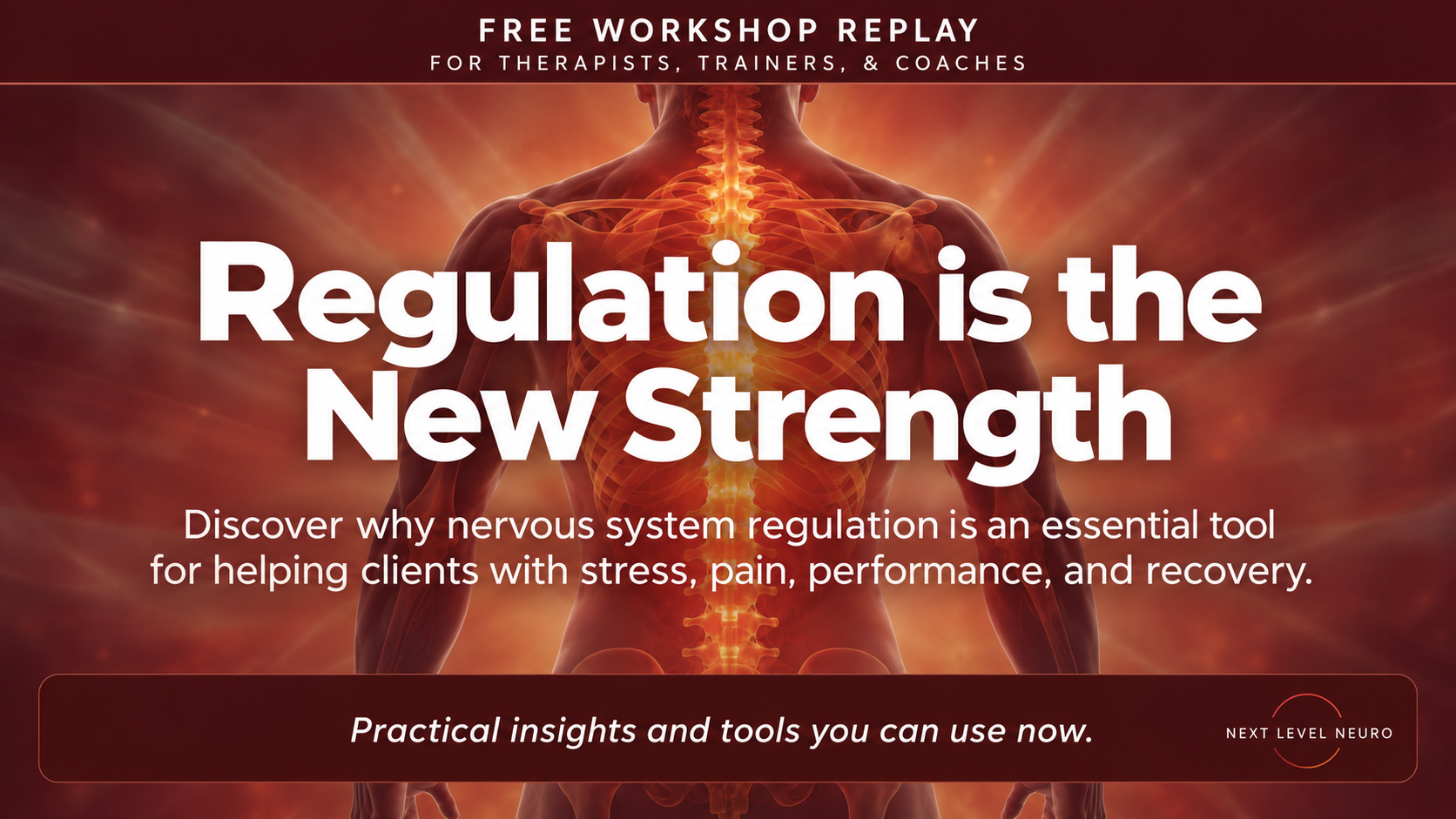
One of the easiest ways we explain this inside Next Level Neuro is with an iceberg.
Imagine a client comes into your clinic with knee pain.
The painful knee is the part of the iceberg sitting above the waterline.
It is obvious.
The client points directly to it and says…
“It hurts right here.”
Of course the knee is going to be the subject of talk... It matters to the client, and their perception of pain is spot-on.
That is what brought them through the door to see you.
So traditional rehabilitation may focus on things like:
- Restoring range of motion
- Building strength
- Improving tissue tolerance
- Improving movement quality
- Improving walking
- Returning the person to training or daily activity
All of that is important, and applied neurology is not asking therapists to stop doing any of that.
But the painful knee may only be the small part of the iceberg we can see.
The much larger part is sitting underneath the waterline.
And that is where things start getting interesting and where understanding applied neurology starts really taking-off.
What Is Happening Underneath the Waterline?
The nervous system is constantly taking in information.
Not just from the painful knee.
From everywhere.
That includes:
- Vision
- The vestibular system
- Proprioception
- Previous injuries
- Breathing
- Sleep
- Stress
- Nutrition
- Sensory information
- Training load
- The environment around us
All of that information helps shape how the brain organizes movement.
So, when someone comes in with knee pain, the knee may be the place where the problem became obvious.
But it may not tell us the entire story of how they got there.
There may be other factors worth looking at:
- An old ankle injury may have changed how they load one side.
- Balance may have changed over time.
- Visual information may be affecting how they stabilize.
- Poor sleep may be changing how their nervous system responds that day.
- Stress, fatigue, or training load may be influencing what you are seeing.
Or maybe none of those things matter at all.
And that last part is important.
Applied neurology is not about looking at every painful knee and assuming…
“This must be coming from the vestibular system.”
It is about becoming curious enough to investigate the whole nervous system.
That is where The Mentorship Program starts teaching our students to look outside of the biomechanical education box.
This Is Where Protocols Start to Become Limiting
Protocols can be useful, especially when you are starting out and need guidance.
They really help that learning curve, because they work for decent number of clients.
They can help shorten the learning curve because they give you:
- Structure
- A clear place to begin
- Examples of how different systems can interact
- A repeatable process to practice
- More confidence when you do not yet have a lot of experience
- Approaches that will work well for many clients
The problem starts when the protocol becomes the answer instead of the starting point.
Because real clients are messy.
They come in with…
- Unique injury histories
- Varying levels of stress
- Good nights of sleep and terrible ones
- Years of training experience or very little at all
- Sensory systems that process information differently
- Higher or lower levels of perceived threat
- More or less capacity to recover
- A nervous system that may respond one way today and another way tomorrow
So two people with what appears to be the same knee problem may respond completely differently to the same protocol.
A protocol might say…
For this problem, do this drill.
But eventually the practitioner has to ask better questions that invovle the whole system.
Things like…
- What am I actually seeing?
- What do I think may be contributing?
- What would be worth testing?
- What can I use as a baseline assessment?
- What happened to their perceived threat & movement after I changed something?
- What does that response tell me to do next?
That is where the shift from memorizing protocols to thinking as a practitioner begins.
Applied Neurology Is a Thought Process
One of the biggest shifts we try to make inside the Next Level Neuro Mentorship is moving practitioners away from constantly asking
“What neuro drill should I use for this problem?”
And toward thinking…..
“What information is this client giving me, and what do I want to test?”
That changes the whole session.
Now you are not searching your memory for the “correct” exercise.
You are building a hypothesis around what may be worth testing...
- Is vision influencing their response?
- Does the vestibular system deserve a closer look?
- Could an old injury be changing proprioceptive input?
- Does this client need less input instead of more?
- Would regulation help before asking for more performance?
These are not conclusions, they are just questions that help find an entry point into the nervous system, so that change can begin.
Here's the shift:
You are not deciding in advance what is wrong with the client. That's what protocols do...
See knee pain upon flexion → Give these corrective exercises
Have tight hamstrings → Give those dynamic stretches.
The process of applied neurology says: Observe, come up with an idea (a Hypothesis), Introduce an Input, Reassess for their Response...
And then follow the reassessment as it begins to prove or disprove your hypothesis.
The Process Can Actually Be Pretty Simple
Applied neurology can sound complicated when people first start talking about all the systems involved.
But the actual process we keep coming back to is simple.
1. Observe the client
Before changing anything, look at what is happening.
Pay attention to:
- How they move
- What they report
- What looks easy
- What looks difficult
- What changes when the task changes
- What their history makes you curious about
You are gathering information, not trying to force it into a diagnosis.
2. Form an idea (a hypothesis)
Based on what you are seeing, choose something worth investigating.
A hypothesis is not…
“Their vestibular system is causing their knee pain.” That's a declaration.
It is more like… “I wonder if this vestibular input is influencing what I am seeing at the knee.”
That is something you can actually test.
3. Establish a baseline
Before you change anything, measure something meaningful.
That might be…
- Range of motion
- Pain
- Strength
- Balance
- Gait
- Coordination
- Movement quality
- A squat
- A rotation
- A sport-specific movement
- Something the client specifically wants to improve
Now you have something to come back to.
4. Apply one input
Change one thing.
Not five.
One.
Maybe it is a visual drill.
…vestibular.
…sensory.
…breathing.
…proprioceptive.
The point is to make a change that matches the hypothesis you are testing.
5. Reassess
Then go right back to the baseline.
This is the part that we can’t skip.
Did it get better?
Did nothing happen?
Did it get worse?
That response helps tell you what to do next.
Why Do We Reassess Right Away?
Because otherwise we are guessing.
This is how we test the hypothesis.
If we change something and do not check the result, we don't really know what happened.
We just know we gave the client a neuro drill.
How would we know if it worked?
For example, maybe we give a short visual input and shoulder rotation improves immediately.
That tells us about how the visual system, in that part of the visual field or that kind of visual tasking, is affecting body movement
Maybe we use a vestibular drill and balance gets worse.
That tells us something too, depending on what head movement caused the destabilization, and how they compensated.
Maybe we change sensory input at the foot, and nothing happens to the knee at all.
Also useful.
The goal is not to prove that every neuro drill works.
The goal is to collect information and be able to act on it.
That information helps us decide whether to:
- Progress
- Regress
- Integrate
- Change the dose
- Try something else
- Abandon the idea completely
The drill gives us the input.
The reassessment gives us the information.
That is where the clinical reasoning starts.
This Is How We Start Looking Under the Iceberg
Now we can connect this back to the iceberg.
The painful knee may be sitting above the waterline.
But instead of only working on that visible piece, we can start investigating what lies underneath.
When we start thinking through the applied neurology lens, we are not randomly throwing neurological exercises at the client.
The point is to test the larger environment the knee is operating inside.
And if changing something underneath the waterline creates a meaningful improvement above it, we have learned something useful.
That does not mean we found “the cause.”
It means we found a piece of the system that appears to matter to their nervous system and have a positive effect on movement (or pain reduction).
We Are Not Trying to Shove the Top of the Iceberg Underwater
This is another way we explain it to our mentorship students.
If the painful area is the visible portion of the iceberg, we do not necessarily want to spend all of our time attacking that piece and hoping it stays down.
We can also work on the structure underneath it.
Change one meaningful input that's not directly related to the painful area...
Reassess.
Then improve another area that's not directly related.
Reassess again.
Over time, as these positive changes are introduced repeatedly, the environment starts changing.
And that may change what is showing up above the waterline.
That is a very different way of thinking than what we have been taught with our biomechancial way of thinking.
"Knee pain = knee protocol."
It gives us more questions to ask.
And more importantly, it gives us a process for answering them.
Knowing More Drills Does Not Automatically Make the Decision Easier
This is one of the strange things about continuing education.
At first, you only know a few neuro drills.
Then you take more courses.
Now you know 30.
And somehow deciding what to do gets harder.
Because now the questions become...
- Which one should come first?
- Should I look at vision?
- Vestibular?
- Proprioception?
- Does this person need regulation first?
- How much input should I give?
- How do I know when I have done enough?
- What if the reassessment improves after two reps but gets worse after five?
- What if the drill worked last week and fails today?
- What do I do when the client does not fit the protocol at all?
Those questions cannot always be answered by learning another drill.
At some point, you need a framework for thinking.
Principles Give You Something You Can Carry Into Every Session
If you are an experienced practitioner, you know that the drills you use today may not be the drills you use five years from now.
Courses will continue to evolve.
Research will keep giving us new information, and your own understanding will grow as you work with more clients and gain more experience.
That is part of becoming a better practitioner.
The exercises may change, but the principles behind why you choose them should remain much more consistent.
But the process can still remain:
- Observe
- Form a hypothesis
- Establish a baseline
- Apply an input
- Reassess
- Make the next decision based on the response
That is what makes principles so useful.
They give you somewhere to begin even when the client in front of you looks nothing like the example you learned in a course.
Applied Neurology Does Not Replace What You Already Know
We say this often because we get this question every single day.
Applied neurology is not asking physical therapists, trainers, or rehabilitation professionals to throw away what they already know.
It is not replacing...
- Biomechanics
- Strength training
- Mobility work
- Manual therapy
- Tissue loading
- Traditional rehabilitation
All of those things can still be - are part of - the process.
Applied neurology gives you another layer of information to work with.
Traditional rehabilitation can tell us a great deal about the part of the iceberg we can see.
Applied neurology helps us become more curious about what may be sitting underneath it.
And once we start looking below the waterline, rigid protocols become harder to rely on.
There are too many variables.
That is why the thought process with applied neurology is so important.
The Goal Is Not More Neuro Drills
This is one of the biggest things we try to teach throughout the Next Level Neuro Mentorship.
We are NOT trying to create practitioners who know more neurological exercises.
We want practitioners to understand...
- Why they are choosing an input
- What they are trying to learn from it
- What they are using as a baseline
- Why they are reassessing
- What the reassessment is telling them
- When to progress
- When to regress
- When to integrate
- When to change direction
Because eventually, the goal is not to memorize the right answer for every client.
There is no protocol for every person who is going to walk through your door.
The goal is to develop a process that helps you figure out what to do when the answer is not obvious.
That is the difference between collecting neuro drills and learning how to think like an applied neuro practitioner.
And that is the foundation we continue building throughout the Next Level Neuro Mentorship.
Ready to Take Your Applied Neurology Education Further?
We are now accepting applications for M11, our next Next Level Neuro Mentorship.
If you already have neuro drills in your toolbox but want to become more confident deciding where to start, what to test, how much to do, and what the reassessment is actually telling you, the mentorship is designed to help you build that deeper framework.
We will help you connect the tools you are already learning to a clinical decision-making process you can use across different clients, different presentations, and different situations.
Click below to book a discovery call with us.
We can talk through where you are now, what you want to improve, and whether the Next Level Neuro Mentorship is the right fit for you and your practice.
Book a Discovery Call
Stop collecting more drills. Start building the framework that tells you what to do with them.
Frequently Asked Questions About Applied Neurology
What is an applied neurology protocol?
An applied neurology protocol is a predetermined sequence of assessments, drills, or interventions designed around a particular goal or presentation.
Protocols can be useful educational tools, especially when learning how different neurological systems may influence movement and performance.
The limitation is that every client will not respond exactly the way the protocol predicts.
That is why we believe protocols work best when they are supported by strong principles and assessment skills.
Does applied neurology mean I should stop using biomechanics?
No.
Applied neurology is not intended to replace biomechanics.
Biomechanics, tissue loading, strength, mobility, manual therapy, and traditional rehabilitation can all remain important parts of treatment and training.
Applied neurology adds another lens through which the practitioner can investigate what may be influencing the client's response.
Why is assessment and reassessment so important?
Assessment and reassessment help the practitioner determine whether an intervention actually changed something meaningful.
The process is simple:
Apply an input.
Then go back and reassess the baseline.
If the baseline improves, worsens, or stays the same, each outcome provides information that can help guide the next decision.
What can I reassess after a neuro drill?
A reassessment can be almost anything meaningful and repeatable for the client, including:
- Range of motion
- Pain
- Strength
- Balance
- Gait
- Coordination
- Movement quality
- A specific athletic or functional task
The important part is establishing the baseline before the neurological input is applied.
What does “one input at a time” mean?
It means trying to avoid changing multiple variables at once when you are attempting to learn from the client's response.
If several interventions are applied together and the client improves, it may be difficult to know which input contributed to the change.
Applying one meaningful input and reassessing gives the practitioner cleaner information.
Does a positive reassessment prove I found the cause of the problem?
No.
A positive reassessment tells us that the input influenced the system in a potentially useful way.
It does not necessarily prove that you identified the single cause of the client's pain or movement problem.
Applied neurology is generally more useful when viewed as an ongoing process of testing, observing, and refining rather than searching for one absolute cause.
What happens if the reassessment gets worse?
A worse reassessment is still useful information.
It may suggest that the input was too challenging, poorly dosed, badly timed, or simply not appropriate for that client at that moment.
The practitioner can then regress, adjust the input, or change direction.
Why might the same neuro drill work one day and not another?
The nervous system is not operating in exactly the same state every day.
Sleep, stress, fatigue, training load, pain, nutrition, recovery, and other inputs can influence how a person responds.
That is another reason reassessment matters.
A drill should not automatically be assumed to be useful simply because it worked previously.
Is applied neurology just about vision and vestibular drills?
No.
Vision and vestibular function are important areas of applied neurology, but they are not the entire system.
Practitioners may also consider proprioception, sensory input, breathing, previous injuries, recovery, stress, sleep, motor control, and other factors influencing the nervous system.
The goal is not to blame one system.
It is to understand how multiple inputs may be influencing the client's output.
How do I know which neurological system to assess first?
That is where principles, history, observation, baseline testing, and clinical reasoning become important.
Instead of automatically beginning with the same system for every client, the practitioner develops a hypothesis based on what the client is presenting.
That hypothesis can then be tested.
Is applied neurology only for complicated clients?
No.
The principles can be used with many different populations and goals.
However, this way of thinking can become especially valuable when progress has stalled, the same problem keeps returning, or the painful area does not seem to explain the entire presentation.
Can trainers use applied neurology, or is it only for physical therapists?
Applied neurology principles can be relevant to physical therapists, trainers, strength coaches, rehabilitation professionals, and other practitioners working within their professional scope.
How those principles are applied will depend on the practitioner's education, licensing, professional responsibilities, and the client they are working with.
What is the difference between collecting neuro drills and understanding applied neurology?
Collecting drills gives you more interventions.
Understanding applied neurology gives you a process for deciding:
Which intervention?
For whom?
At what dose?
At what time?
And based on what response?
That decision-making process is where applied neurology begins becoming clinically useful.
How does the Next Level Neuro Mentorship teach this process?
The Next Level Neuro Mentorship is built around helping practitioners develop a deeper framework for assessment, neurological principles, clinical reasoning, dosage, integration, and reassessment.
The goal is not simply to provide another library of exercises.
It is to help practitioners understand how to think through the person standing in front of them.
Want more information on our Mentorship
and Programs?
We hate SPAM. We will never sell your information, for any reason.